Paphos Gate: Western Entrance in Nicosia’s Venetian Walls


Site at a Glance
- Rating
- 4.4
- Popularity
- Low
- Country
- Cyprus
- Primary era
- Early Modern
- External website
- Open
- Eras represented
- Early Modern, Modern
- Civilizations
- British, Venetian
- Site type
- Military
- Remains
- Gate
On this page10 sections
History
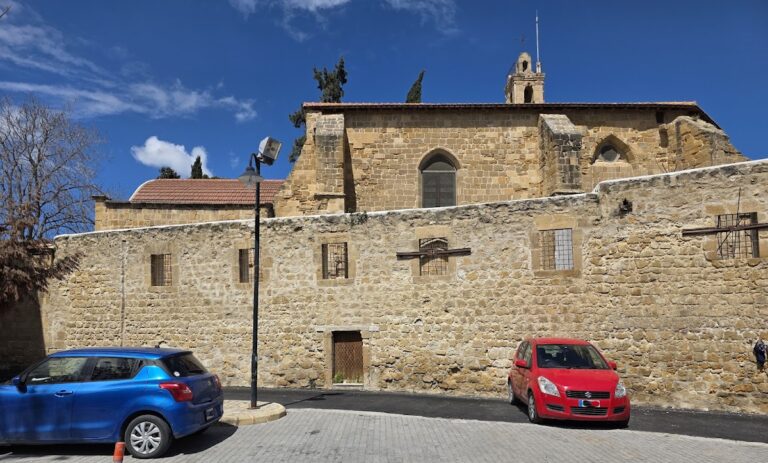
Paphos Gate is a western entrance in the Venetian Walls of Nicosia, Cyprus, built by the Republic of Venice in 1567–1568 as part of the city’s sixteenth-century military fortifications. Facing the island’s western city of Paphos, it was designed by the Venetian military engineer Giulio Savorgnano and probably stands beside the medieval castle and monastery associated with the Lusignan dynasty, the medieval ruling family of Cyprus.
Venetian construction
Savorgnano’s plan for the Walls of Nicosia included Paphos Gate as a western route into the fortified city. Construction began in 1567 and ended in 1568, shortly before the Ottoman conquest of Nicosia. The gate was also known as Porta San Domenico and St Dominic Gate.
Ottoman administration
Under Ottoman rule, the gate followed a strict daily routine. It was locked after sunset, with its keys entrusted to the officer commanding the barracks above it, and reopened at dawn. Every Friday it also closed for about two hours at midday so soldiers could attend services at a mosque.
Movement through the gate was regulated by Ottoman authorities. Muslims could enter Nicosia and other fortified places on horseback, while non-Muslims, commonly called rayahs, were required to dismount. Villagers visiting the city had to leave before sunset for security reasons.
British control and later military use
On 12 July 1878, after Cyprus passed from Ottoman to British control, Lord John Hay’s expeditionary force formally took possession of Nicosia at the barracks above Paphos Gate. The gate and barracks were briefly called Minotaur Gate after Hay’s flagship, HMS Minotaur. The barracks were also the first place in Cyprus where the British flag was raised.
During British rule, the buildings above the gate housed Cyprus police headquarters until 1958 and later continued as divisional headquarters. In 1879, the administration closed the gate to regular traffic and cut through the nearby wall to create another passage. The gate later served as an arsenal for Greek military forces during the Turkish invasion of Cyprus. These changes, including the demolition of part of the wall, altered the historic crossing and its immediate setting.
Remains
Paphos Gate forms a western entrance in the Venetian Walls, oriented toward Paphos and positioned at about 145 metres above sea level. The gate occupies an elevated position overlooking the lower surrounding area, while buildings rise directly above the passage. A nearby opening cut through the wall in 1879 forms an additional crossing associated with the gate.
Gate and buildings above
Paphos Gate
The gate is part of the sixteenth-century Venetian defensive circuit enclosing historic Nicosia. Its position and orientation reflect its role as the western access toward Paphos. The site probably lies beside the medieval Lusignan castle and monastery, although it is not securely identified as part of those earlier buildings.
Upper barracks
The structures above the gate occupy the elevated part of the entrance. Under Ottoman rule they were used as artillery barracks and as the residence of the Kaymakam, an Ottoman administrative official who generally served as a district governor or deputy governor.
Wall opening
1879 passage
The section of wall cut through in 1879 eased communication around Paphos Gate. Its north wall carries the inscription “VR 1879,” using the Latin initials for “Queen Victoria,” the British monarch at the time.