St. Michael: Evangelical Lutheran Parish Church in Fürth


Site at a Glance
- Rating
- 4.6
- Popularity
- Low
- Country
- Germany
- Primary era
- Medieval
- External website
- Open
- Eras represented
- Medieval, Early Modern, Modern
- Civilizations
- German, Holy Roman Empire
- Site type
- Religious
- Remains
- Church
On this page10 sections
History
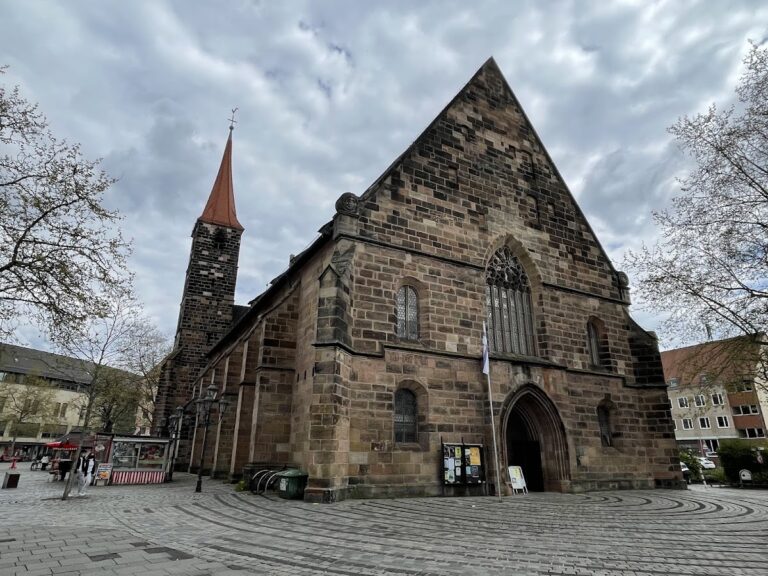
St. Michael is an Evangelical Lutheran parish church in Fürth, Germany, whose surviving Romanesque nave dates to around 1100. Dedicated to the Archangel Michael, a Christian protector traditionally associated with defeating evil, it was long the center of Fürth’s ecclesiastical life. Michael has been the church’s patron and Fürth’s patron saint since the thirteenth century.
Medieval foundations
Fürth was securely mentioned on 1 November 1007, when Henry II, the medieval German king and Holy Roman Emperor, transferred the settlement and its existing churches to the Bamberg cathedral chapter. The document does not state how many churches stood there. A Martinskapelle near the Rednitz in the valley is thought to have been the only church at that time. Its parish was transferred in 1016, after the death of Megingaud, Bishop of Eichstätt.
St. Michael first appears in a document from 1349. It may have been established as a second church while St. Martin remained the sole church in Fürth under the Diocese of Eichstätt and a new territorial lordship was developing. At that time, one-third of church income went to St. Michael and two-thirds to St. Martin. A procession carrying relics and banners to St. Martin was also required.
Flooding of the Rednitz could make St. Martin difficult to reach, and the parish of St. Johannis in Burgfarrnbach was separated from Fürth for that reason. St. Martin was described as a subsidiary church in 1362, although the procession to the older chapel continued. The Chapel of St. Lawrence at the Holy Sepulchre was described in a papal document of 1235 as a filial church of the Fürth church, probably still St. Martin. From approximately 1237 to 1354, these churches were administered as a union under one senior parish priest, while St. Lawrence had become the more important church by about 1300.
Changing ecclesiastical authority
Before 1243, the senior parish priest had moved his residence to Nuremberg while remaining a cleric of the Bamberg cathedral chapter. Papal bulls issued in 1388 and 1402 ended the Bamberg canons’ preferential rights over St. Lawrence and St. Sebald and required senior parish priests to reside in their own parishes. Documents from 1474 and 1513 record the senior priest’s right to appoint Fürth’s parish priests. In 1477, the senior priests became provosts, and Fürth’s clergy came under Nuremberg’s jurisdiction.
Fürth therefore moved from Bamberg ecclesiastical authority through a union of churches and, between approximately 1354 or 1388 and 1513, toward Nuremberg authority. The Reformation, the sixteenth-century movement that created Protestant churches and changed ecclesiastical administration across central Europe, followed Nuremberg’s example. Fürth adopted Nuremberg’s Reformation on 5 June 1524, and the change was implemented between 1524 and 1526. The first visitation on 3 September 1528 conventionally marks its beginning in the town.
This religious transformation complicated Fürth’s political three-lord rule. The Bamberg prince-bishopric, the Nuremberg burgraves, who became the Margraves of Brandenburg-Ansbach after 1415, and the Imperial City of Nuremberg all competed for authority over the town.
War, rebuilding, and architectural change
After the Martinskapelle probably disappeared during the Thirty Years’ War, the European conflict of 1618 to 1648 that caused widespread destruction and population disruption in the German lands, St. Michael remained Fürth’s sole church until 1824. For centuries its tower dominated the town skyline, and in the rebuilt old town the church was described as Fürth’s only medieval building and its most venerable and historically important monument.
The church was extensively refashioned in Baroque form in 1675. Plans made in 1689 to enlarge it with transepts were not carried out. Instead, galleries were added between 1629 and 1704 to accommodate a growing population. The interior was remodeled in 1830 by Albert Christoph Reindel, director of the Nuremberg academy. Two side altars, a 1624 brass baptismal font, the late Gothic baptismal font, and the 1680 Moses pulpit were removed, and the church acquired its Romanticizing neo-Gothic character.
A sacristy was added in 1881. The nave windows were extended downward and neo-Gothic ornament was installed in 1885, while a southern gallery staircase followed in 1886. That staircase was removed in 1975 to 1978. The interior was redesigned in Art Nouveau in 1905, and the galleries were painted a single color in 1952. Several decorative layers remain visible on a gallery-balustrade board beside the organ.
War damage and modern church life
During the Second World War, artillery damaged the tower after a Wehrmacht command post had been established there on 12 April 1945. The upper clock faces were destroyed. Repairs followed in 1948 and 1952, and replacement clock faces were installed in 1997. New stained-glass windows were added in stages between 1958 and 1969, the choir and nave floors were leveled in 1978, and a new main organ was built in 1979. A discussion during the 1975 to 1978 renovation about removing the neo-Gothic reredos and Christ figure ended with both being retained.
The bells were repeatedly affected by warfare. Wallenstein’s troops removed the largest bell in 1632, and the remaining bells were recast in 1791 and 1792. Two bells were taken for wartime metal collection on 29 June 1917, and three more were removed during the Second World War. Replacements were installed in 1922 and 1952, and the three 1952 bells were consecrated by city pastor Eduard Putz on 8 June that year.
From 1923 to 1964, Frieda Fronmüller served St. Michael as organist and choir director, becoming church music director in 1955. The church belongs to the Evangelical Lutheran Church in Bavaria. In 1990, the Fürth congregation acquired the small Italian organ after its restoration in Augsburg in 1985.
Remains
Nave and tower
The nave, the principal lengthwise body of the church, was built around 1100 and is the oldest surviving part of St. Michael. It has been altered repeatedly, but Romanesque masons’ marks remain on both its northern and southern sides. The church axis runs southeast at an approximate angle of 130 degrees. Its alignment toward sunrise at Martinmas has been interpreted as a possible indication of an original dedication to St. Martin or a reference to the earlier Martinskapelle.
The 45-metre-high tower was built in 1380 to 1390 and added to the nave, with construction taking place partly before and partly after the choir. Its base measures approximately 7.5 by 7.5 metres. In a town without other fortifications, the tower served as a fortified refuge during wartime, and a paid watchman occupied it during the Thirty Years’ War. It has four principal stories up to the present gallery. The portal, dated approximately to 1390 to 1410 through comparison with Nuremberg work, belongs to the tower’s medieval phase.
The octagonal upper section was added around 1520 to 1530. Differing masons’ marks and poorer construction quality distinguish it from the lower tower. Its gallery is relatively rare in Franconia. Until 1885, the tower could be entered from the church interior only through a narrow opening. The later southern entrance became the usual entrance to the church, while the tower addition probably blocked an older access route.
A crucifix with reliefs of Mary and John stood on the tower gallery until the Second World War. In 1955, the sculptor Hasenschwanz replaced it with a copy. A tower clock appears in an engraving of 1705, and a possibly older sundial originally stood below it. Four clocks were installed on the octagonal upper section around 1883. The west portal is surmounted by a 1977 copy of a decorated tympanum, the field above a doorway, dated 1380 to 1390.
Choir and altar furnishings
The choir, the area reserved for clergy and worship at the eastern end, was added around 1480. Its interior has a star vault, a ribbed vault whose ribs form a star-like pattern, with two longitudinal bays, a five-section termination, and a continuous central rib. The bosses include the heraldic device of Konrad Held, parish priest from 1464 until approximately 1500. He paid half the choir’s construction costs and donated its altar. The terminal boss bears the red-and-white toothed design of Dompropst Metten von Lichtenstein, who donated 100 gulden.
A 6.80-metre-high sacrament house, an architectural enclosure for the Eucharist, is made of Vacher sandstone and attributed to the workshop or circle of Adam Kraft, the late medieval sculptor active in Nuremberg. Its figures vary in artistic quality. Christ holds a chalice to the spear wound, a detail that emphasizes the structure’s role as a repository for the Eucharistic bread and refers to blood flowing from the wound.
The present altar combines a stone mensa dated 1497, a neo-Gothic reredos, or ornamental altarpiece behind an altar, made by Albert Christoph Reindel in 1830, and a figure of Christ made in 1883 by Johann Christian Hirt, a Fürth artist and royal professor. The artistic quality of the reredos and figure has been questioned since the second half of the twentieth century. Other interior works include a copy of Peter Paul Rubens’s Descent from the Cross, a Sorrowful Man dated approximately 1490 to 1500 and possibly made by Hans Nußbaum, figures of John the Baptist and King David in the choir coves, and a wooden crucifix from around 1510 on the choir’s southern side. An oil painting of St. Michael from approximately 1730 to 1750 hangs above the chancel arch.
Windows and memorials
The original windows included the Lorenz Tucher donor panel. The present ten-part choir windows and adjoining nave windows were designed by Hans Gottfried von Stockhausen and produced at the Mayer court art institute. They were installed in 1958, 1963, and 1969. The 1963 Baptism Window moves through Creation, the four rivers of Eden, Noah’s Ark, the crossing of the Red Sea, the Exodus, Moses bringing water from the rock, the Baptism of Jesus, the worldwide missionary commission, and a human couple renewed through baptism.
Passion Window I, installed in 1958, presents the agitated crowd, sleeping disciples, Christ’s arrest, his conversation with a disciple, the institution of the Last Supper, and his entry into Jerusalem. The choir-head window from the same year shows Christ holding the globe and St. Michael fighting the dragon. Passion Window II depicts the removal of Christ from the cross, guards at the cross, Mary and John beneath it, the three crosses at Golgotha, soldiers casting lots for Christ’s garment, the Crown of Thorns, and Peter grieving over his denial.
The Revelation Window, installed in 1969, includes Elijah beneath the juniper, water given to the thirsty, Job’s lament, the healing of a blind man, the feeding of the five thousand, Christ speaking with the woman at Jacob’s well, clothing the naked, and Peter’s release from prison. The 1958 Call to Service window shows the return of the Prodigal Son, the shepherd finding the lost sheep, three parables, Zacchaeus in the mulberry tree, Matthew following Jesus, and Saul’s call to discipleship. The 1969 Grace Window represents the heavenly Jerusalem, with water flowing from a central Lamb beside a tree bearing fruit twelve times a year as described in Revelation 22. Its human couple corresponds to the couple in the Baptism Window.
Several memorials remain attached to the nave. They commemorate Martin Leitzmann, in a work by Friedrich Romsteck from 1754; Lieutenant Colonel Johann von Mayenfeld, dated 1760; and court juror Andreas Holzmann, donated in 1741 and cast by Romsteck. A 1932 memorial plaque to Gustav Adolf by the Fürth artist Konrad Mannert is mounted on the southern side. A plaque for the Chapel of the Holy Sepulchre is attached to the northern exterior of the choir. An Ölberg group formerly stood on the choir’s southern side and was removed in the nineteenth century. In front of the church’s south side, a 1928 monument to Wilhelm Löhe by Johannes Götz consists of a bronze bust on a granite pedestal with three bronze reliefs.
Organs and bells
The main organ was built in 1979 by Ekkehard Simon of Landshut, while the neo-Gothic case and facade of the 1904 Steinmeyer organ were retained. The instrument has mechanical action, electric stop control, a setter system with 128 combinations, and 45 speaking stops distributed among three manual divisions and the pedal. The small organ known as the “Italian Woman” was built in Naples in 1775 by Januarius Severino. It has a short octave, no pedal, 45 keys, and its original meantone tuning at a pitch of a’ = 432 Hz. Its natural keys are covered with ivory and its sharp keys with ebony, although the keys may date from the nineteenth century. Apart from a modern blower motor, the instrument remains in its original condition.
The Italian organ’s principal 8-foot stop combines wooden stopped pipes in the lowest range, open wooden pipes in the middle range, and open metal pipes in the upper range. A Tirapieno control engages or disengages the 4-foot, 2-foot, 1 1/3-foot, and 1-foot ranks together. A 1961 interior chandelier by Fürth metalworker Franz Nüssel represents the heavenly Jerusalem toward which the congregation is journeying.
The peal contains four ringable bells. The D bell, cast in Nuremberg in 1791 by Stumm, weighs approximately 2,000 kilograms and bears the arms of Nuremberg’s governors and the names of Fürth church wardens August Friedrich Dresel, Johann Brenner, Johann Arnsperger, and Konrad Dehm. The other three bells were cast by Rincker of Sinn in 1952. The F bell is called “Jesus Lives” and weighs 940 kilograms, the G bell “Jesus Is Victor” weighs 670 kilograms, and the B bell “Jesus Is King” weighs 400 kilograms.
The tower also holds Fürth’s oldest bell, dating approximately to 1400. It was used until the First World War, when its sound no longer matched the other bells. Its inscription reads, “Lucas Marcus Matheus Johannes Ave Maria Gratia.”