St. Jakob: An Evangelical Lutheran Church in Nuremberg


Site at a Glance
- Rating
- 4.5
- Popularity
- Low
- Country
- Germany
- Primary era
- Medieval
- External website
- Open
- Eras represented
- Medieval
- Civilizations
- Holy Roman Empire, Teutonic Order
- Site type
- Religious
- Remains
- Church
On this page8 sections
History
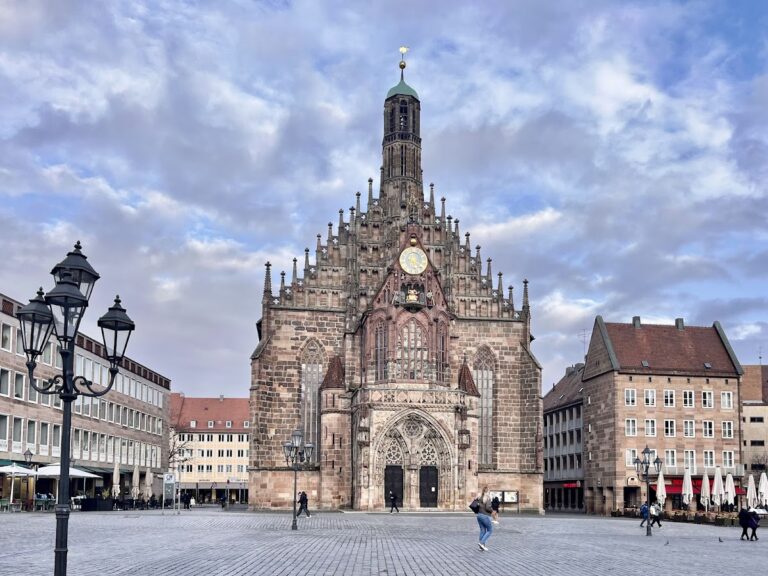
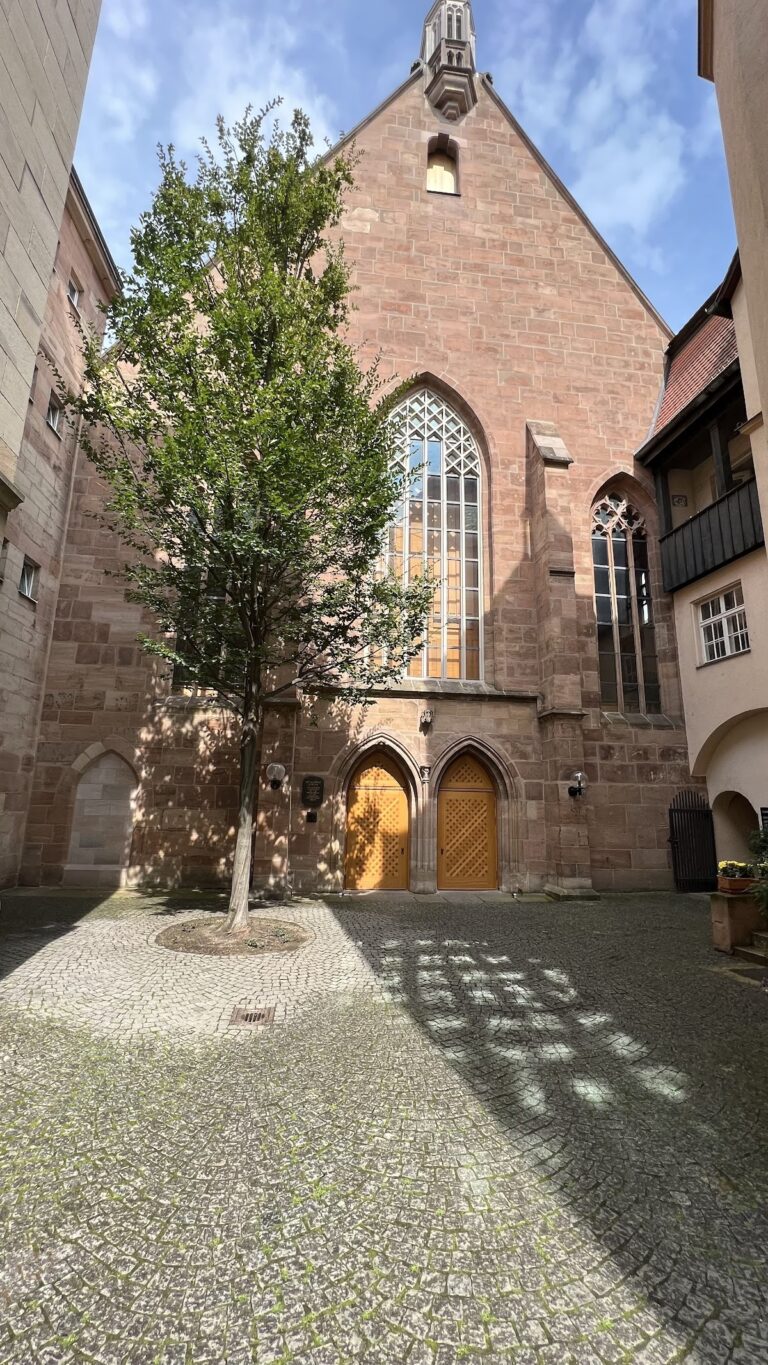
St. Jakob is an Evangelical Lutheran church in Nuremberg, Germany, dedicated to Saint James the Greater. Located in the southwestern Jakoberviertel within the Lorenzer Old Town, it developed from a small Romanesque chapel and became a Protestant city church after the Reformation. It is also a station on the Franconian Way of St. James.
From Chapel to Teutonic Order Church
On 20 February 1209, Holy Roman Emperor Otto IV transferred the small chapel to the Teutonic Order, a Catholic military and religious institution that held extensive properties in Central Europe. About eight decades later, the chapel was demolished and replaced with a larger church built on the foundations of its earlier choir. Materials from the first building were reused in the replacement.
The order established St. Elisabeth Hospital opposite St. Jakob. Frederick II, Holy Roman Emperor from 1220 to 1250 and King of Sicily, increasingly supported the order, and in 1304 its possessions were expanded by the addition of the former royal court and the surrounding land.
Reformation and Confessional Change
The Reformation, the sixteenth-century movement that led to the creation of Protestant churches across Western and Central Europe, changed St. Jakob’s religious use. A preaching post was established in 1531, and the church became one of Nuremberg’s Protestant city churches. Ownership, however, remained with the Catholic Teutonic Order.
During the Thirty Years’ War, Gustavus Adolphus of Sweden confiscated the order’s property in 1632. He transferred St. Jakob to the city of Nuremberg and ordered extensive renovation. The Peace of Westphalia, which ended the war in 1648, returned the church to the Teutonic Order.
Secularization and Modern Restoration
In 1806, during secularization, the transfer of church property and institutions to secular states, the Teutonic Order House and its associated buildings passed to the Kingdom of Bavaria. St. Jakob became Nuremberg’s third Evangelical parish church in 1810.
The church suffered severe damage during the Second World War and was restored afterward. The surrounding institutional complex also changed over time, as buildings connected with the Teutonic Order were later replaced by the Deutschhaus Barracks and then by police headquarters.
Remains
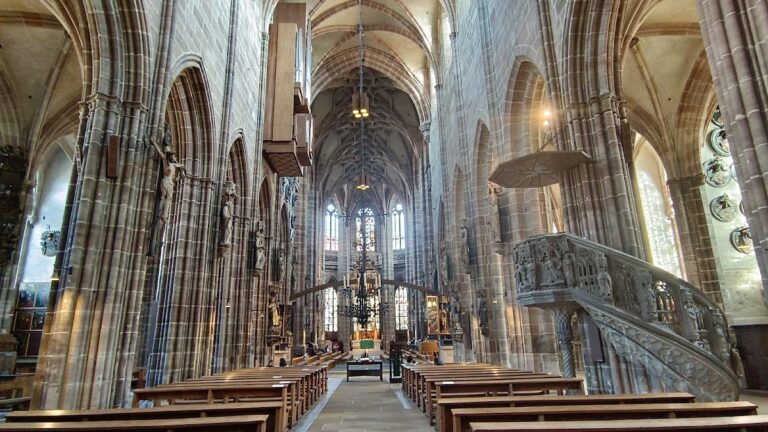
The surviving site includes the church developed from the medieval chapel, its tower, interior furnishings, and musical equipment, together with the former institutional buildings associated with the Teutonic Order. The church’s later form remains connected to the earlier structure through the foundations of the old choir and the reuse of material from the demolished chapel.
Church and Interior Furnishings
St. Jakob’s tower contains four bells suspended in a wooden frame and supported by wooden yokes. Inside, the high altar retains a reredos, an ornamental screen or panel behind an altar, dating from 1360 to 1370. The church also has a pipe organ built in 1968 by G. F. Steinmeyer & Co. as opus 2206. It has three manuals, meaning keyboards, 39 registers that control sets of pipes, and electric action.
Former Teutonic Order Complex
The church was associated with the Teutonic Order House and with St. Elisabeth Hospital, which stood opposite. The order’s former complex was later replaced on its site by the Deutschhaus Barracks and subsequently by police headquarters, reflecting the transfer of the property into secular state control.
St. Elisabeth Church
St. Elisabeth Church, begun in 1785 as an unfinished domed building, passed through several uses before completion in 1902. It served as a state warehouse for building materials, a military depot, and an emergency church. Air raids in 1943 caused heavy damage. Reconstruction continued until 1962, when the original three-aisled vaulted hall was replaced by a self-supporting hall.