St Mary’s Church, Goudhurst: A Medieval Parish Church in Kent

Site at a Glance
- Rating
- 4.7
- Popularity
- Very Low
- Country
- United Kingdom
- Primary era
- Medieval
- External website
- Open
- Eras represented
- Medieval, Early Modern, Modern
- Civilizations
- English
- Site type
- Religious
- Remains
- Church
On this page18 sections
History
St Mary’s Church, Goudhurst, in the United Kingdom, is an Anglican parish church whose substantial present building is largely thirteenth-century. It remains an active church within the Diocese and Province of Canterbury, the Archdeaconry of Maidstone, and the Deanery of Weald.
Medieval foundation and development
The first recorded mention of a church at Goudhurst dates to 1119, when Robert de Crevecoeur gave it to Leeds Priory, a medieval religious house in Kent. The earliest building was probably small, occupying the area of the present south chapel and part of the south aisle. Chaplains from Combwell Priory served the church, and by about 1300 one of them, Peter, was using the title of vicar.
The present church developed as a large sandstone building during the thirteenth century. Its aisles and side chapels formed part of a substantial parish foundation that continued to be altered over subsequent centuries.
Destruction and rebuilding in the seventeenth century
Lightning struck the tower on 23 August 1637, destroying both the tower and its 115-foot spire. The five bells housed within it melted in the intense heat. In 1638, the London masons Edmund Kinsman, James Holman, and John Young rebuilt the west tower in a truncated Classical-Gothic style.
The rebuilt tower initially held one bell, cast in 1640. The collection had become a three-bell ring by 1690 and had grown to eight bells by 1775. Several earlier bells were recast to improve their tuning, while retaining the names of their original donors. The present ring was completed in 1834, when the tenor bell was recast.
Local conflict and later history
On 21 April 1747, the church and churchyard became the setting for the Battle of Goudhurst. The confrontation was between the Goudhurst Militia, commanded by “General” William Sturt, a former army corporal, and the Hawkhurst Gang, a notorious eighteenth-century smuggling organisation in southeastern England led by Thomas Kingsmill, who was from Goudhurst.
Kingsmill had threatened to burn the village and kill its inhabitants unless the militia was disbanded and Sturt surrendered. The militia resisted the attack, killing Kingsmill’s brother George in the first volley; two other smugglers also died. Sturt later became warden of Goudhurst Workhouse. Kingsmill was hanged at Tyburn in 1749, at the time London’s principal site for public executions, and his body was given to the High Sheriff of Kent to be hung in chains at Goudhurst.
The tower also acquired a role in scientific surveying. During the Anglo-French Survey of 1784 to 1790, a late-eighteenth-century geodetic project that used precisely measured lines and prominent observation points, it served as a major surveying point. The work, supervised by General William Roy, measured the precise distance and relationship between the Paris Observatory and the Royal Greenwich Observatory.
Victorian restoration and modern status
Major restorations between 1865 and 1870 were carried out by William Slater and Richard Carpenter under the supervision of Ewan Christian. Carpenter undertook a further restoration alone in 1877, when a vestry and much of the south aisle were built. The chancel is largely nineteenth-century and took its present form on the basis of discoveries made during the Victorian work.
St Mary’s Church was designated a Grade I listed building on 20 June 1967. In England, this is the highest national heritage-protection category, reserved for buildings of exceptional architectural or historical interest. The church continues to function as a parish church.
Remains
St Mary’s stands on a hill, and its tower commands extensive views over the surrounding countryside. The surviving building is a large sandstone church with a nave, aisles, and side chapels alongside the chancel. Its fabric brings together a mainly thirteenth-century structure, a seventeenth-century west tower, and substantial nineteenth-century work.
West tower and bells
Rebuilt tower
The west tower was rebuilt in 1638 after the lightning strike and has a truncated Classical-Gothic form. Its clock face dates from the early twentieth century. The tower now contains a ring of eight bells, representing the successive enlargement and recasting of the church’s bell collection.
Chancel and nave
Chancel fittings
The largely nineteenth-century chancel contains a simple arched piscina, a small basin used for washing sacred vessels, and a hollow-chamfered ambry, a recessed cupboard for religious objects. A fine nineteenth-century altar rail has iron-twist uprights enclosing the sanctuary.
Nave arcades and screens
The nave has five-bay arcades. The rood screens to the north and south chapels incorporate fourteenth- or fifteenth-century panelling. The upper portion of the south-chapel screen is carved as a memorial to the First World War.
Pulpit and fonts
The pulpit stands on an octagonal stone base and steps with iron and brass rails. Its body is thirteenth-century and carries relief carvings of the apostles and evangelical symbols. Brass candlesticks and a book rest form part of the pulpit, while the brass lectern dates from the nineteenth century.
The nave font has a nineteenth-century bowl decorated with evangelical symbols and set on a medieval, probably fifteenth-century, base. A second medieval bowl in the north aisle is decorated with arcading and crosses.
Memorials and funerary features
Culpeper effigy and monuments
The church contains a painted wood-and-gesso effigy, a carved or modelled representation of a person, of Sir Alexander Culpeper and his wife Constance.
The south chapel contains memorial brasses to John Bedgebury, who died in 1424; Sir John Culpeper, who lived from 1424 to 1480; and Walter and Agnes Culpeper, who died in 1462 and 1457. It also holds an alabaster standing wall monument to “Young” Sir Alexander Culpeper, who lived from 1541 to 1599. His son, Sir Anthony Culpeper, erected it in 1608. The base represents Sir Alexander’s sixteen grandchildren, eleven boys and five girls.
The upper section of the monument includes a half-figure of Sir Thomas Culpeper as an old armoured man holding a skull. Below, Sir Alexander kneels on the right with his son Sir Anthony behind him, while Lady Mary appears opposite.
Old Sir Alexander Culpeper monument
In a separate bay window of the south aisle stands the monument to “Old” Sir Alexander Culpeper, who died in 1537. It consists of a lozenge-panelled chest with recumbent wooden effigies decorated with coloured gesso. The monument is one of approximately eighty of its type in England, and the knight’s head rests on a helmet.
Relief panels in the reveal of one bay depict God in Majesty, the Virgin and Child, and St George and the Dragon. Another carved panel, dated 1537, shows a knight, a lady, and children praying at a desk.
Campion and north-chapel monuments
The chancel contains a large hanging monument to William Campion, who died in 1615, and Rachel Campion, who died in 1606. Allegorised female figures rest on its pediment, while obelisks on pedestals flank the monument. William and Rachel kneel opposite one another at a prayer desk, and figures of their five sons and four daughters are carved on the obelisk pedestals.
The north chapel contains monuments to Edmond Roberts, who died in 1627, Richard Pack, who died in 1838, and Edward Lewis Miller, who lived from 1831 to 1846 and died after falling from a cliff on the Isle of Wight. Miller is also commemorated by a Grade II listed obelisk at Afton Down on the Isle of Wight.
Bathurst memorials and south-chapel tablets
A spearhead-railed enclosure attached to the tower and vestry contains footstones associated with the Bathurst family. The south chapel holds plain white and black Bathurst tablets, including the monument to John Bathurst, who died in 1697. His “Bread Tomb” was used for laying out bread for distribution to the parish poor. A grey marble tablet commemorates Edward Bathurst, who died in 1772.
The south chapel also contains a black marble wall tablet with a cherub’s head dedicated to Anthony Fowle of Twyssenden, who died in 1679. A large plain white marble tablet commemorates William Campion, who lived from 1640 to 1702, and includes a half-bust turned towards the left.
Surviving medieval glass
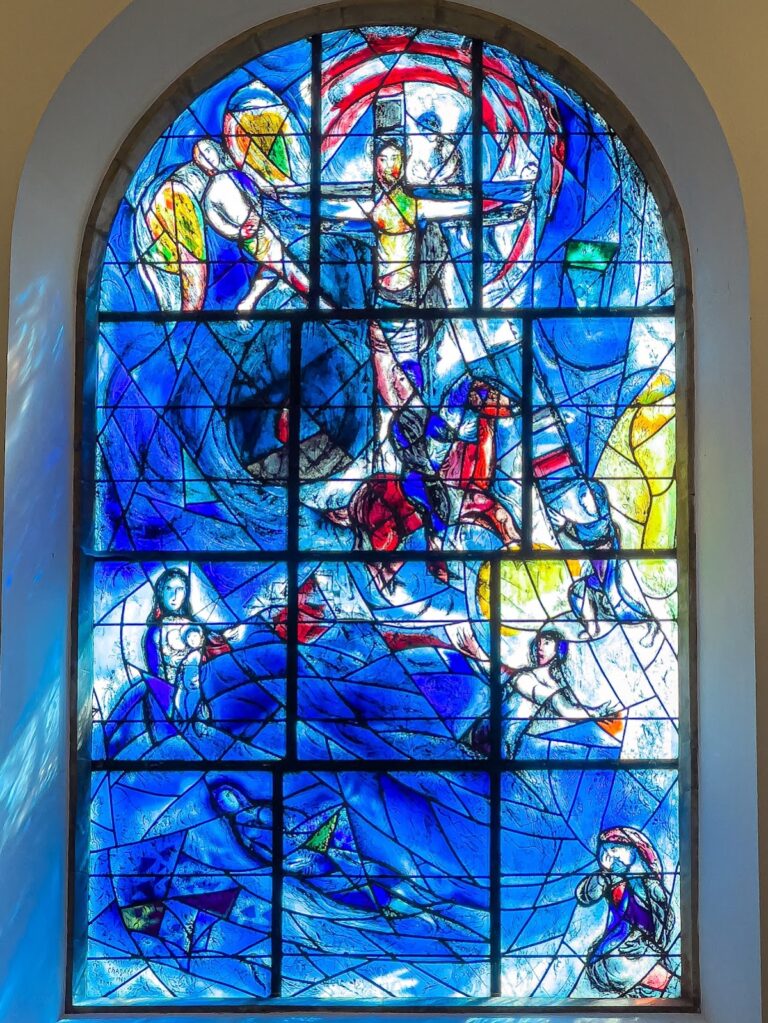
Fragments of fifteenth-century glass survive in the south-west window, adding a medieval element to the later layers of the south aisle.