Church of All Saints, Tudeley: A Church of England Parish Church


Site at a Glance
- Rating
- 4.9
- Popularity
- Low
- Country
- United Kingdom
- Primary era
- Medieval
- External website
- Open
- Eras represented
- Medieval, Early Modern, Modern
- Civilizations
- British, English
- Site type
- Religious
- Remains
- Church
On this page9 sections
History
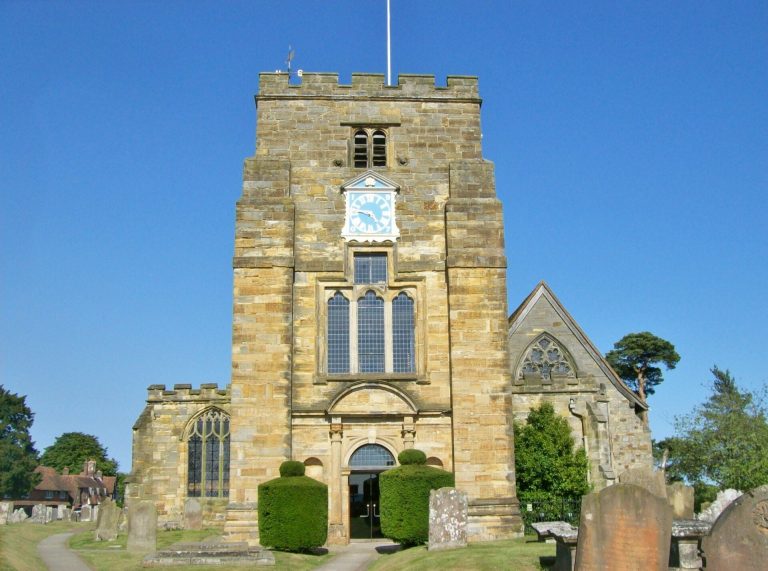
Church of All Saints is a Church of England parish church in Tudeley, United Kingdom, with a history of worship reaching back to the seventh century. The church is listed as founded in the twelfth century, and its sandstone nave and tower footings may predate the Norman Conquest, the English takeover that began in 1066 under William, Duke of Normandy.
Early and medieval history
A place of worship existed at Tudeley when the settlement was one of only four such places in the Weald during the seventh century. The church appears in the Domesday Book of 1086 under Tudeley’s alternative name, Tivedale. The Domesday Book was William I’s administrative survey of England, recording landholdings, settlements, and resources.
In 1293, the church was given to Tonbridge Priory. Most of the existing building was created during the later medieval period, particularly in the thirteenth and fourteenth centuries.
Changes in ownership and rebuilding
After the Dissolution of the Monasteries, the sixteenth-century suppression and seizure of England’s monastic institutions under Henry VIII, control passed to Christ Church, Oxford. In 1529 it passed to the Crown, and in 1548 the church returned to private hands. It is now a parish church in the Diocese of Rochester and the parish of Tudeley.
Extensive rebuilding began in the late eighteenth century. The existing brick tower was constructed in 1765, and the church was described as rebuilt in 1798. Robert Medley Fulford rebuilt the nave and added the north aisle between 1871 and 1875. The chancel arch followed in 1885.
Memorials and the Chagall windows
The 1571 Fane monument commemorates George Fane, who was Sheriff of Kent in 1557 and 1558. A sheriff was a senior royal official responsible for a county’s judicial and administrative affairs. The monument was restored in 1885. George Fane was the son of Richard Fane and Agnes Stidulf, while the chancel contains the monumental brass of Marion Badsell, Agnes Stidulf’s mother and the daughter and heiress of Henry Stidulf of Badsell.
On 19 September 1963, Sarah, the 21-year-old daughter of Sir Henry and Lady D’Avigdor-Goldsmid of nearby Somerhill House, drowned in a sailing accident off Rye in East Sussex. Her parents commissioned Marc Chagall, a Belarusian-French modern artist known for imaginative paintings, prints, and stained-glass designs, to create a memorial window. Installed in 1967, it led Chagall to offer designs for all the church’s windows. He produced the remaining eleven in watercolour during the following decade, working with the French glassworker Charles Marq at his workshop in Reims.
The complete set of twelve windows was installed by 1985. Replacing four Victorian memorial windows in the chancel caused controversy, and the earlier glass was moved to the vestry at the back of the church. The final Chagall windows were dedicated and installed in 1985, shortly before the artist’s death. Church of All Saints is described as the only church in the world whose entire set of windows consists of stained glass designed by Chagall.
Remains
Medieval and later fabric
The church retains sandstone footings for its nave and tower that may date from before 1066. Portions of the earlier stone shell of the chancel and the lower walls of the nave and west tower also survived later rebuilding. The building was reconstructed in red Flemish-bond brick during the late eighteenth century, with a blue-slate roof. Three bells were cast and hung in the tower. The nave was rebuilt in Bath stone between 1871 and 1875, when the north aisle was added, and the chancel arch dates from 1885.
Memorials and stained glass
Chancel memorials
The chancel contains the restored Fane monument and the monumental brass of Marion Badsell. The Fane memorial carries the inscription “Nec Temere Nec Timide.”
The twelve Chagall windows
The church’s twelve stained-glass windows form a sequence of varied colours, figures, animals, and religious imagery. Window 1 shows Eve offering Adam the forbidden fruit, with Adam, Eve, and a donkey. Window 2 is formed from deep blue glass with a crescent moon, while Window 3 combines deep blue glass with a green leaf, an angel, and a moon. Window 4 has deep blue glass and a white bird, bears the signatures of Chagall and Charles Marq, and includes a small face that may represent Chagall.
Window 5 uses warm colours and has a blue fish in its quatrefoil. Its stone surround is on the north side of the church but faces east. Window 6 depicts an angel with a harp, a bird, and a donkey, while Window 7 shows a red tumbling angel and a bird. Window 8, the east Memorial Window dedicated to Sarah D’Avigdor-Goldsmid, depicts a drowned woman.
Window 9 shows a serene angel, bears Chagall’s signature, and contains a detail scratched by the artist. Window 10 depicts an angel and “Vava,” Chagall’s nickname for his wife. Windows 11 and 12 both depict the Resurrection. The first includes a small angel, a green bird, and four candles at the top; the second includes birds, a donkey, and four candles. The former Victorian memorial glass remains in the vestry after its removal from the chancel.