St Mary’s Church, Battersea: An Anglican Parish Church
Site at a Glance
- Popularity
- High
- Country
- United Kingdom
- Primary era
- Early Modern
- Eras represented
- Medieval, Early Modern, Modern
- Civilizations
- British, English
- Site type
- Religious
- Remains
- Church
On this page26 sections
History
St Mary’s Church, Battersea, is a Church of England parish church in the United Kingdom, where Christian worship has continued since about 800. An earlier church was built on the site around that time; the present building was erected between 1775 and 1777. St Mary’s is the oldest church in Battersea and one of the five earliest documented Christian holy sites south of the Thames in London.
Parish history
Battersea was historically in Surrey, and the church belonged to the Diocese of Winchester, an area administered by a bishop. It is now in the Diocese of Southwark, part of the Church of England. The active parish is shared among three Anglican churches, and St Mary’s is Grade I listed for its heritage and architectural merit.
The present church and its community
The present church was designed by local architect Joseph Dixon and completed in 1777. On 17 August 1782, the poet and visual artist William Blake married Catherine Boucher at St Mary’s. The painter J. M. W. Turner painted the river from the vestry window.
The crypt was used for burials until 1854. Those buried there include American military officer Benedict Arnold and members of his family, bishop John Inglis, Sir Rupert George, civil servant Nathaniel Middleton, and Hugh Morgan, an apothecary to Queen Elizabeth I. Botanist William Curtis was buried in the churchyard.
Remains
Building and interior
Plan and exterior
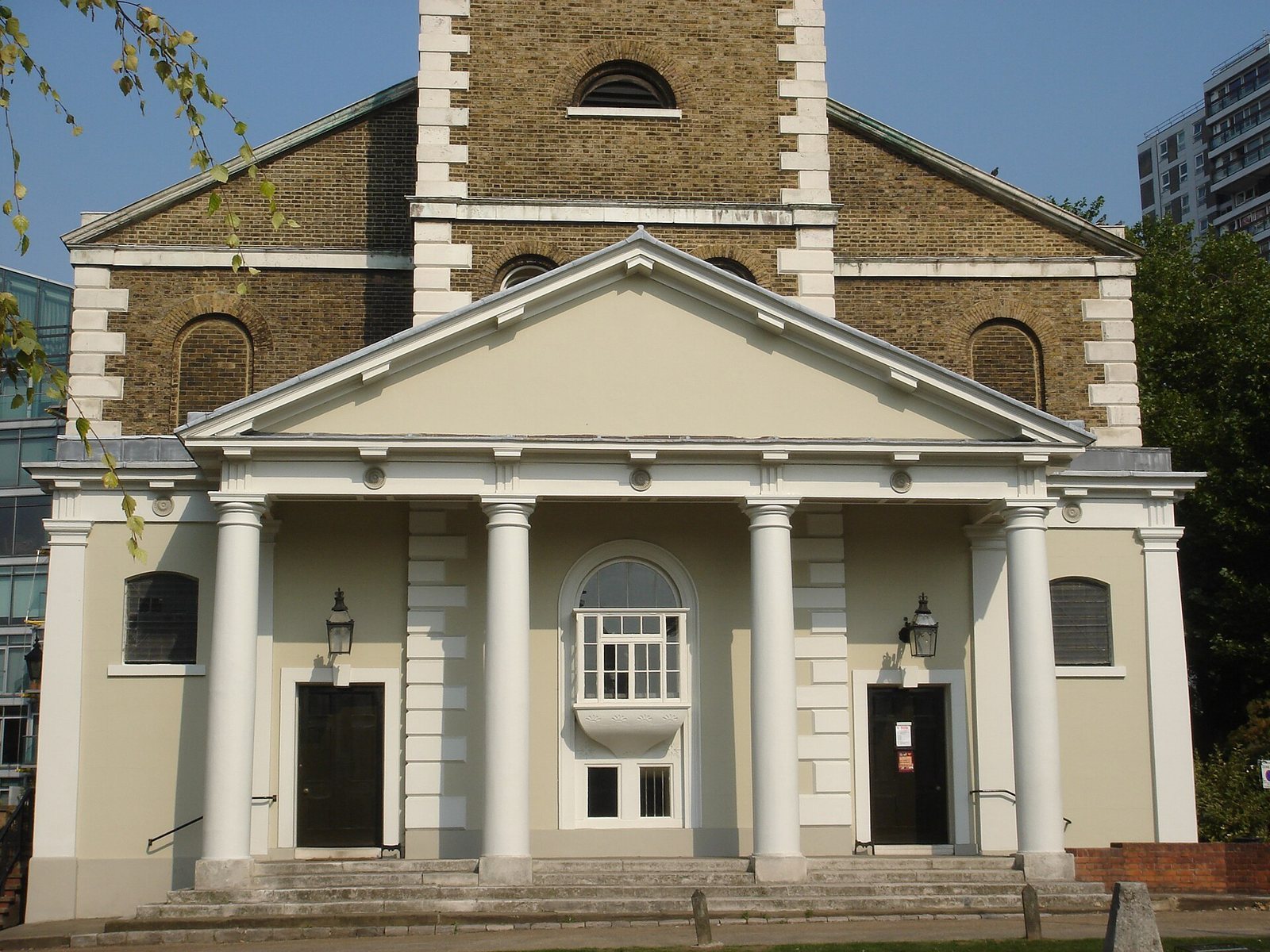
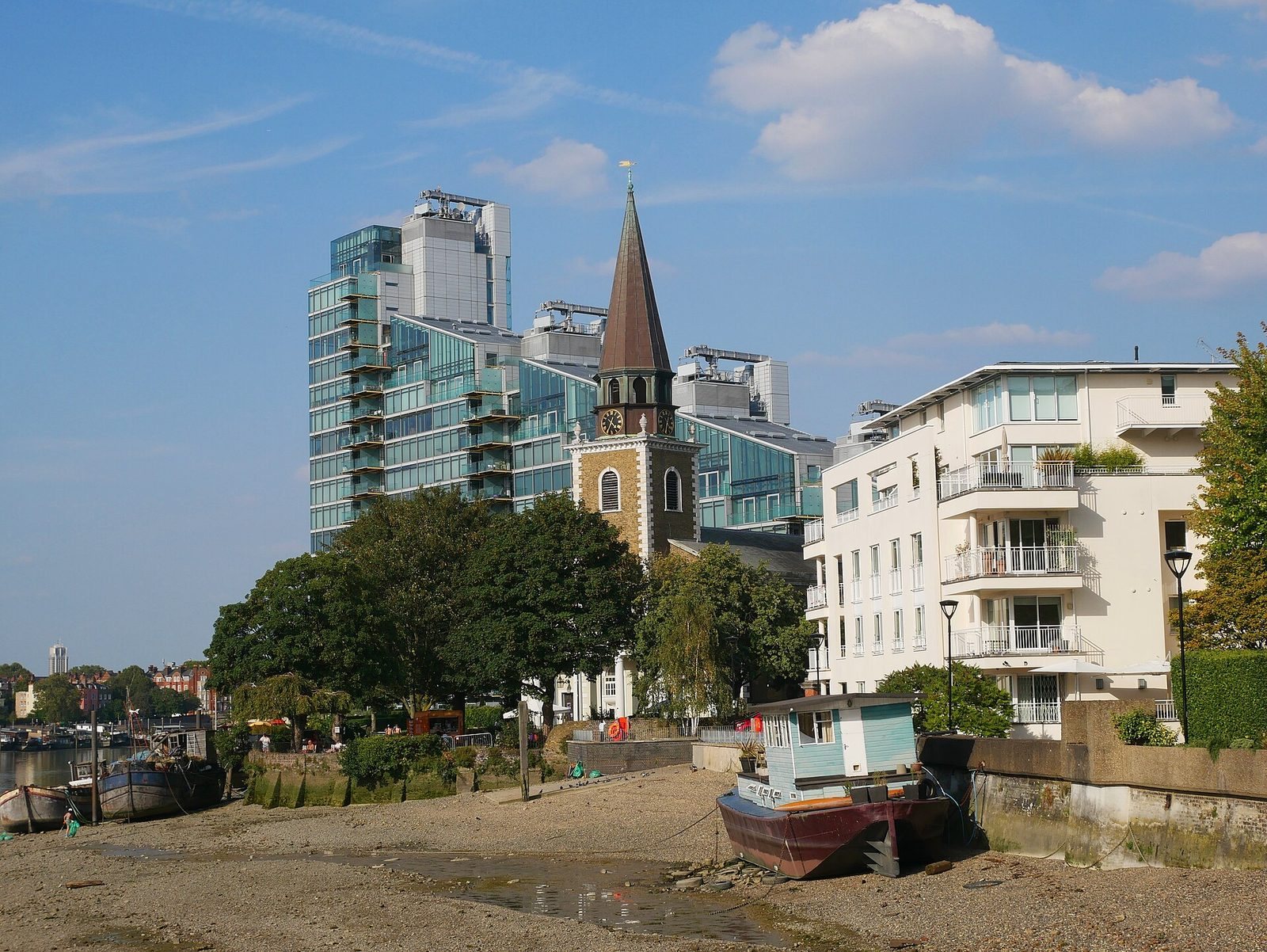
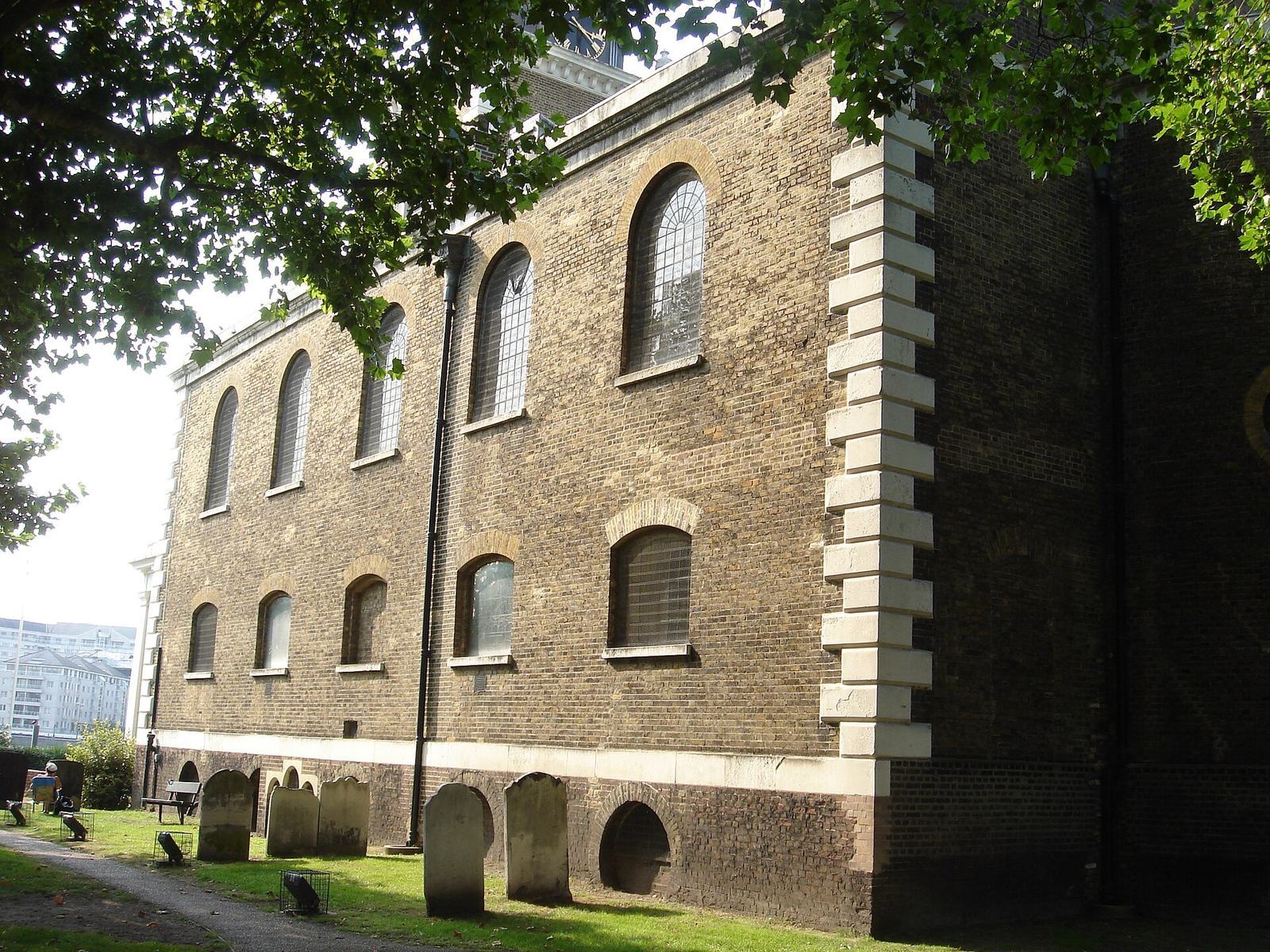
The brick church has stone quoins, which strengthen and mark its corners, along with other stone dressings. Its rectangular nave, the main body of the church, ends to the east in an apse, a recess containing the sanctuary. A tower stands at the west end. The west front has a single-storey porch, where plain Tuscan columns support a pediment. Behind it, the tower rises to a clock chamber and a small spire.
Nave and galleries
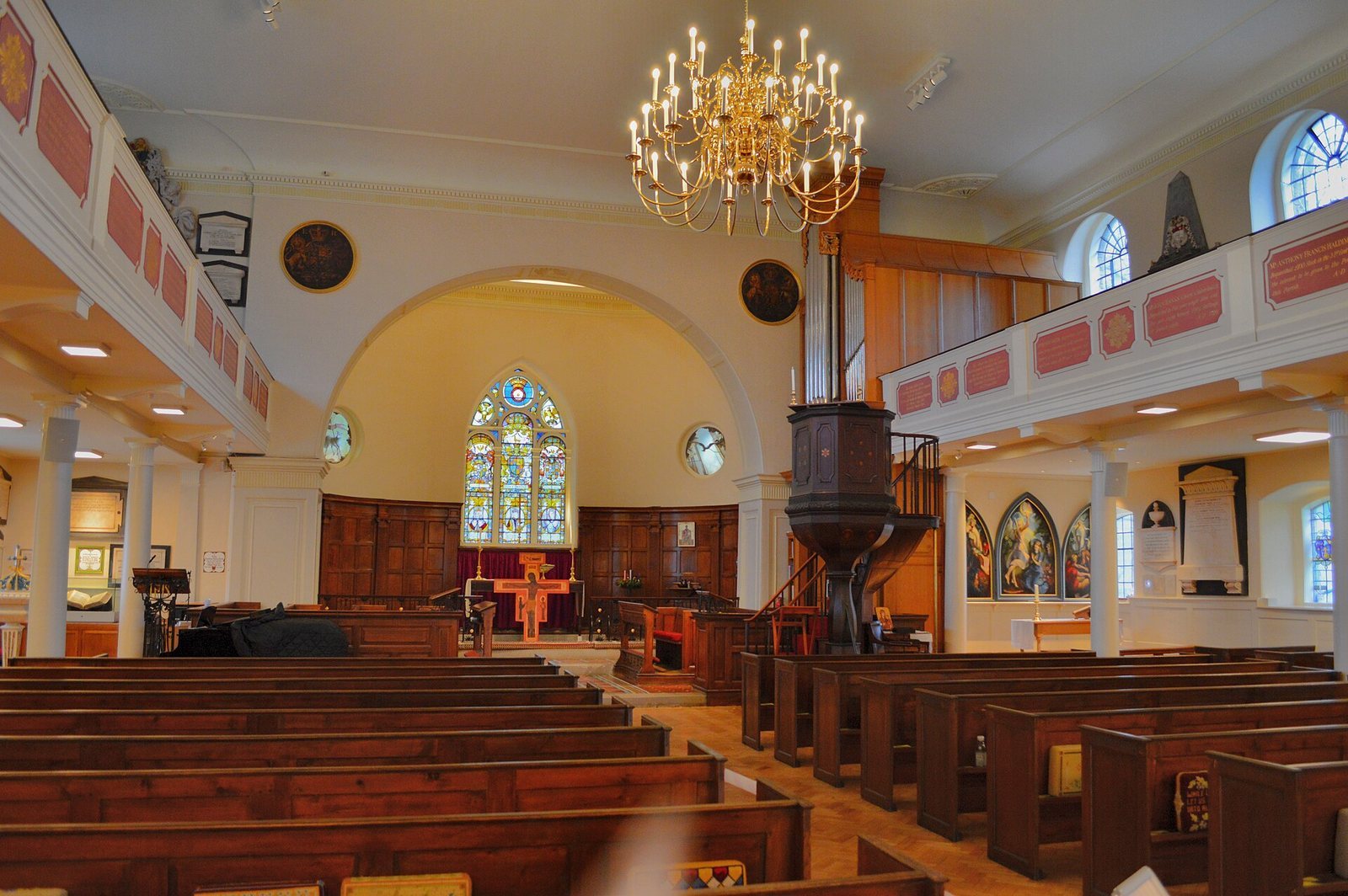
A flat ceiling spans the church. Wooden galleries supported by columns extend along three sides of the interior, and the nave windows are set in two tiers. Those in the upper tier have rounded tops.
Windows and church art
Older stained glass
The sanctuary’s east window dates to 1379. Other painted glass, made in 1631, includes portraits of Henry VII, his mother Margaret Beaufort, and Queen Elizabeth I.
Dove and Lamb windows
James Pearson made the stained-glass Dove and Lamb windows, originally dating to 1796. A German V-1 flying bomb, an explosive weapon used during the Second World War, damaged them in 1944; they were restored in 1946.
Side-chapel triptych
A three-panel artwork, or triptych, by John Napper was made in 1946 for the side chapel. It depicts the Annunciation, the Christian account of the angel Gabriel telling Mary she will bear Jesus, with Battersea Park and Battersea Power Station in the background. In the right panel, Christ walks on the Thames; in the left, Lazarus rises beneath the church porch.
Benedict Arnold window
Designed and made by John Hayward, four commemorative windows were installed in the north and south aisles between 1976 and 1982. The south-aisle window for Benedict Arnold dates to 1976. Below a portrait of Arnold in uniform are the arms of George Washington, an American flag, a Betsy Ross flag, the Continental Union flag of 1775, and the Union Jack.
William Blake window
The north-aisle William Blake window dates to 1979. Its portrait, based on one by Thomas Phillips, is surrounded by figures representing Innocence and Experience. At the bottom, Albion represents Britain and humanity, while a winged figure called Emanation represents a spiritual female counterpart. The lower left includes Blake’s signature from the church’s marriage register and drawings by Blake and Catherine.
J. M. W. Turner window
The north-aisle window commemorating J. M. W. Turner dates to 1979. Like the other memorial windows, it was designed and made by John Hayward. Morgan Crucible Company Ltd gave it to mark its long association with the parish.
William Curtis window
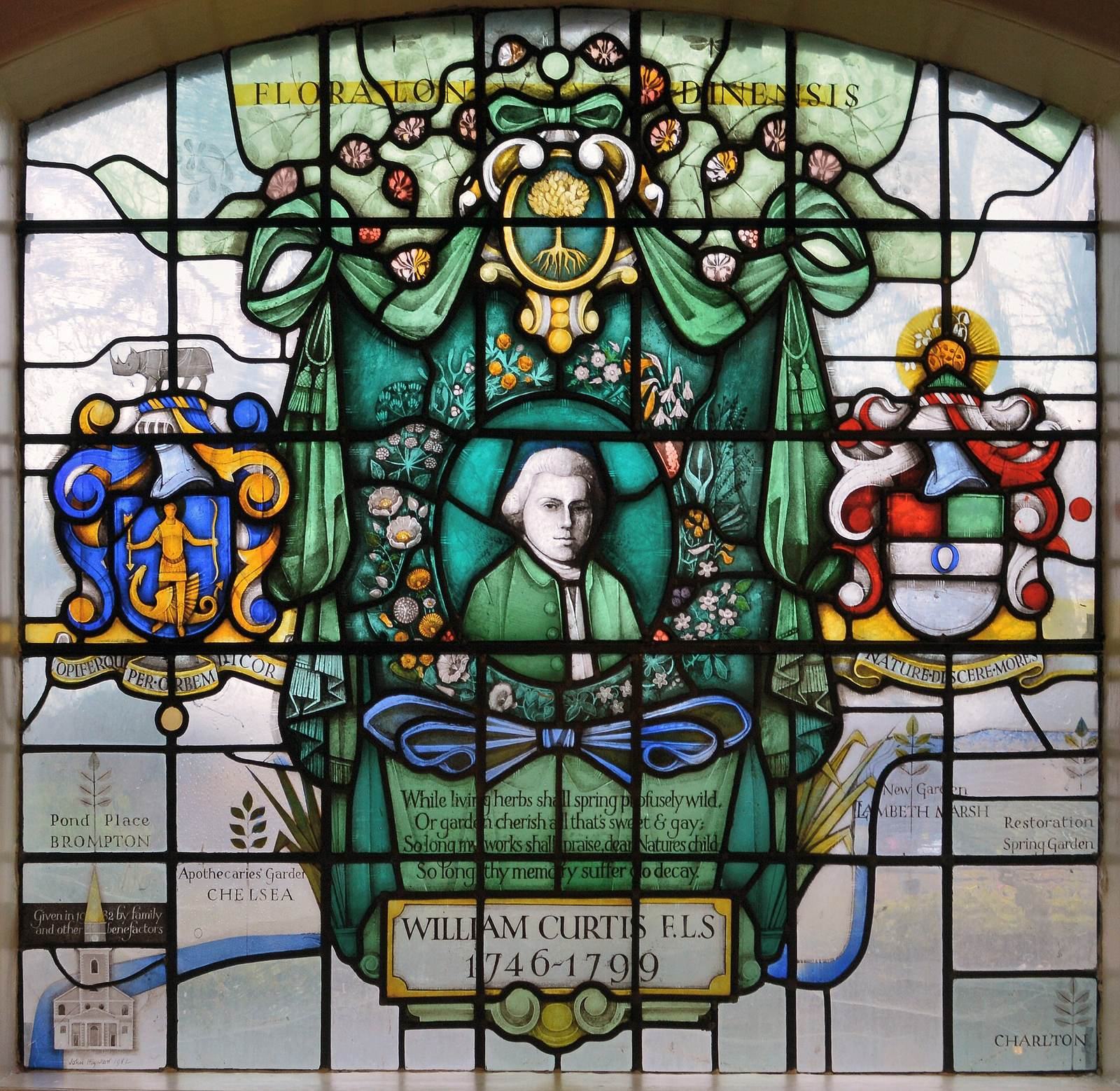
The south-aisle window for William Curtis dates to 1982. His portrait is framed by botanical illustrations from Flora Londinensis, including geranium, wild daffodil, snowdrop, cuckoo pint, blackberry, primrose, dandelion, wild rose and buttercup. The window carries an epitaph drawn from Curtis’s lost headstone, the emblem of the Royal Horticultural Society, and the arms of the Society of Apothecaries and the Linnean Society. A map marks the sites of Curtis’s gardens at Bermondsey, Charlton, Lambeth Marsh and Brompton, as well as the Chelsea Physic Garden.
Other interior features
Organ
Saxon Aldred made the organ in 1993. It bears a carving of a ram in recognition of Battersea’s Ram Brewery.
War memorial
At the back of the church, a terracotta war memorial by Freda Skinner depicts the Gate of Life guarded by the Angel of Sacrifice.
Vestry doors
Glass doors added to the vestry in 2008 were engraved by Sally Scott FGE.
Monuments
Baron St John and Joan Roydon
Several monuments in the church come from its earlier building. A memorial to Baron Oliver Nicholas St John of Lydeard, Viscount Grandison, and his wife Joan Roydon includes two busts sculpted by Nicholas Stone the Elder. St John, who died in 1630, served as Lord High Treasurer, a senior officer responsible for royal finances, and Lord Deputy of Ireland, the Crown’s chief representative there.
Sir Edward Wynter
The monument to Sir Edward Wynter, who died in 1685, portrays him fighting a tiger and Moors. Its epitaph recounts his adventures.
Sir John Fleet and James Bull
A bust crowns the monument to Sir John Fleet, who died in 1712 and served as Lord Mayor in 1695. His son-in-law James Bull, a merchant who died aged 44 in 1713, is also commemorated.
Henry St John and Mary Clara des Champs de Marcilly
The monument to Henry St John, Viscount Bolingbroke, and Mary Clara des Champs de Marcilly, Marchioness of Villette and Viscountess Bolingbroke, has cameo portraits facing one another across a shield. Sculptor Louis-François Roubiliac signed it at the base. Bolingbroke, who died in 1751, had served as Secretary of War and Secretary of State under Queen Anne; his wife died in 1750. He wrote the epitaphs for both.
John Camden and Elizabeth Neild
The memorial to John Camden, who died in 1780, and his eldest daughter Elizabeth Neild, who died in 1791, shows a girl beside a funeral urn and includes a poetic eulogy. It is signed by Coade of Lambeth, a maker of artificial-stone ornaments, and dated 1792.
Richard and Eleanor Rothwell
J. G. Bubb made the monument to Richard Rothwell, who died in 1821, and his wife Eleanor, who died in 1834.