Saints Peter and Paul Church in Kraków: A Jesuit Baroque Church
Site at a Glance
- Popularity
- Very High
- Country
- Poland
- Primary era
- Early Modern
- Eras represented
- Early Modern
- Civilizations
- Polish–Lithuanian Commonwealth
- Site type
- Religious
- Remains
- Church
On this page16 sections
History
Founding and Jesuit period
Saints Peter and Paul Church in Kraków is a Roman Catholic church in Poland, founded by King Sigismund III Vasa for the Jesuits, a Catholic religious order. Built from 1597 to 1619, it is regarded as Kraków’s first Baroque building and may also have been the earliest in present-day Poland. Baroque design is associated with dramatic spaces and richly ornamented interiors.
The first design was probably drawn up by the Italian Jesuit Giovanni de Rossi. Józef Britius began the work, and Giovanni Maria Bernardoni later revised the plans. Giovanni Battista Trevano shaped the final design by 1619, including the façade, dome, and interior. The church was consecrated on 8 July 1635. In 1638 the Jesuits formed a musical ensemble there, numbering 80 to 100 singers and then the largest in Poland.
Changes of use and parish life
When the Jesuit order was suppressed in 1773, the church and college came under the Commission of National Education, an education authority established that year in the Polish-Lithuanian Commonwealth. The commission transferred the properties to Kraków University. In 1786 the church passed to the Cistercians, a Catholic monastic order, at Mogiła. It served as an Orthodox church from 1809 to 1815.
The Free City of Kraków, a semi-independent city-state, paid for repairs to the dome between 1822 and 1825. In 1830 the All Saints parish was transferred to the church, with a ceremony held on 8 August. It has served the parish since then and remains within the Archdiocese of Kraków.
Conservation and later history
A wide-ranging conservation campaign began in 1899 under architect Zygmunt Hendel. Work on the dome and lantern took place in 1899-1901 and 1906-1907; the façade was treated from 1901 to 1907, and the roofs in 1900 and 1902-1908. Interior work followed from 1907 to 1916, alongside repairs to the stairs beside the enclosure. Around 1890, Saint Joseph Bilczewski served at the church as an assistant parish priest.
The church received the honorary Catholic title of minor basilica in 1960. It forms part of Kraków’s Historic Centre, inscribed as a UNESCO World Heritage property in 1978, and is included in the 1994 Historic Monument designation for the city’s historic urban complex.
The church’s crypts hold the remains of Jesuit preacher Piotr Skarga, Bishop Andrzej Trzebicki, and Witold Szeliga Bieliński. Work to establish a National Pantheon there began in 2010; its first section opened in 2012, the 400th anniversary of Skarga’s death. Later interments include dramatist Sławomir Mrożek in 2013, chemist Karol Olszewski in 2018, Bishop Tadeusz Pieronek in 2019, poet Adam Zagajewski in 2021, and composer Krzysztof Penderecki in 2022. Elżbieta Penderecka was interred there in 2025. The pantheon also includes mathematicians and cryptologists Marian Rejewski, Jerzy Różycki, and Henryk Zygalski, as well as chemist Zygmunt Wróblewski.
A Foucault pendulum, an apparatus whose changing apparent swing demonstrates Earth’s rotation, was first installed in the church in 1949 at the initiative of professors Kazimierz Kordylewski and Władysław Horbacki. It was displayed again in 1991 for an anniversary marking Nicolaus Copernicus’s arrival in Kraków, removed during renovation in 1993, and rehung in 2000.
Remains
Plan and setting
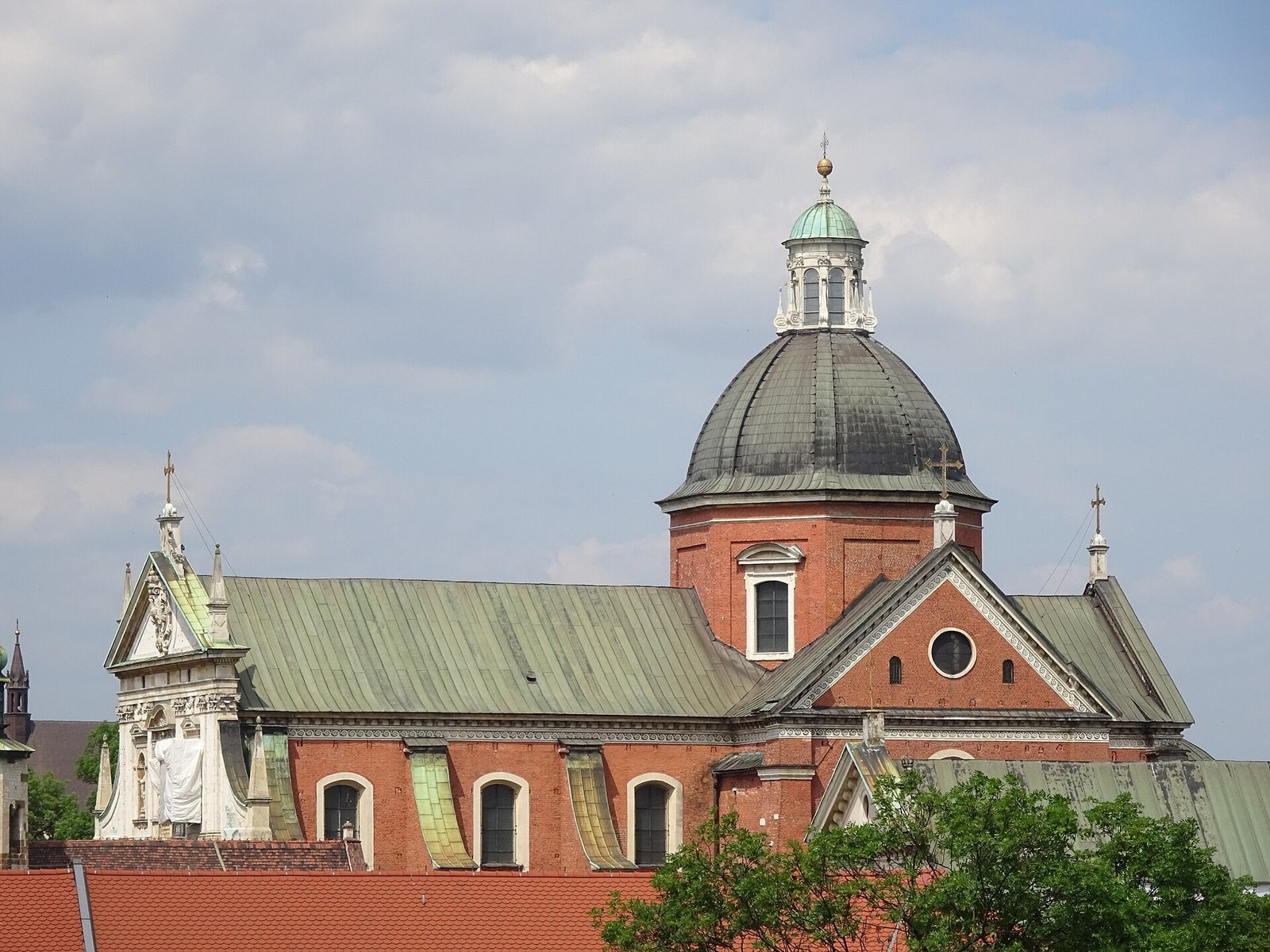
The church stands on the eastern side of St. Mary Magdalene Square, near St. Andrew’s Church. Its brick-and-stone plan brings together a broad central nave, side aisles used as chapels, and a crosswise transept. A dome rises above the crossing, where the transept meets the nave; beyond it, a short rectangular presbytery ends in a semicircular apse. Among Kraków’s historic churches, it has the greatest seating capacity.
Exterior
Façade
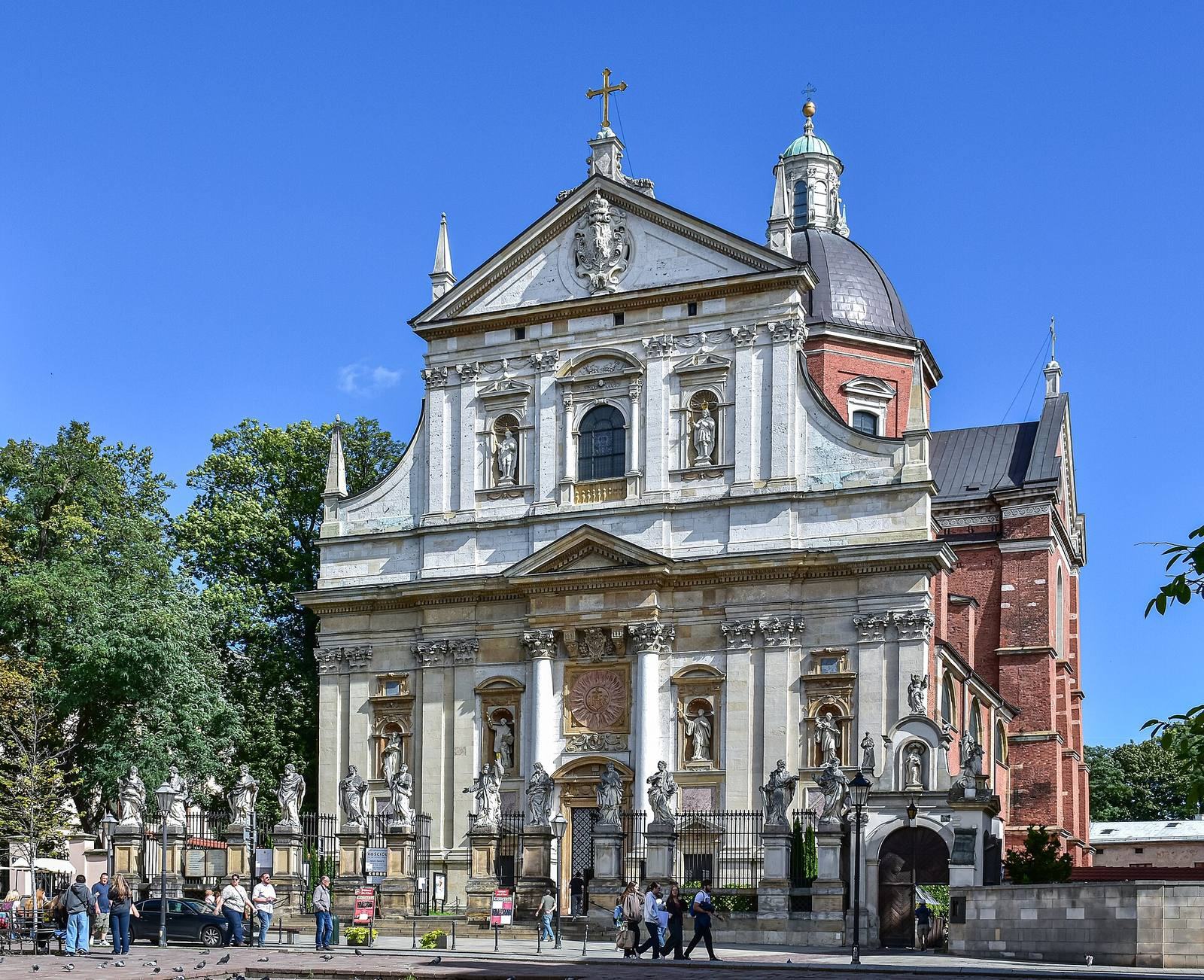
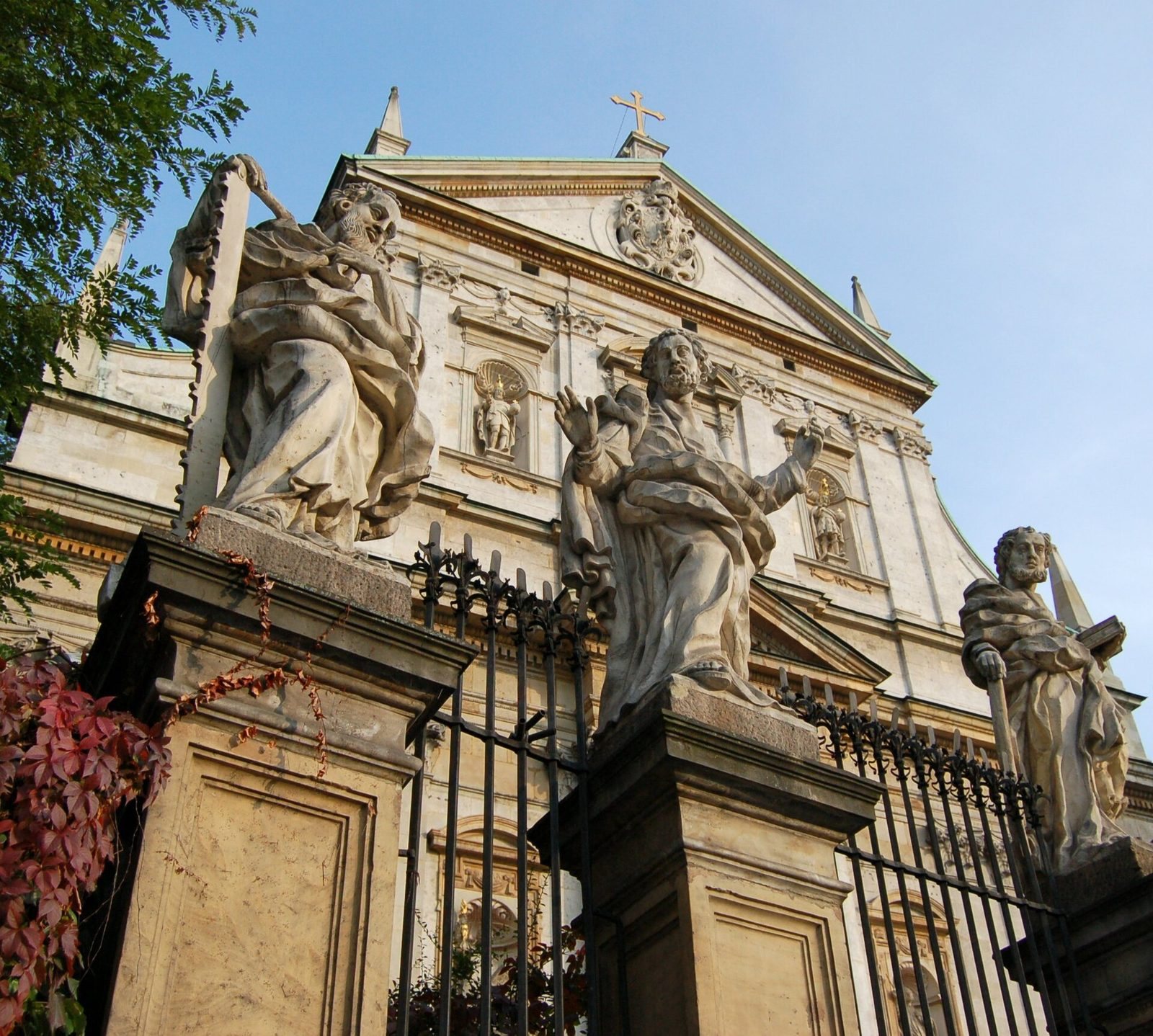
The two-storey façade is faced with dolomite. Its composition recalls Santa Susanna in Rome and shares features with the Jesuit church of Il Gesù, also in Rome. Niches hold statues of Jesuit saints Ignatius of Loyola, Francis Xavier, Aloysius Gonzaga, and Stanislaus Kostka, made by Dawid Heel. Above the main portal is the Jesuit emblem. The upper storey bears images of Saint Sigismund of Burgundy and Saint Ladislaus I of Hungary, while the top displays the founder’s coat of arms, an eagle with a sheaf on its breast.
Apostle enclosure
An enclosure adorned with statues of the apostles was designed by Kacper Bażanka and made by Dawid Heel in 1722, using Pińczów limestone. Acid rain severely damaged the original eighteenth-century sculptures. Copies carved from the same limestone by Kazimierz Jęczmyk now stand in their place.
Interior
Presbytery
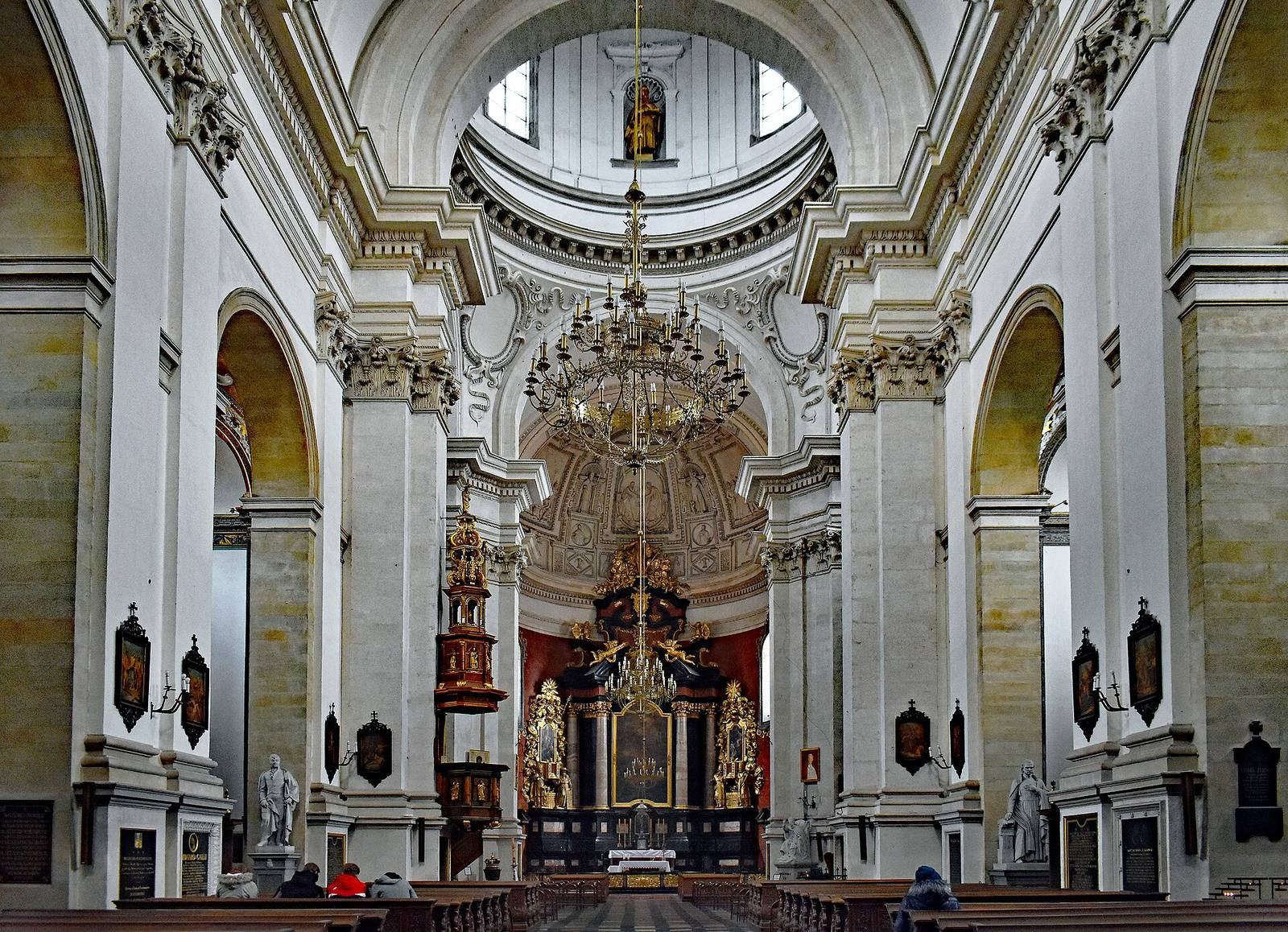
The late Baroque high altar dates to 1735. Its design is attributed to Bażanka, and its sculptures are by Antoni Frączkiewicz. The altar painting, The Giving of the Keys to Saint Peter, was painted by Józef Brodowski around 1820, drawing on an eighteenth-century work by Szymon Czechowicz that no longer survives. By the presbytery’s north wall stands the late seventeenth-century tomb of Bishop Andrzej Trzebicki. On the south wall is Czechowicz’s 1763 painting of All Saints, transferred from the former All Saints Church.
Nave
The main nave contains an early Baroque pulpit and several monuments. These include a statue of Piotr Skarga by Oskar Sosnowski, made in 1869 and brought from Wawel Cathedral in the early twentieth century, and a monument to Kajetan Florkiewicz by Franciszek Wyspiański, dated 1877. A monument to Pope Pius IX, by Walery Gadomski and Michał Korpal, dates to 1880. The baptismal font, dated 1528, came from the former All Saints Church.
Transept
The north arm contains an early Baroque altar with a painting of the Virgin Mary, Saints Anne, and Joachim. It also holds a tomb for the Rohoziński and Michałowski families, with a statue by Marceli Guyski depicting Christ presented to the crowd. In the south arm, an altar to Saint Stanislaus Kostka has a painting of the saint from the first half of the seventeenth century. Other features there include the Bartsch family monument of 1827, a statue of Maurycy Poniatowski by Wiktor Brodzki, a statue of Maurycy Drużbacki by Antoni Madeyski dated 1912, and a Branicki family memorial designed by Bażanka between 1720 and 1727.
Side chapels
The north aisle contains the chapels of the Passion, Our Lady of Loreto, and Saint Ignatius of Loyola. Those on the south side are dedicated to the Lord’s Supper, Saint Michael the Archangel, and the Holy Trinity. The Lord’s Supper Chapel includes a tomb for the Brzechffa family, designed by Bażanka in 1716.
Stucco decoration
Ornamental plasterwork by several workshops is concentrated mainly on the vaults. Before 1619, a stucco artist named Jan created scenes from the lives of Saints Peter and Paul and statues of Poland’s patrons, Saints Wojciech and Stanislaus, for the apse of the presbytery; his workshop also decorated the dome vault. Giovanni Battista Falconi’s workshop worked on the chapels in the 1630s and 1640s. The side aisles have small figures within ornamental designs and framed panels decorated in multiple colors. The vault in the Chapel of Saint Francis Borgia was completed in 1698 by Kazimierz Kaliski’s workshop.
Lighting and interior installations
The interior lighting was arranged to direct attention toward the priest celebrating Mass. Pillars supporting the dome were intended to suggest the side wings of a theatre stage.
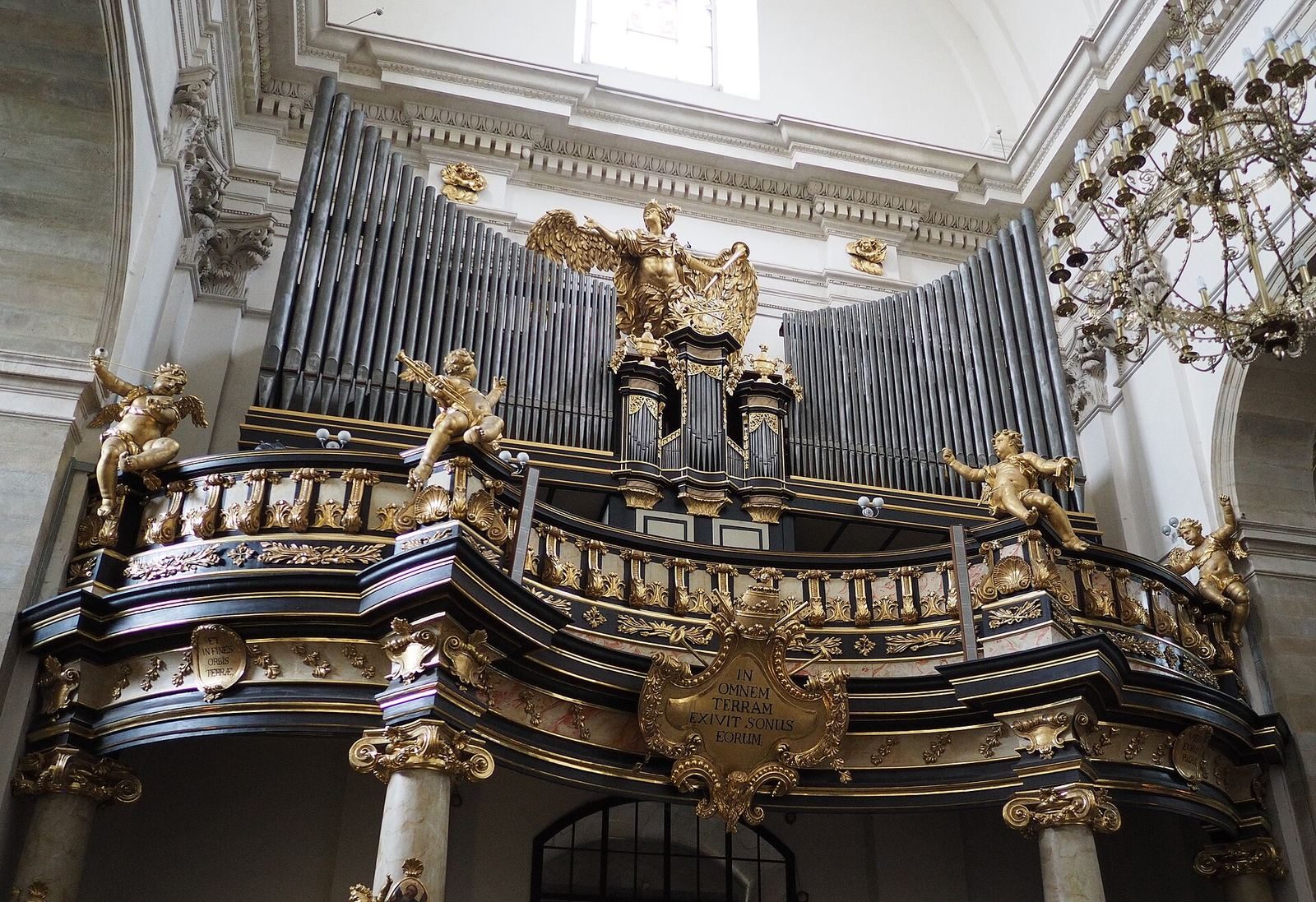
The underground crypts contain the church’s burial chambers and the National Pantheon. The organ has 45 stops, which control its sounds, three hand-operated keyboards, and a pedal keyboard played with the feet.
A 46.5-metre Foucault pendulum weighing 25 kilograms hangs inside the church. A red laser marks a clock face on the floor as the pendulum swings, providing an indirect demonstration of Earth’s rotation.