St Mary’s Church: A Medieval Parish Church in Scarborough
Site at a Glance
- Rating
- 4.6
- Popularity
- Low
- Country
- United Kingdom
- Primary era
- Medieval
- External website
- Open
- Eras represented
- Medieval, Early Modern, Modern
- Civilizations
- English
- Site type
- Religious
- Remains
- Church
On this page7 sections
History
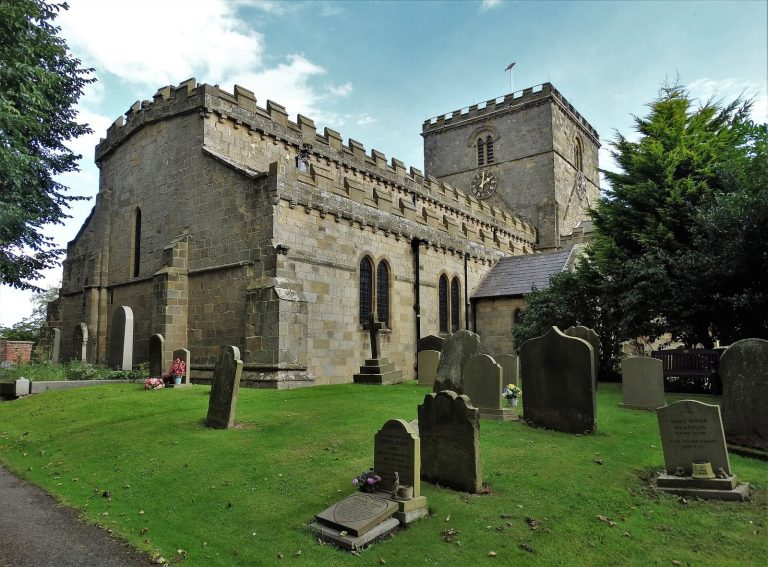
St Mary’s Church is a Church of England parish church in Scarborough, United Kingdom, first mentioned in 1150 and built during the 12th century. The Church of England is England’s established Anglican church, distinct from the Roman Catholic Church, and the building was formerly Roman Catholic. In 1189, King Richard I assigned its revenues to Citeaux, the founding abbey of the Cistercian order, a reform branch of Western Christian monasticism. This arrangement lasted for more than 200 years, until King Henry IV placed the church under the responsibility of Bridlington Priory in 1405.
Medieval enlargement
The church began as a single-nave building, but from the late 12th century it was substantially enlarged. North and south aisles were added, together with towers at the west and east ends, and construction continued until 1225. Work was partly delayed by an ecclesiastical interdict linked to the dispute between King John and the papacy. An interdict was a prohibition on certain church services or activities.
Further expansion took place in the 15th century. Two transepts, the sections projecting across a church to form a cross-shaped plan, were added, turning the eastern tower into a central crossing tower. Around 1450, the large northern St Nicholas aisle was built, while five chapels were constructed along the south aisle. The chancel was extended eastward by approximately 26 metres in the Perpendicular style, a late medieval English Gothic style known for strong vertical lines and large window openings.
Civil War destruction and rebuilding
During the English Civil War, the 17th-century conflict between supporters of Parliament and supporters of King Charles I, Parliamentary forces besieged the Royalist garrison in Scarborough Castle in 1645. They occupied St Mary’s Church and placed cannons in the breached east window of the chancel. The churchyard served as a firing position against the castle. Three days of fighting destroyed the St Nicholas aisle and the chancel and severely damaged much of the remaining church.
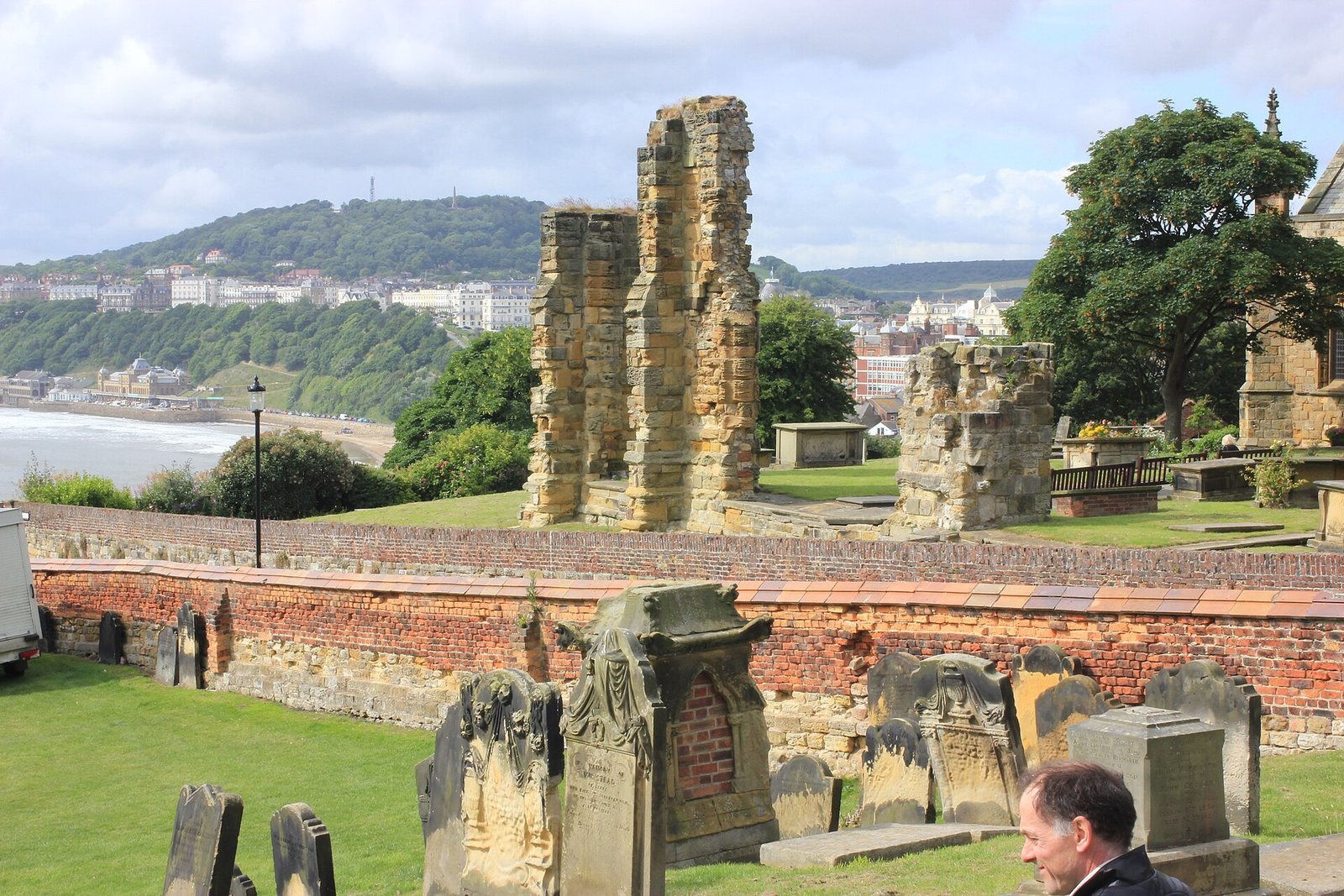
The tower was damaged and later collapsed before being rebuilt in the late 17th century. In 1669, the northern aisle was reconstructed on a reduced plan, with its walls moved inward. The former limits of the northern transept and chancel consequently remained as ruins in the churchyard. The building underwent heavy restoration in the 19th century and is now approximately half the size of its medieval predecessor. Further damage occurred during the Second World War.
Archaeology and commemoration
Excavations in 1970 examined the medieval remains. Work inside the church and beneath its floor revealed medieval walls, pillars, and other remains, as well as six skeletons. The church is a Grade I listed building. Its staircase and churchyard wall have Grade II listing, while the visible ruins and buried remains of the medieval church are protected as a Scheduled Monument because they preserve the remains of a large medieval church in an important medieval town.
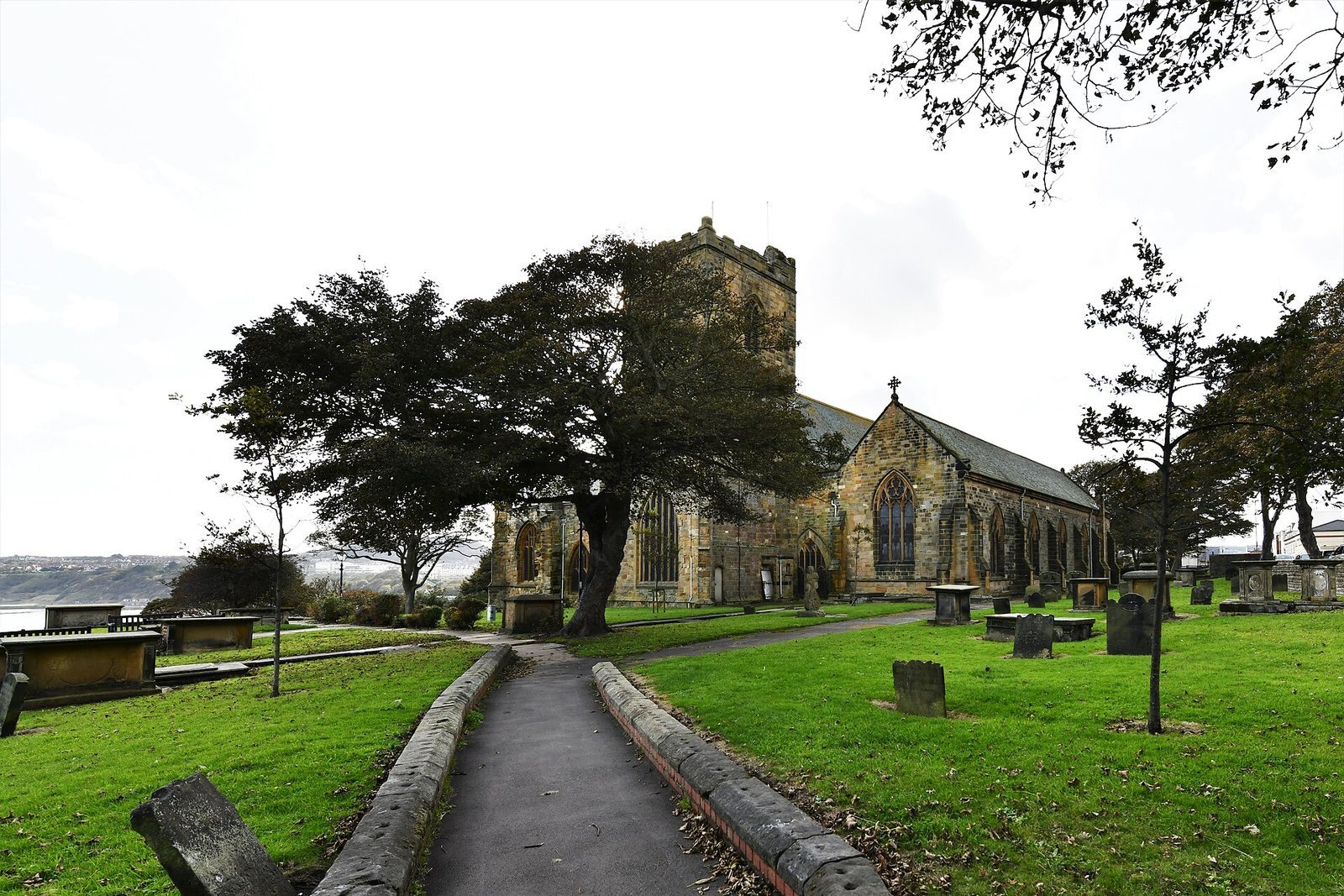
The church stands high above Scarborough’s old town, immediately below Scarborough Castle and about 300 metres from it, on a headland between North Bay and South Bay. The surrounding area remained largely undeveloped until 1725, leaving the church relatively isolated. A route partly formed as a staircase connects it with the harbour. The churchyard contains mainly 18th- and 19th-century graves and has had no new burials since 1858. It includes the grave of Anne Brontë, the English novelist and poet who died in Scarborough in 1849.
Charlotte Brontë commissioned Anne’s original gravestone. Its inscription included several errors, including an age of 28, although Anne was 29 when she died. After the stone eroded, a new inscribed plinth was installed in the early 2010s and corrected her age.
Remains
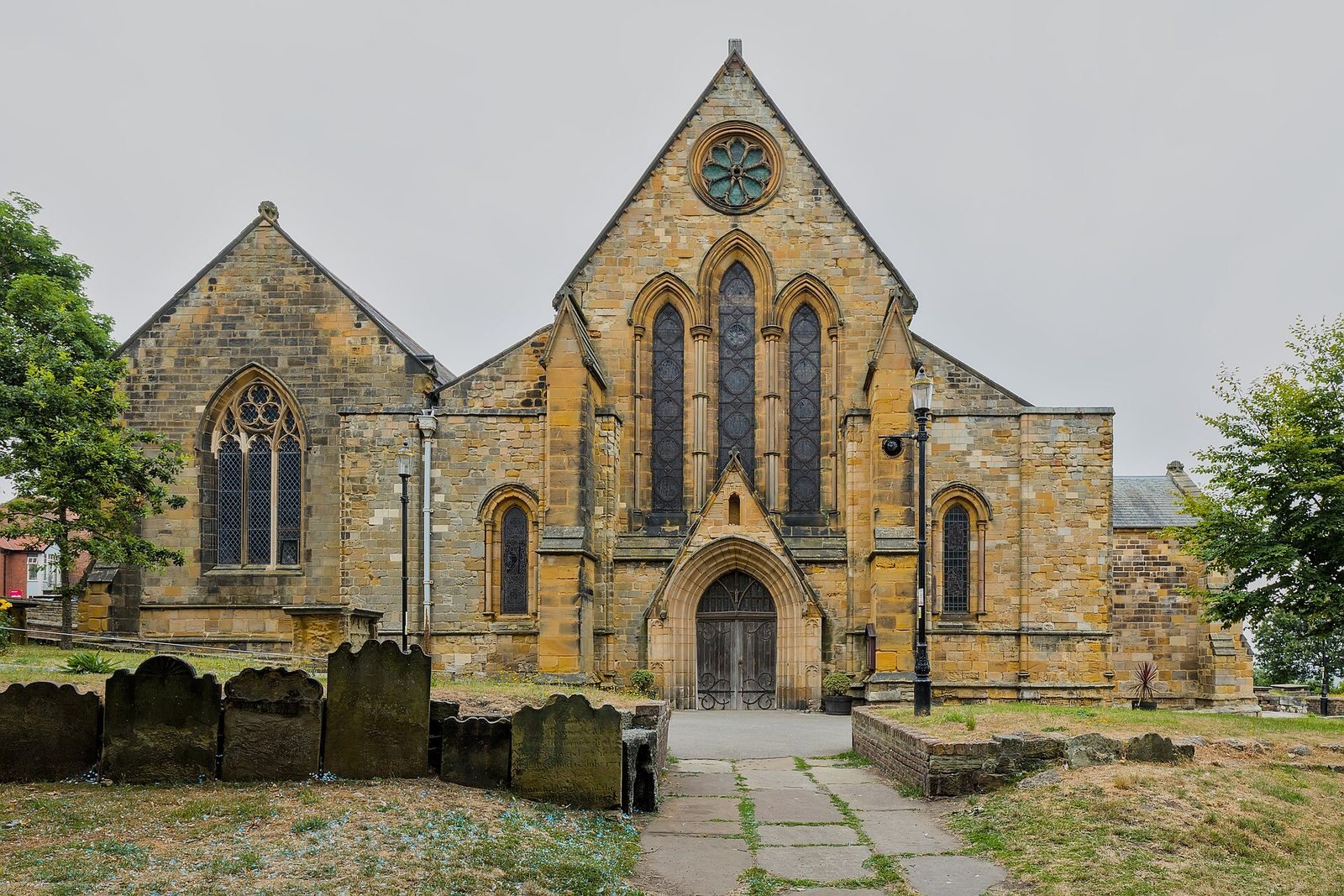
The surviving church occupies a plateau enclosed by a probably 15th-century churchyard wall. Its present form represents part of a much larger medieval plan that included a west tower, a central crossing tower, north and south aisles, transepts, a long chancel, and several chapels. The churchyard preserves the former chancel and northern transept as visible external ruins, while the rebuilt northern aisle marks the reduced later extent of the building. Garden areas lie to the south, and the wider grounds remain relatively open.
The surviving church
The present building has a square tower at its east end. It replaced the former central crossing tower after the chancel and northern transept were destroyed. Along the south side is a series of side chapels with stone-vaulted roofs, surviving elements of the medieval enlargement. The church’s internal walls are almost covered by wall monuments dating from the late 18th and early 19th centuries. One funerary monument was made by Louis-François Roubiliac, an 18th-century French-born sculptor who worked mainly in England.
Windows and archaeological remains
The Civil War fighting destroyed the church’s leaded-glass windows. The present windows are 19th- and 20th-century replicas. A large seven-light east window was designed and manufactured by Harry Stammers, a master glassmaker based in York, and installed in 1958. Its subject is the Benedicte, a canticle traditionally associated with the biblical Song of the Three Young Men and with praise offered by all creation.
Anne Brontë’s grave is marked by the original headstone and the later inscribed plinth. The headstone identifies her as the daughter of the Reverend Patrick Brontë, incumbent of Haworth, and gives her date of death as 28 May 1849. Beneath the church floor, the 1970 excavations exposed medieval walls and pillars and recovered the remains of six skeletons, extending the surviving evidence of the earlier building below the present structure.