St. Catherine’s Church: Lübeck’s Surviving Franciscan Monastic Church


Site at a Glance
- Rating
- 4.5
- Popularity
- Low
- Country
- Germany
- Primary era
- Medieval
- External website
- Open
- Eras represented
- Medieval, Early Modern, Modern
- Civilizations
- German, Holy Roman Empire
- Site type
- Religious
- Remains
- Church
On this page20 sections
History
St. Catherine’s Church in Lübeck, Germany, is the surviving church of the city’s former Franciscan monastery, rebuilt mainly in the early fourteenth century in the Brick Gothic tradition. It is Lübeck’s only surviving monastic church and formed part of a religious foundation that shaped burial practices, education, art collections, and civic life in the city.
Franciscan foundation and medieval rebuilding
In 1225, during the lifetime of Francis of Assisi, the Franciscans received land at the corner of Königstraße and Glockengießerstraße for a monastery and church. Francis of Assisi was the Italian religious leader who founded the Order of Friars Minor, whose members are commonly known as Franciscans. The order followed a mendicant ideal based on communal religious life and reliance on voluntary support rather than monastic landed wealth. Little is known about the first church erected on the Lübeck site.
The monastery belonged to the Saxon Franciscan Province, a regional administrative division of the order. From 1274 it was the seat of one of the province’s twelve custodies, each supervising several Franciscan houses. Lübeck’s custody covered the Franciscan establishments along the Baltic coast, giving the monastery an administrative role beyond the city itself.
A major rebuilding campaign began in the eastern part of the present church at the beginning of the fourteenth century, probably around 1303. The surviving roof structure has been assigned to that year through dendrochronology, a method that dates wooden building elements by analysing their tree-ring patterns. The work included the choir and transept and used Brick Gothic construction, the northern European Gothic tradition in which brick replaces or supplements stone as the principal building material.
Construction halted around 1310 during a dispute involving the friars, Lübeck, and Bishop Burkhard von Serkem. The monastery was placed under an interdict, a medieval ecclesiastical sanction that suspended or restricted specified religious rites. After reconciliation with Burkhard’s successor, Bishop Heinrich II Bochholt, building resumed in 1319.
The Lübeck mayor Segebodo Crispin made an important financial contribution to the rebuilding and established the northern chapel beside the choir as a family chapel. Choir stalls were installed in 1329, the nave was completed from 1335 onward, and the church was probably finished by 1356. That year, the monastery hosted the provincial chapter of the Saxon Franciscan Province. Further chapels and extensions followed, including the richly furnished chapel of the Zirkel Society in 1458. The choir staircase was rebuilt around 1510 to 1515.
The church’s unusually large scale, high choir, and lower level resembling a crypt have prompted the architectural historian Matthias Untermann to question whether the building was initially intended as a collegiate church and later transferred to the Franciscans for completion. This interpretation concerns the building’s original purpose and helps explain why its design is unusually elaborate for a Franciscan church.
Burial rights and religious use
Burial rights became a major issue in the church’s medieval history. In 1277, Lübeck and Bishop Burkhard von Serkem disputed whether burials could take place there. The conflict led to the interdict and proceedings before the Roman Curia. A settlement in 1281 confirmed the Franciscans’ right to conduct burials in the church, after which St. Catherine’s became one of Lübeck’s most popular burial places.
The church’s connection with burial continued after the Reformation, although its institutional setting changed. The Reformation ordinance issued by Johannes Bugenhagen in 1531 transformed the monastery into a Latin school, later known as the Katharineum zu Lübeck. Bugenhagen was a Lutheran pastor and church organiser associated with Martin Luther who helped formulate Protestant church ordinances in several north German cities.
St. Catherine’s became a subsidiary church of St. Mary’s Church and served for school worship. Burials continued there until the nineteenth century. The former sacristy housed Lübeck’s consistory from 1760 to 1814. This ecclesiastical and civic court met three times a year to deal with marriage and family cases. In 1829, the room was transferred to the city library.
Other former monastery rooms had already been assigned to Lübeck’s city library at the beginning of the seventeenth century. The surviving medieval complex now also contains the Katharineum, Lübeck’s historic Latin-school and secondary-school institution, and the city library.
Secularization, collections, and changing uses
During the French occupation of Lübeck from 1806 to 1813, the church was secularized. It was first used as a horse stable and then as a military hospital. These uses formed part of a wider transformation in the building’s function, which later shifted between worship, education, exhibitions, and museum activity.
From 1841, the high choir housed Lübeck’s first collection of medieval sculpture. Carl Julius Milde played a particularly important part in rescuing and securing works from the Burgkloster. The resulting Lübeck Collection of Antiquities opened in 1848 and became the foundation of the medieval sacred-art department at the St. Anne’s Museum in 1915.
During the nineteenth and early twentieth centuries, St. Catherine’s hosted fairs, exhibitions, and concerts as well as alternating liturgical and museum uses. Albert Kollmann exhibited his private collection there in 1899, including works by Max Liebermann. An Esperanto exhibition took place during the German Esperanto Congress of 1911. The Nordic Week of 1921 included exhibitions of Emil Nolde’s religious pictures and religious sculpture. Other displays presented architectural material, documents, seals, and incunabula from Lübeck collections. Incunabula are books printed in Europe before the beginning of the sixteenth century.
From 1926, a collection of plaster casts of sculptures of Lübeck origin from the Baltic region was assembled in the church. It included a monumental cast of Bernt Notke’s St. George and the Dragon group from Stockholm and several altars. Notke was a leading late-medieval sculptor and painter active around the Baltic Sea. The collection connected the church with the wider artistic networks of the medieval region.
War damage and modern administration
The Palm Sunday bombing of Lübeck in 1942 destroyed or burned many other churches in the city centre. St. Catherine’s was subsequently prepared for regular worship. A Russian Orthodox congregation received a chapel in the lower choir, which it continues to use as the Church of Blessed Procopius. A Greek Orthodox congregation also worshipped in the lower choir for many years.
From the early 1980s, the church was used by the Priestly Fraternity of St. Pius X for Tridentine-rite Masses. The city ended this use in May 2009. In the early 1960s, the connection between the church and the monastery cloister, by then associated with the school, was restored. The Katharineum used the church for weekly morning devotions until the 1990s and continues to hold school ceremonies and concerts there.
Since about 1980, the building has been administered as Museum Church St. Catherine by Lübeck’s Museum of Art and Cultural History. Management responsibility passed to the Cultural Foundation of the Hanseatic City of Lübeck on 1 January 2006. A comprehensive renovation took place from autumn 2011 to spring 2015, supported through the federal World Heritage Fund. The medieval monastery complex forms part of Lübeck’s Old Town, which was inscribed on the UNESCO World Heritage List in 1987. St. Catherine’s is now a museum church that continues to accommodate selected school and religious events.
Remains
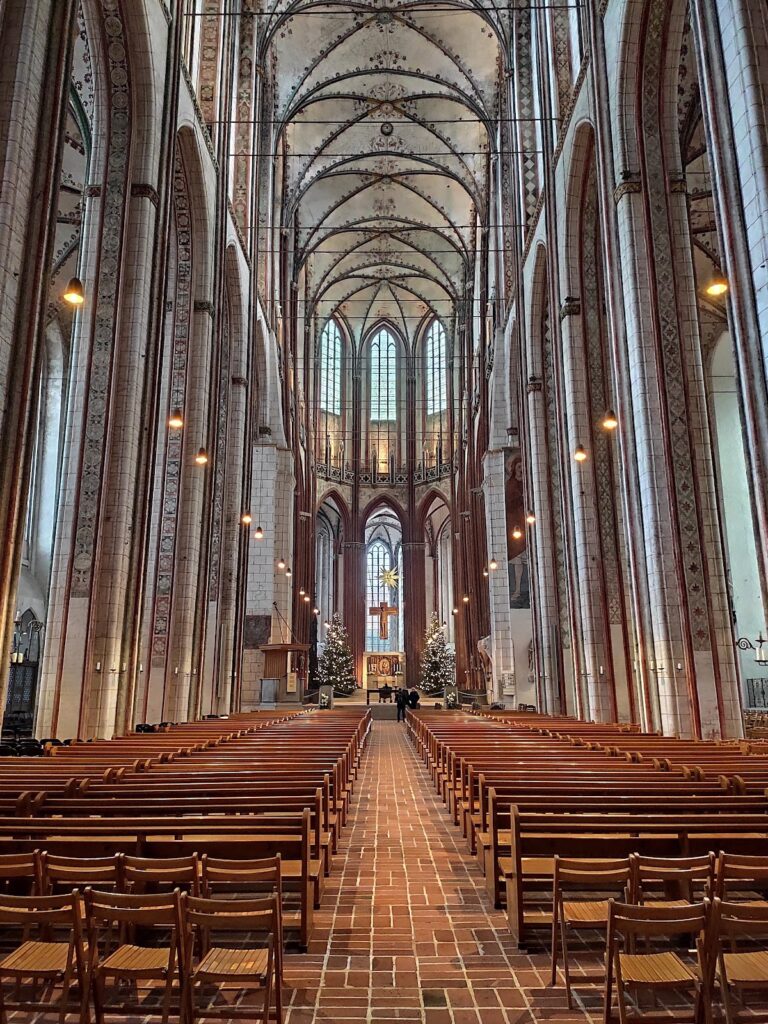
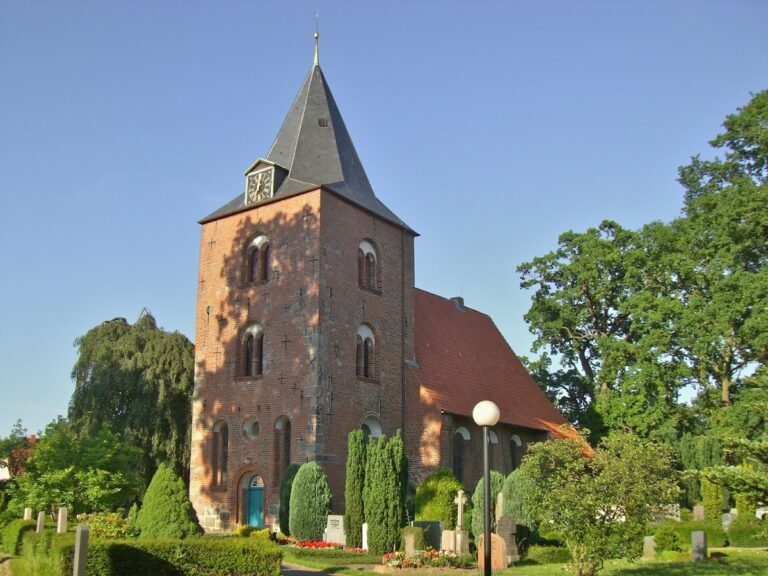
St. Catherine’s is a three-aisled, nine-bay basilica in Brick Gothic style. A basilica has a taller central nave flanked by lower side aisles. The building’s side aisles are asymmetrical because of the course of Glockengießerstraße. At the east end, a polygonal choir termination joins a two-aisled transept. The transept does not project beyond the side walls and is expressed most clearly at roof level. The church has no tower, as is characteristic of a mendicant-order church, but a roof turret once contained a bell cast in 1399 by the master founder Johannes Reborch. That bell is now displayed in the nave.
Choir, lower level, and medieval decoration
High choir and lower choir
The church has an unusually high choir built above a hall-like lower choir that extends forward as far as the crossing. This arrangement contributes to the building’s unusual scale and to its crypt-like lower level. The fourteenth-century painted decoration survives in part and has been partly uncovered again. The high choir retains the choir stalls installed in 1329 and enlarged around 1472 to 1473. Their back wall carries representations of Franciscan saints, while their arrangement was altered in 1829.
Choir staircase and triumphal cross
A fresco on the choir staircase, probably the final painting produced during the monastery’s period, shows four scenes from the life of Francis of Assisi. His stigmatisation occupies the centre of the composition, and the fresco dates to around 1510 to 1515. At the junction of the nave and choir stands a triumphal-cross group from around 1450. A triumphal cross is a large cross placed at or near the division between nave and choir. The cross is carved fully in the round toward the west, while its choir-facing side presents a Crucifixion dated by inscription to 1489.
Rood screen and clock
The parapet of the rood screen, the choir screen separating the nave from the choir, retains a clock donated in 1597 by the church wardens Johann Spangenberg and Carsten Petersen. Six panel paintings were added in the early seventeenth century. They depict Christ in Gethsemane, the Kiss of Judas, Christ before the High Priest, the Flagellation, Ecce Homo, and the Carrying of the Cross.
Nave, transept, and former furnishings
Nave pulpit and organs
The nave contains a pulpit made in 1699. It was transferred from the former St. Lawrence’s Church after that building was demolished in 1899. St. Catherine’s original Renaissance pulpit went to St. Peter’s Church in the same year and was destroyed there during the bombing of 1942.
None of the church’s historical organs survives. An organ positive from 1723, acquired in East Prussia and installed on the high choir in 1937, was later moved to St. Mary’s Church. A Kemper & Son organ installed in the southeast corner of the transept and inaugurated on Palm Sunday 1948 remains in the church, although it is in poor condition.
Altars and paintings now in the St. Anne’s Museum
Several former furnishings are preserved in the St. Anne’s Museum, whose collections include important examples of medieval sacred art. They include Hermen Rode’s St. Luke altar, the Schlutup family altar from the circle of Henning von der Heyde made around 1500, and a winged altarpiece with a Crucifixion from around 1515 to 1520.
The Passion altar from the Zirkel Society chapel, also called the Schwartau Altar, was transferred to St. George’s Chapel in Bad Schwartau in the early seventeenth century and entered the St. Anne’s Museum in 1926. The museum also displays the Crispin family portraits from the northern side choir’s family chapel, the doors of the upper-choir reliquary cabinet painted with Eucharistic motifs in a typological arrangement around 1480 to 1500, and Hans Kemmer’s votive painting of Hinrich Gerdes, transferred there in 1916. A reliquary cabinet is a case designed to contain and display relics or other sacred objects.
Paintings from the church held in museum storage include Elijah and the Angel, painted and donated by Magdalena Hedwig Röder in 1681, and The Sacrifice of Manoah. The latter is now regarded stylistically as an early work by Godfrey Kneller rather than by Röder. Kneller was a German-born painter who became a leading portraitist in England. His brother Johann Zacharias Kniller was a painter and engraver.
Burials and memorials
Medieval tomb slabs
Nearly the entire floor of the remaining church is formed by tomb slabs dating from the Middle Ages through the late eighteenth century. The medieval funerary monuments include 114 slabs dating up to 1600, with five additional examples now in the St. Anne’s Museum.
The upper choir retains the tomb slab of Jakob, bishop of Ösel, who was buried at the church in the fourteenth century. Other bishops buried there included Johannes, elected bishop of Reval, and Helenbert Visbeke, bishop of Schleswig. The lower choir contains the Flemish-influenced brass tomb slab of Mayor Johann Lüneburg, who died in 1461. Mayor Hinrich Castorp and the Danish royal official Erich Krummediek, buried in 1439, were also interred in the lower choir.
Later epitaphs and sarcophagus
The southern side aisle contains the epitaph of the reckoning master Arnold Möller, designed by Möller himself with his life dates expressed through magic squares. It also contains the epitaph of the master builder Zacharias Kniller, made by his sons Godfrey Kneller and Johann Zacharias Kniller, and the early-classical marble sarcophagus of Claus von Reventlow, who died in 1758. The Danish sculptor Simon Carl Stanley made the sarcophagus.
The northern side aisle contains the grave and epitaph of Johann Adam Reincken, a Hamburg organist and composer. The church also preserves epitaphs associated with the de Hane and Budan families. These memorials extend the building’s commemorative history beyond its medieval Franciscan foundation.
Paintings, bells, and sculpture
Tintoretto’s painting
Jacopo Tintoretto’s Raising of Lazarus, dated 1576, hangs on the west wall of the southern side aisle. Tintoretto was a major sixteenth-century Venetian painter known for dramatic compositions and energetic Mannerist style. The painting measures 140 by 104 centimetres and is set within a large Mannerist frame measuring 318 by 235 centimetres. The frame carries four coats of arms, three of them belonging to the Brabant émigré families de Hane, Gude, and Budan. The fourth coat of arms remains unidentified.
West façade sculpture ensemble
The west façade carries the sculpture ensemble Community of Saints. Ernst Barlach began the designs in 1929 at the initiative of museum director Carl Georg Heise, with an original plan for sixteen figures. By 1933, three clinker-brick sculptures had been made: Woman in the Wind, Beggar, and Singing Monastic Pupil. The figures were hidden in 1936 to protect them from confiscation as “degenerate art” and placed in their intended façade niches in 1947.
Gerhard Marcks completed the ensemble in his own style with six additional figures: Christ as the Man of Sorrows, Arsonist, Virgin, Mother and Child, Cassandra, and Prophet. They were installed in the façade niches on 18 February 1949. Their elongated upper bodies and slightly enlarged heads were designed for viewing from below across the narrow street. Wire screens were later fitted to protect the figures from pigeon fouling.
Notke cast and bells
A cast of Bernt Notke’s St. George and the Dragon group remains associated with the church. The original, made to commemorate Sten Sture the Elder’s victory at the Battle of Brunkeberg, is in Stockholm’s Storkyrkan. Sten Sture the Elder was a Swedish regent, and the battle was a fifteenth-century conflict commemorated by Notke’s sculpture. The Lübeck cast was produced for the twentieth-century collection of works of Lübeck origin from the Baltic region.
The church’s bell collection includes a cathedral bell cast in 1315, a bell from the demolished St. Clement’s Church dating from about 1330 to 1340, and a bell cast in 1745 for the Heiligen-Geist Hospital by the Lübeck founder Dietrich Strahlborn. The names of the hospital’s foundation wardens are inscribed on the 1745 bell.
A bell cast in 1672 by Albert Benningk for St. Menas Church in Staraya Russa was temporarily placed in St. Catherine’s during the twentieth century. German soldiers confiscated it in 1942 because its inscription identified Lübeck as its place of manufacture. Lübeck returned the bell to Staraya Russa in 2001.
Nearby sites