St. Leonard’s Crypt: A Romanesque Burial Place Beneath Wawel Cathedral
Site at a Glance
- Popularity
- High
- Country
- Poland
- Primary era
- Medieval
- Eras represented
- Medieval, Modern
- Civilizations
- Unclassified
- Site type
- Religious
- Remains
- Tomb
On this page8 sections
History
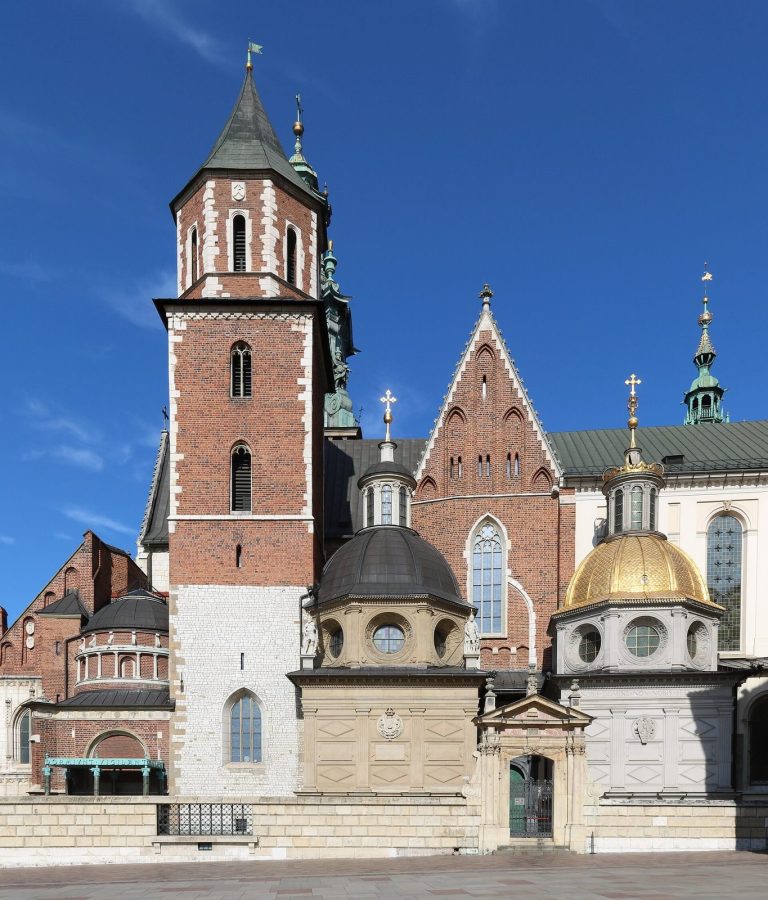
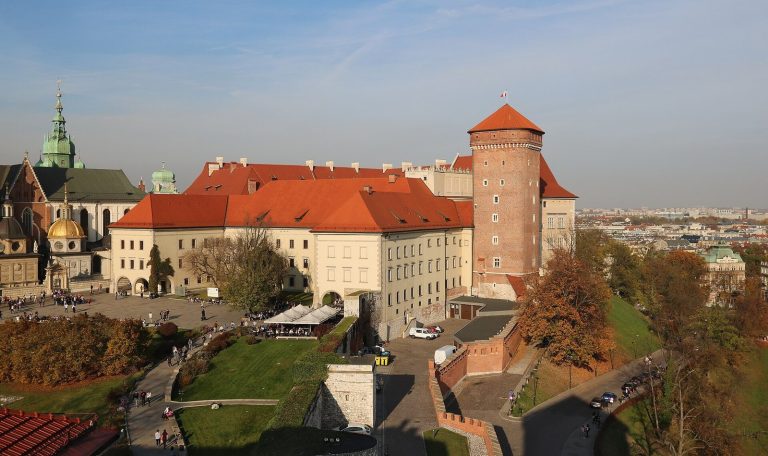
St. Leonard’s Crypt is a burial chamber beneath Wawel Cathedral in Kraków, Poland, built around 1038–1039 under the Piast ruler Casimir I the Restorer in the Romanesque style, a medieval tradition characterized by massive construction and rounded arches. Its construction coincided with Kraków becoming Casimir’s residence and Poland’s capital.
Foundation and the earlier cathedral
The crypt was dedicated to Saint Leonard of Limoges and became part of the cathedral built in a later phase. Work on that Romanesque cathedral began toward the end of the 11th century. Known as the Hermanowska Cathedral, it was probably commissioned by Władysław I Herman, Duke of Poland from 1079 to 1102. The cathedral was consecrated in 1142, and the crypt is its oldest surviving part.
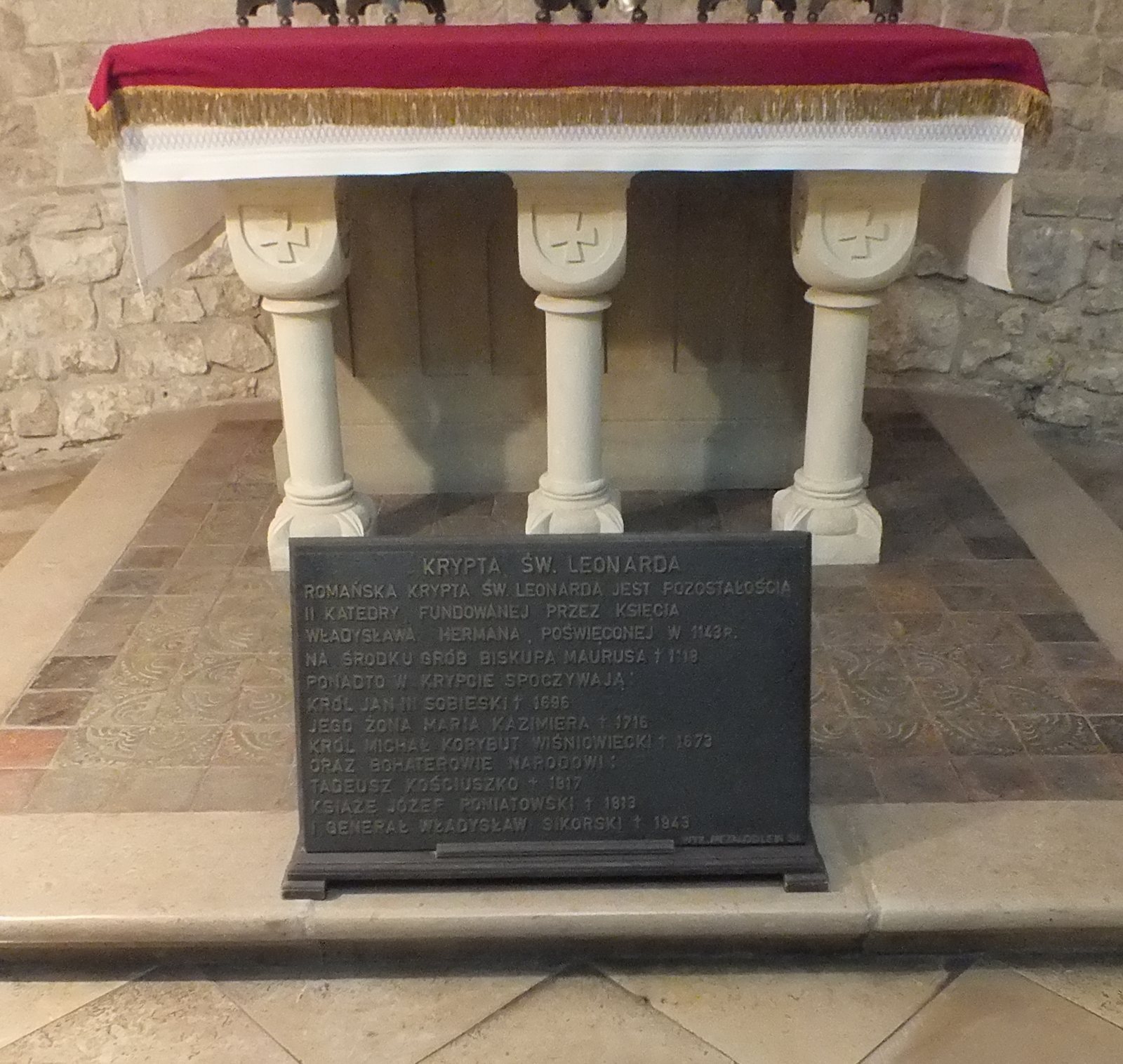
Burials began before the cathedral was complete. The earliest known interment was Bishop Maurus, a French-born cleric who served from 1110 to 1118, in 1118. A floor inscription commemorates him. Excavations in 1938 recovered grave goods from his burial, including a paten, a plate used in the Eucharist, and a chalice, a cup for wine.
Royal and national burials
Later interments included Michał Korybut Wiśniowiecki, elected king of Poland and grand duke of Lithuania from 1669 to 1673, and John III Sobieski, who held those titles from 1674 to 1696. In 1683, Sobieski commanded allied forces at the Battle of Vienna and helped bring the city’s second Ottoman siege to an end. His wife, Marie Casimire Louise de la Grange d’Arquien, was queen of Poland and grand duchess consort of Lithuania from 1674 to 1696.
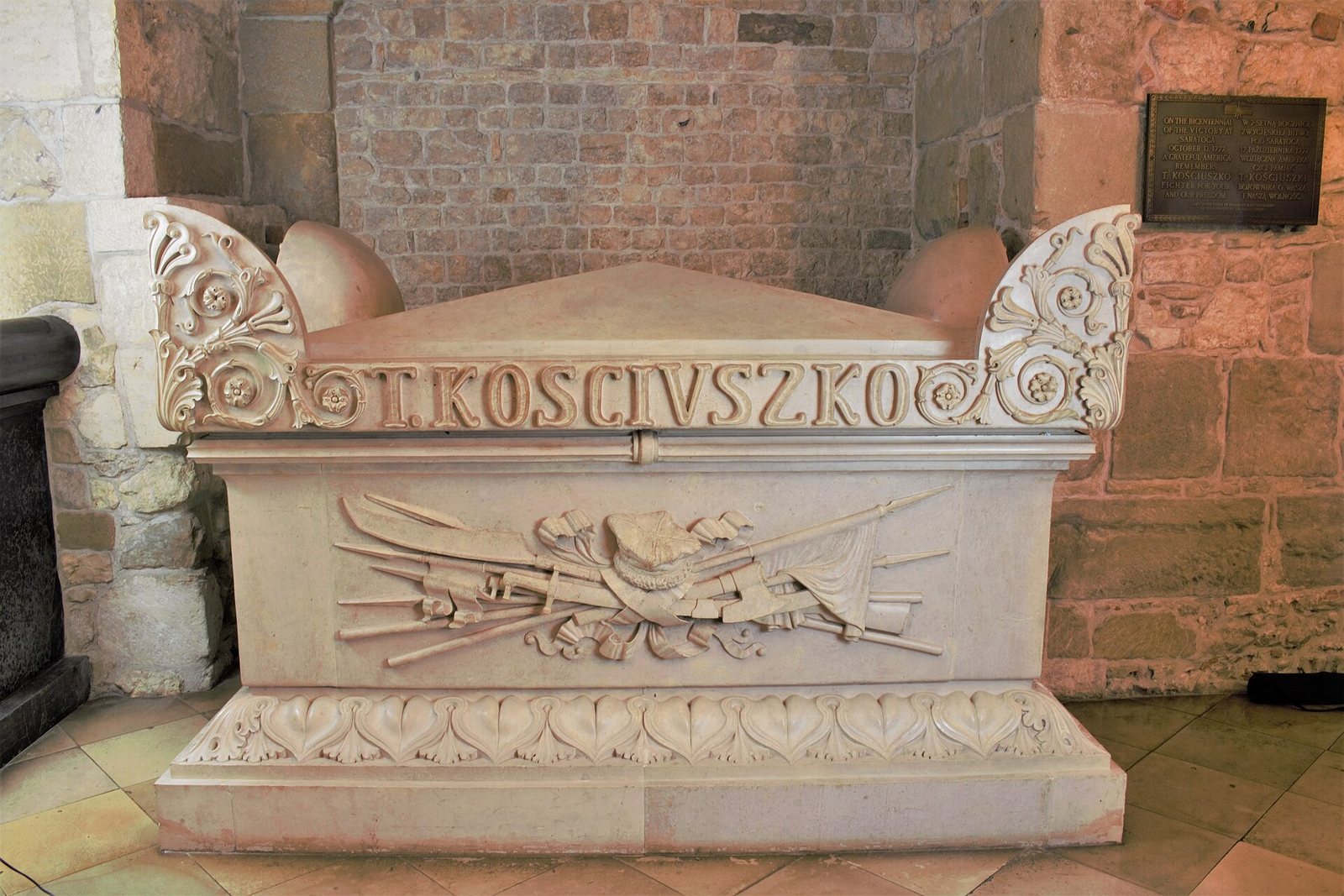
Józef Antoni Poniatowski, a nephew of King Stanislaus II Augustus, was an Austrian officer, Polish statesman and general, a prince of the Holy Roman Empire, a Central European polity that lasted until 1806, and a Marshal of France, a senior military dignity. Tadeusz Kościuszko, a Polish nobleman and national hero, led the 1794 uprising against Russia and Prussia. He had also served as a general alongside George Washington during the American Revolutionary War, from 1777 to 1783.
Twentieth-century burials and commemoration
Władysław Sikorski, a Polish officer, commander-in-chief and statesman, was prime minister of Poland in 1922–1923 and led the Polish government-in-exile from 1939 to 1943. On November 2, 1946, Karol Józef Wojtyła, later Pope John Paul II, celebrated his first Mass at the crypt’s altar after his ordination as a priest.
Remains
Romanesque interior
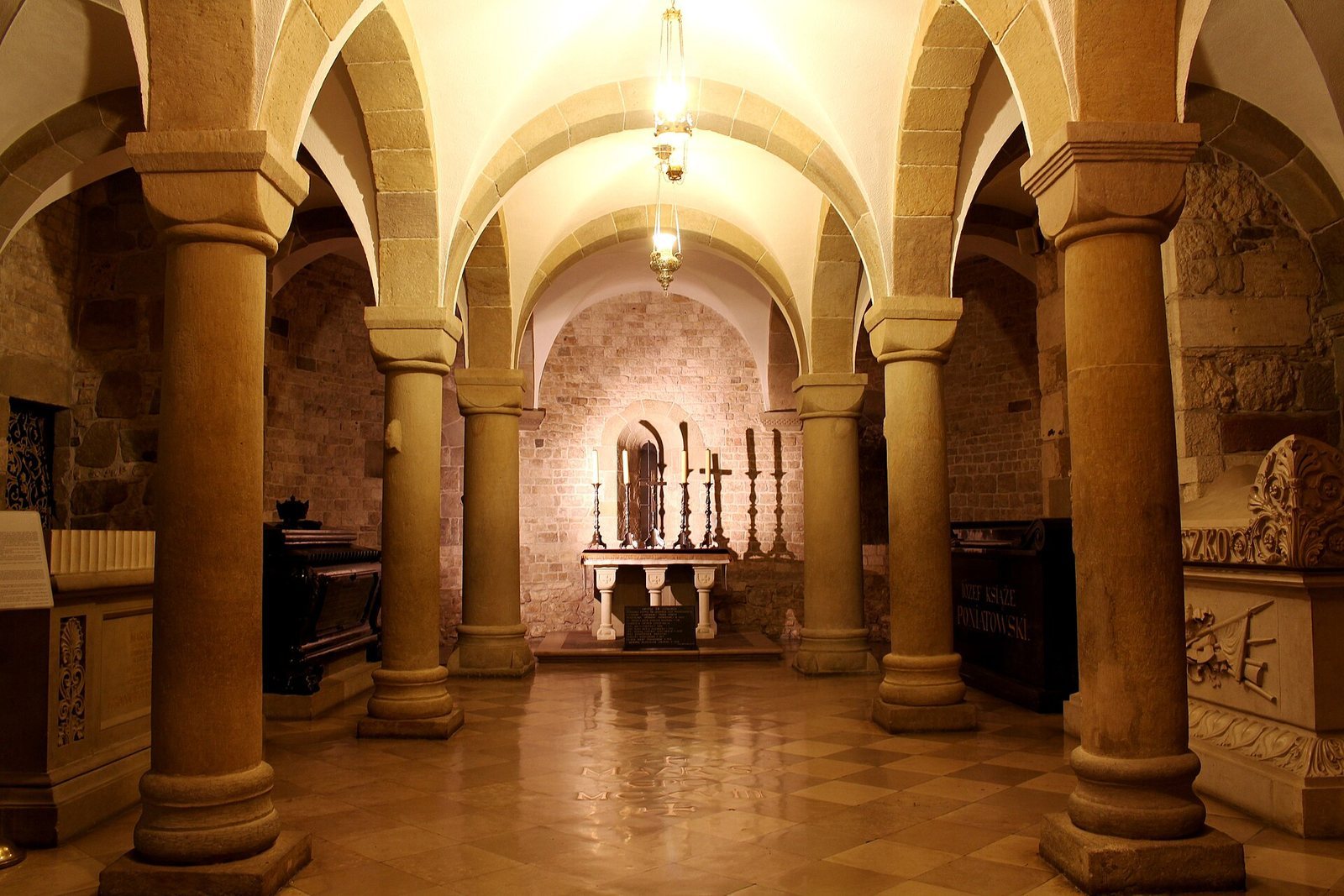
The crypt is regarded as the best-preserved Romanesque interior in Poland. Its rectangular space has three aisles, separated by eight short stone columns. The columns have roughly finished bases and simple semicircular capitals, and support cross vaults formed by intersecting vaulted sections. Transverse arches span between the supports and emphasize the vaults’ substantial construction. Large, carefully dressed stone blocks give the interior an austere, monumental character.
Remains of the earlier cathedral
Other remains associated with the earlier cathedral include the foundations of the Clock Tower and the lower wall sections of the Silver Bell Tower. A cathedral chapter seal from the 13th century depicts the earlier building. The crypt itself is also part of the surviving remains of that cathedral.
Altar and sarcophagi
The altar was made in the 19th century to a design by French architect Eugène Viollet-le-Duc, known for his work on medieval architecture. Sarcophagi (stone coffins) in the crypt are associated with Michał Korybut Wiśniowiecki, John III Sobieski, Marie Casimire, Józef Poniatowski, Tadeusz Kościuszko and Władysław Sikorski.