Löfstad Castle: A Swedish Seventeenth-Century Manor and Museum


Site at a Glance
- Rating
- 4.3
- Popularity
- Medium
- Country
- Sweden
- Primary era
- Early Modern
- External website
- Open
- Eras represented
- Medieval, Early Modern
- Civilizations
- Swedish
- Site type
- Domestic
- Remains
- Castle
On this page8 sections
History
Löfstad Castle, also spelled Lövstad, is a seventeenth-century Swedish manor house in Kimstad parish, near Norrköping. Built in stone between approximately 1638 and 1660 for Field Marshal and Count Axel Lillie and his wife Christina Mörner, it became the centre of an estate with medieval roots and remains a museum preserving the interiors associated with its last private owner.
Medieval Estate and the Lillie Family
The estate’s name appears in written records from the fifteenth century, including entries dated 1422, 1429, and 1478. Earlier forms included “loeffstadhe” and “Læpstadhum”. The spelling Löfstad appeared in Suecia antiqua et hodierna in the 1720s, while modern maps also use Lövstad. Jöns of Loeffstad, named in a parchment document from 1478, is the oldest known owner. The estate had belonged to the Lillie family since at least 1510.
The earlier manor was probably arranged around a square courtyard. After its main building was destroyed, the western range continued to serve as a residence until the 1650s. Axel Lillie and Christina Mörner then commissioned the stone castle that survives today. During construction, the plans were changed and the main building was lengthened by about seven metres at both ends. Christina Mörner received Löfstad as a morning gift, a form of marriage settlement.
Seventeenth- and Eighteenth-Century Changes
A substantial modernization followed in the 1670s and 1680s under the architect Mathias Spihler. A three-window-axis projection was added to contain a staircase, the towers were raised, and the roof was changed to a mansard form, with two slopes on each side. The painted decoration of the courtyard facade was covered with limewash. A fire in 1750 resulted in the installation of a new roof in the style of the period, after which the exterior remained substantially unchanged.
The castle is depicted in Erik Dahlbergh’s Suecia antiqua et hodierna and in an oil painting from the first half of the eighteenth century. Its later owners included members of the De la Gardie and von Fersen families, followed by the Piper family. Sophie von Fersen, who was married to Count Adolf Ludvig Piper, inherited Löfstad. Ownership then passed to their son Carl Fredrik Piper and later to Charles Emil Piper.
The Piper Family and Museum
Charles Emil Piper’s daughter Emilie Piper became Löfstad’s last private owner. The interiors were preserved in the condition associated with her death in 1926. After the death of her sister Sophie, who had no descendants, the castle passed by testament in 1940 to Riddarhuset, Sweden’s historic institution representing the nobility, and the Östergötland Antiquities and Museum Association, now represented by Östergötlands Museum.
Löfstad opened as a museum in 1942. Riddarhuset owns the castle and its associated land, while the furnishings belong to Östergötlands Museum. The castle is protected as a Swedish cultural-heritage monument, or byggnadsminne, a legally protected historic building or site.
Remains
The Castle and Courtyard
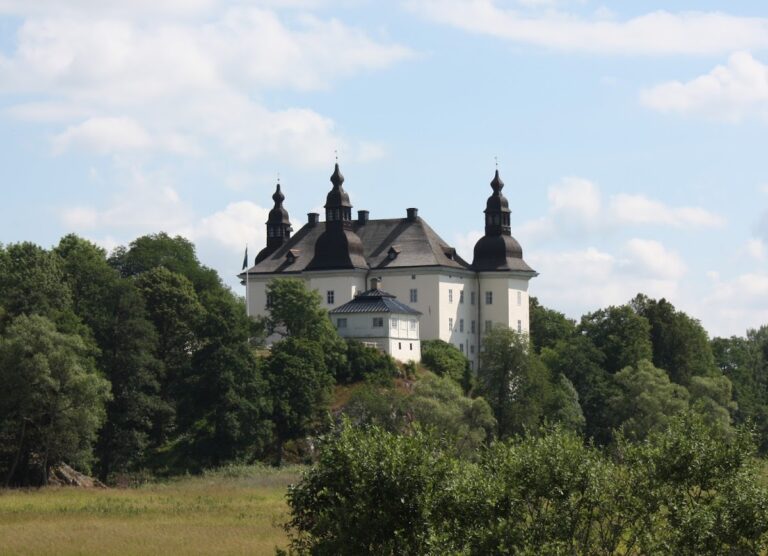
Löfstad Castle stands on elevated ground near Lövstadsjön, surrounded by a garden and an English landscape park established around 1800. The building consists of a central main block with three storeys on the courtyard side and an additional partly below-ground souterrain storey toward the park. Two long, two-storey wings extend from it and end in towers.
The original seventeenth-century design had a high gabled roof with stepped gables, painted decoration on the courtyard facade, and an external staircase leading to the principal floor. The later alterations replaced the roof with a mansard form, raised the towers, and inserted the three-window-axis projection for the staircase. The courtyard paintings were later covered with limewash. Portals, a sandstone frieze, and a banquet hall survive from the seventeenth-century fabric.
The Former Manor
The earlier manor stood west of the castle, on the site of the present agricultural buildings. It probably formed a square courtyard with a main building that contained a cellar and two single-storey stone wings. Traces of the main building’s cellar have been found, while the eastern range survives externally in medieval form.
Park and Interior Collections
The English landscape park contains a marble memorial to Marshal of the Realm Axel von Fersen the Younger, erected by his sister Sophie von Fersen. The present interior is predominantly later in date, but it has been preserved in the condition associated with Emilie Piper’s death in 1926. The castle also contains a library of approximately 5,000 volumes and a collection of paintings, chiefly portraits of the owners and their relatives.