St.-Laurentius-Kirche: A Romanesque Evangelical Lutheran Church in Langwarden


Site at a Glance
- Rating
- 4.3
- Popularity
- Very Low
- Country
- Germany
- Primary era
- Medieval
- External website
- Open
- Eras represented
- Medieval, Early Modern, Modern
- Civilizations
- German, Holy Roman Empire
- Site type
- Religious
- Remains
- Church
On this page11 sections
History
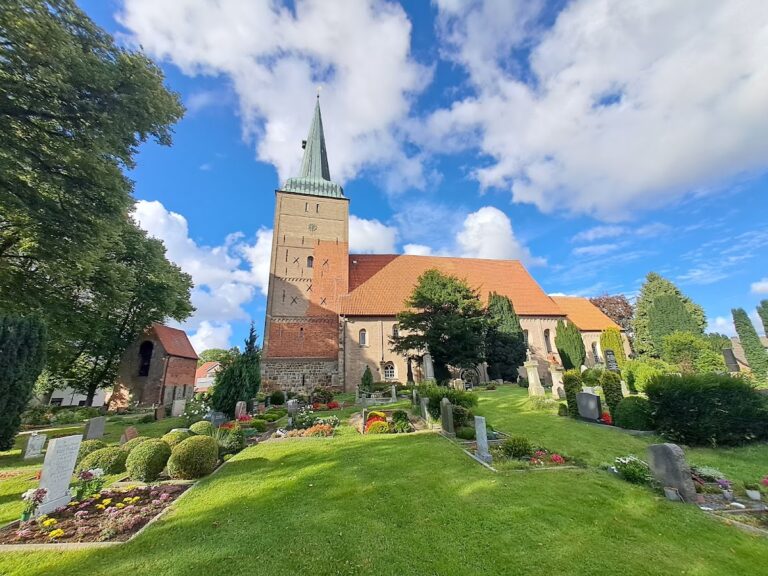
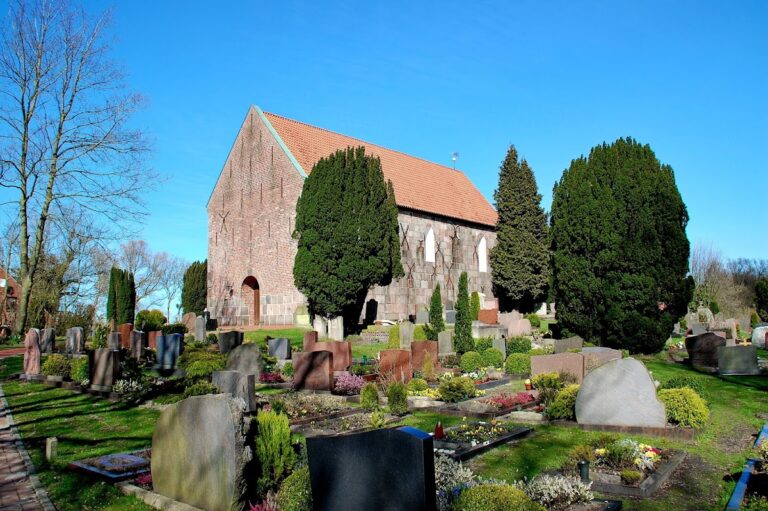
St.-Laurentius-Kirche is an Evangelical Lutheran church in Germany, situated on a Warft, a raised settlement mound built in low-lying coastal regions to protect buildings from flooding, in Langwarden, Lower Saxony. Built around 1150 in the Romanesque style, a medieval architectural tradition known for massive masonry, round-headed arches, and relatively small openings, it is a protected historic monument. The church is dedicated to Saint Laurence, a third-century Christian martyr traditionally associated with service to the poor and church charity. Its congregation now belongs to the Wesermarsch church district of the Evangelical Lutheran Church in Oldenburg.
Romanesque origins and nineteenth-century reduction
The original building was a cross church constructed from tuff, a porous volcanic stone. Its scale eventually proved too large and expensive for the small congregation to maintain. In 1844, both transepts were demolished, the eastern gable was rebuilt, and the apse was given its present form. The surviving structure therefore combines a medieval Romanesque core with a substantially altered nineteenth-century plan.
The 1903 rebuilding
In 1903, the nave was shortened by seven metres at its western end. Material recovered from the alteration was used to construct the present slender, three-storey bell tower after the remains of the former tower had been removed. This work established the exterior arrangement that characterizes the church today.
Seventeenth-century artistic furnishings
The interior contains a major group of seventeenth-century furnishings connected with the workshops of Ludwig Münstermann, a prominent North German sculptor and altar-maker, and Onno Dircksen. Münstermann’s pulpit dates from 1633. The altar retable, the ornamental structure forming the backdrop or upper part of an altar, was made in 1652 after Münstermann’s models and is attributed to Dircksen. Other furnishings from this period include a confessional from 1656, also attributed to Dircksen’s workshop, and an epitaph for Pastor Melchior Mejer.
The historic organ and bells
The organ was probably built in 1650 by Hermann Kröger and his master journeyman Berendt Hus. A carving on the case confirms its date, and the organist of St. Lamberti Church in Oldenburg inspected and accepted it in the following year. Arp Schnitger overhauled the instrument in 1704 and 1705, adding three mixture stops to the three divisions, replacing one reed stop, and revising the others. Gerhard Janssen Schmid removed the Schnitger stops in 1818, while Alfred Führer restored the original specification in 1934. The Führer company restored the organ in three stages between 1978 and 1983, and Hendrik Ahrend restored it in 2015, reconstructing seven lost stops.
The church bell cast by Ghert Klinghe in 1468 cracked in 1930 and could no longer be used. A smaller bell made by Rincker has hung in the tower since that time. The historic bell was placed in front of the church in 2000.
Remains
Church fabric and former crossing
The surviving church retains a Romanesque core of tuff. Its north wall preserves the original arrangement of narrow pilaster strips, vertical strips that articulate a wall, beneath a terminating arched frieze. The former crossing remains visible on the exterior through the northern arch, positioned between the stumps of the demolished transept walls. These wall remnants now resemble buttresses. Because the south wall was rebuilt, the corresponding southern crossing arch can be seen only inside the church. The interior has a flat ceiling.
Galleries and painted decoration
Galleries run along the entire north wall and stand in front of the blocked opening of the former south transept. Their balustrades carry painted scenes from the Old and New Testaments, with most compositions based on illustrations in the Merian Bible, richly illustrated editions associated with the seventeenth-century artist and engraver Matthäus Merian the Elder.
Altar and pulpit
The 1652 altar retable has a lower section, or predella, whose sides project strongly and display frontal reliefs of Christ’s Entry into Jerusalem, the Last Supper, and the Raising of Lazarus. Busts of the first Protestant pastors occupy the sides. Two horizontally oval donor portraits lead to the main tier, where a narrow central image presents a fully three-dimensional group of Christ on the Mount of Olives.
Three Evangelists, Matthew, Mark, Luke, and John being the traditional authors of the four canonical Gospels, and Saint Paul support the main entablature as human architectural figures finished to resemble marble. The open arches of the outer wings contain Martin Luther and Pastor Melchior Mejer. The figure now representing Mejer originally depicted Philipp Melanchthon. Above the centre, a flat rectangular box rests on the entablature like a canopy and represents the Ark of the Covenant, a motif associated with Münstermann’s altars. Figures of the Crucified Christ and the Risen Christ crown the ensemble. Münstermann’s 1633 pulpit was originally richly decorated, but its ornament was removed in the early nineteenth century.
Older furnishings and memorials
A sacrament house built around 1500 depicts the Jesse Tree, a Christian image tracing Christ’s descent from Jesse, the father of King David. The shaft of the baptismal font, dated 1664, represents the Tree of Knowledge. The confessional beside the altar dates from 1656 and is attributed to Onno Dircksen’s workshop, as is the epitaph for Pastor Melchior Mejer.
Organ and bells
The organ has 21 stops divided between two manuals and a pedal. Its keyboards use a short octave, an early keyboard arrangement with a reduced lowest octave. Fourteen stops survive from 1650, and its original spring chests, the wind-chest mechanisms that supply pipes with air, remain in place. The instrument is regarded as the oldest organ in the Oldenburg region and as one of the important North German Baroque organs. It also preserves one of the few surviving instruments by Berendt Hus, who taught Arp Schnitger, and records the development of organ building before Schnitger’s work.
The historic bell outside the church has a diameter of 168 centimetres. The Rincker bell in the tower is smaller, with a diameter of 32 centimetres.