The Collegiate Church of St. John the Baptist in Cantiano, Italy
Site at a Glance
- Popularity
- Very Low
- Country
- Italy
- Primary era
- Early Modern
- Eras represented
- Early Modern, Modern
- Civilizations
- Papal States
- Site type
- Religious
- Remains
- Church
On this page15 sections
History
Foundation and collegiate status
The Collegiate Church of St. John the Baptist is the principal Catholic church of Cantiano, Italy, in the Diocese of Gubbio. A collegiate church is served by a chapter, a body of canons, and is not necessarily a cathedral. The church replaced the earlier parish church of San Giovannino, meaning Little Saint John, and was built to receive an image of Christ bound to a column. Worshippers at a rural chapel in Colsecco had credited the image with granting graces since 1605 and revered it as miraculous.
Ulderico Carpegna, bishop of Gubbio, consecrated the church and opened it for worship in 1631. On 17 January 1661, Pope Alexander VII granted it collegiate status and established a permanent chapter, led by an archpriest, a senior priest with supervisory duties, and comprising six canons. Their assigned offices included theologian, penitentiary, responsible for confession and penance, master of ceremonies, church-fabric officer overseeing upkeep, and chamberlain with administrative duties.
Recognition and modern changes
In 1721, Pope Clement XI raised the church’s standing by naming it a “Distinguished Collegiate Church” in a papal bull, a formal document issued by the pope.
On 29 October 1980, a roof truss above the central nave collapsed, and the church closed. Restoration, advanced through the efforts of then-archpriest Fausto Panfili, continued for five years. The church reopened for worship on Christmas night in 1985, when Bishop Ennio Antonelli of Gubbio presided at a solemn Mass.
From the late 2000s into the early 2010s, archpriest Claudio Crescimanno rearranged the furnishings around the main altar and sanctuary to recover the church’s earlier liturgical character. A later parish priest reinstated an arrangement developed after the Second Vatican Council, the Catholic Church’s gathering held from 1962 to 1965. This arrangement was regarded as closer to ordinary Roman Rite practice, the principal liturgical tradition of the Latin Church, but as less attentive to the church’s historical, artistic, theological, and liturgical character.
Remains
Plan and exterior
Plan and interior
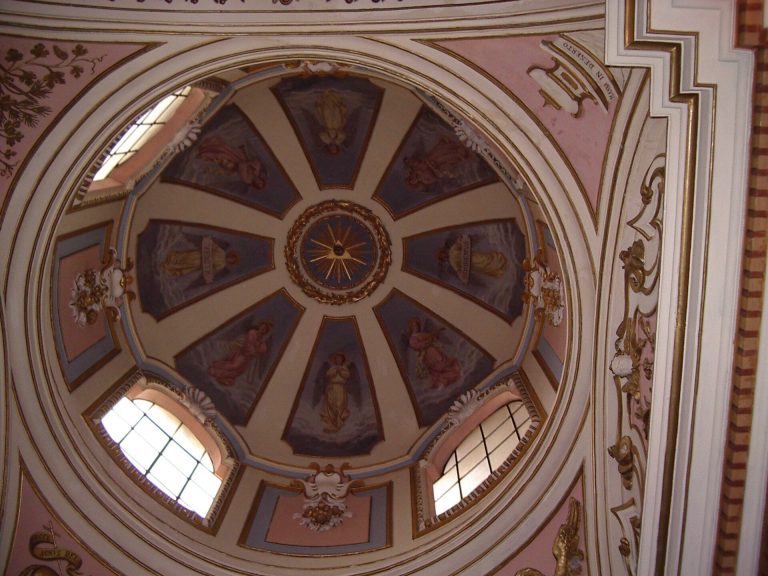
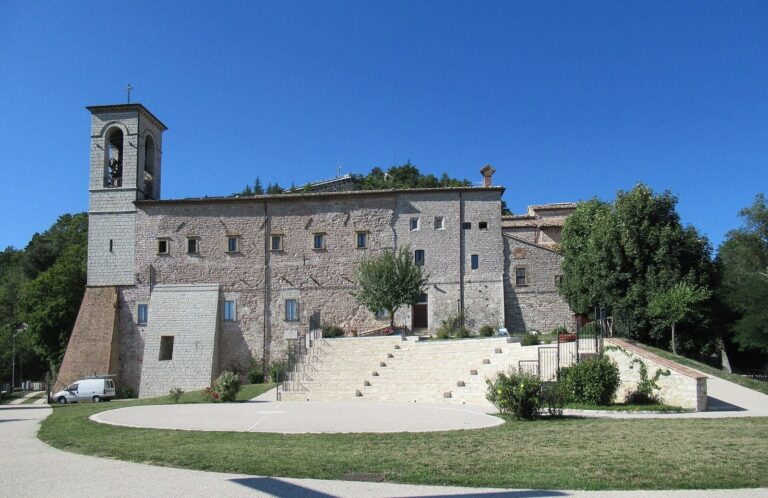
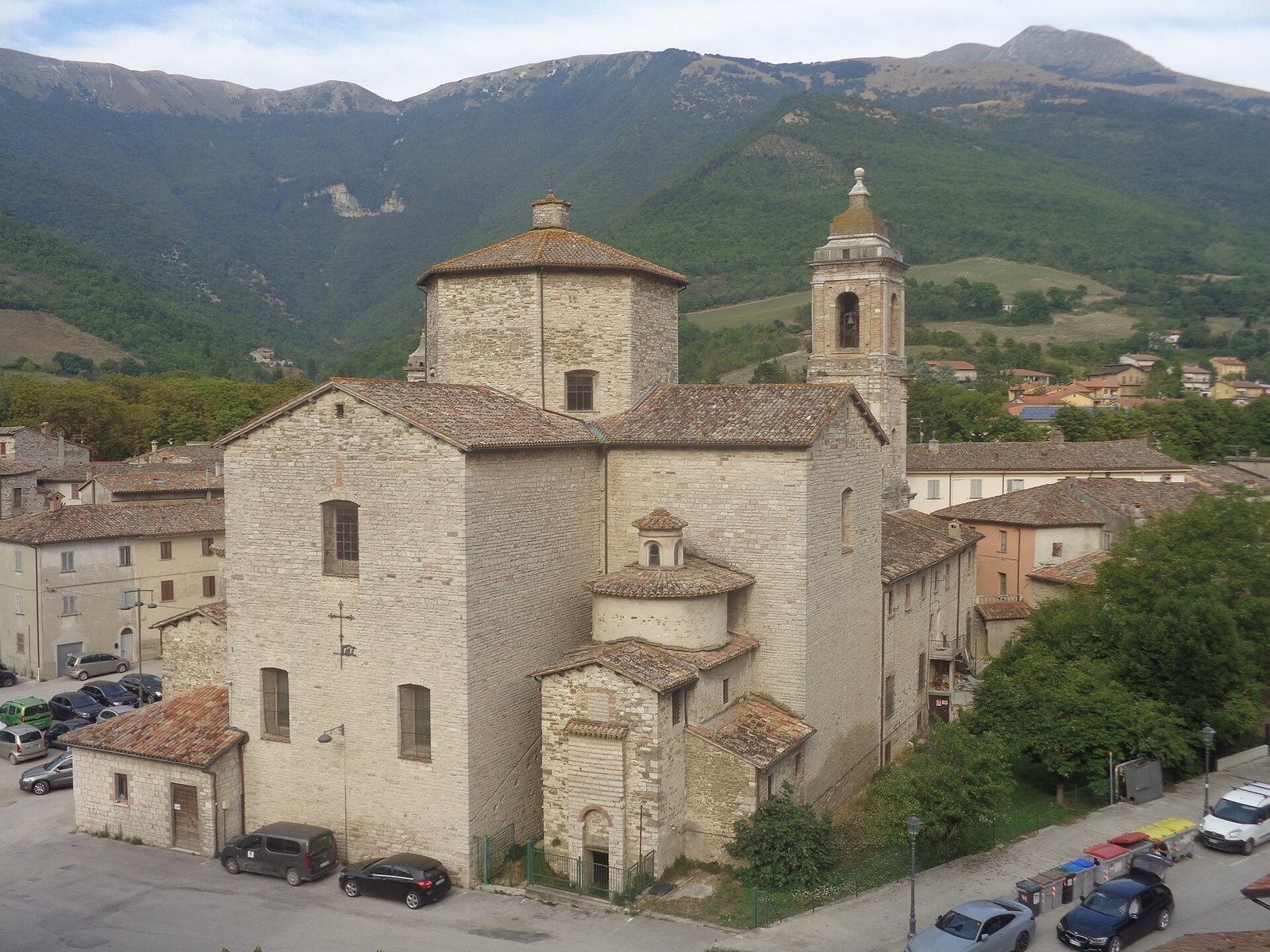
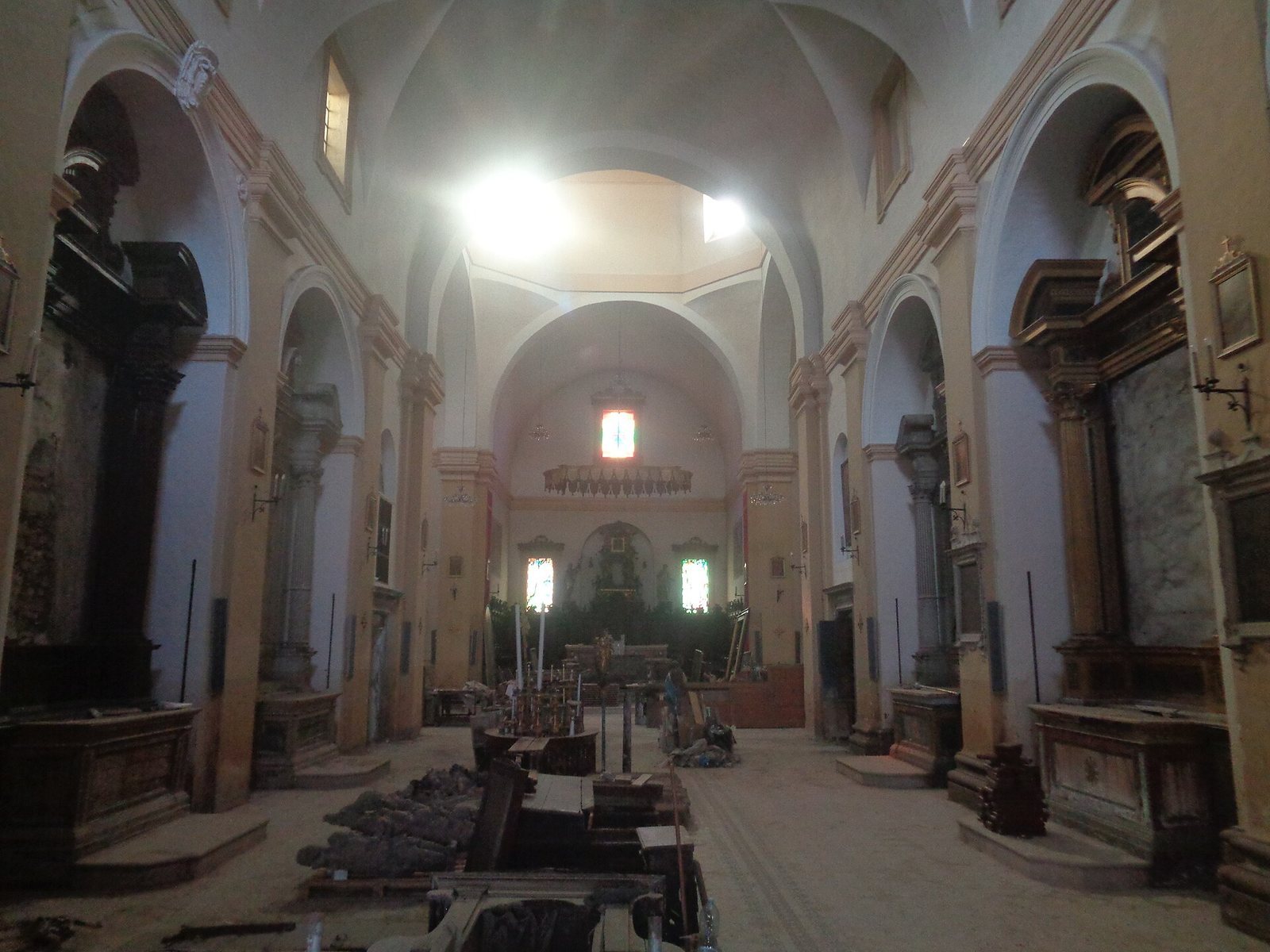
The church follows a Latin-cross plan, with a long central nave crossed by a transverse arm called the transept. The single large nave has a barrel vault, a continuous arched ceiling, and six side altars. An octagonal dome rises above the crossing, topped by a lantern, an upper structure that admits light. The apse, the rounded or polygonal end of the church, contains the central altar and wooden choir stalls. Each arm of the transept has a side chapel and an altar at its end.
Facade and bell tower
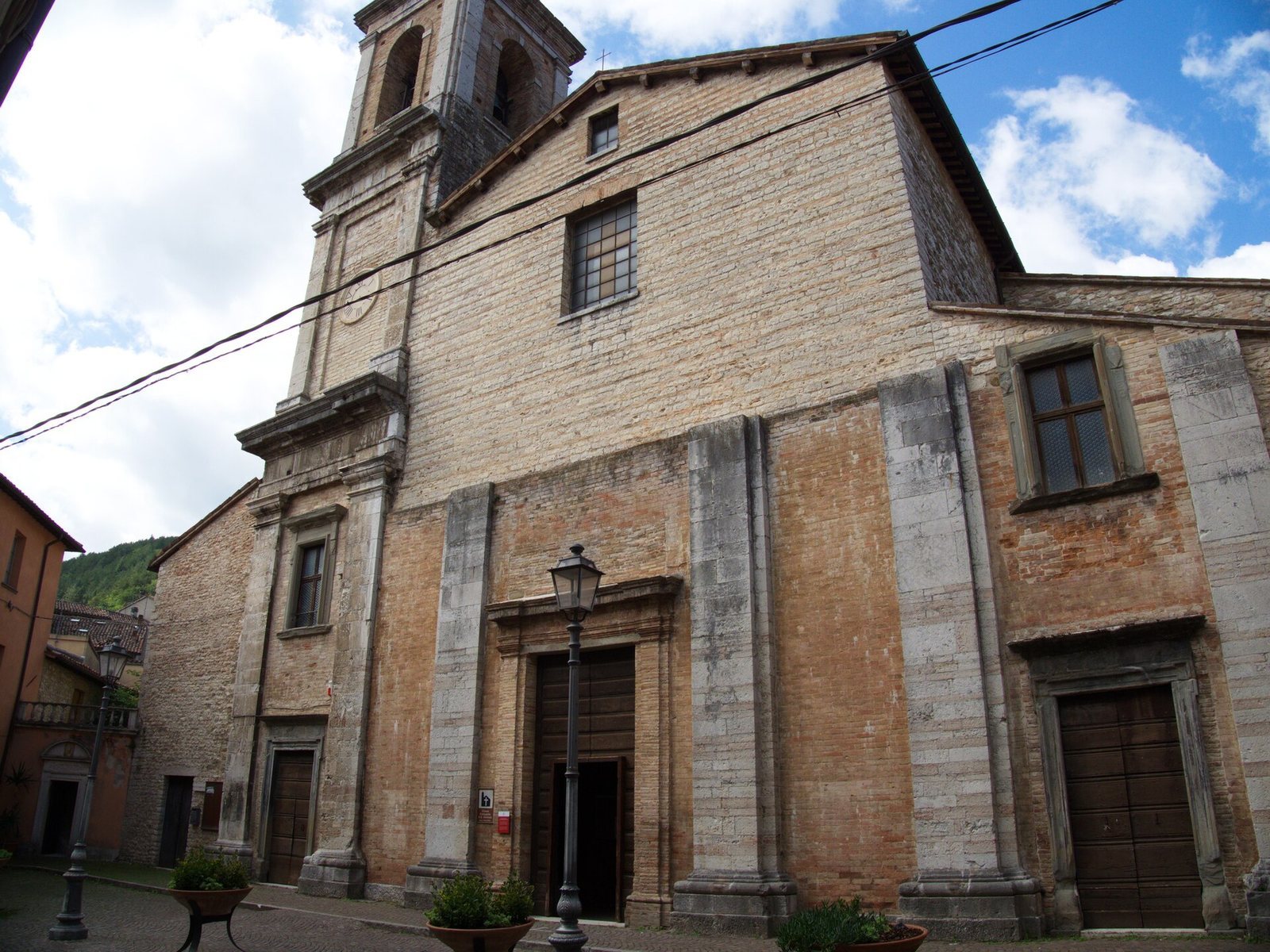
The facade is made of Umbrian terracotta and has a peaked upper profile. A bell tower stands on its left. The front remains incomplete compared with architect Anton Francesco Berardi’s design, which called for two symmetrical towers.
Paintings and devotional works
Seventeenth-century altar paintings
Three seventeenth-century paintings made for altars are attributed to Francesco and Flaminio Allegrini. They depict the Virgin with St. Jerome and other saints, the Annunciation, and the Nativity of Mary. The brothers came from Cantiano and also worked in Rome as painters to the papal court during the second half of the seventeenth century.
Transept paintings
An altar painting of St. Charles Borromeo in the left arm of the transept is attributed to the Venetian painter Claudio Ridolfi. Opposite it, the right transept holds a seventeenth-century Last Supper by Ventura Mazza of Cantiano, who studied under Federico Barocci, an Italian Renaissance painter. Another canvas, also attributed to Ridolfi, shows the transfer to Loreto of the Holy House, believed in Catholic tradition to be the Virgin Mary’s house, together with St. Andrew.
Painting in the Fabi Chapel
The Fabi Chapel altar holds a painting of the Virgin and Child known as the Madonna of Mercy. Gaetano Lapis of Cagli made it in the first half of the eighteenth century.
Madonna of the Goldfinch
A fifteenth-century circular painting of the Virgin and Child with the young St. John is known as the Madonna of the Goldfinch. Its wooden frame is gilded and decorated with fruit and foliage. For centuries the painting was attributed to Eusebio di Giacomo, also called Eusebio di San Giorgio. A plaque inside the church instead credits his teacher, Pietro Vannucci, known as Perugino, a Renaissance painter.
Carved furnishings and organ
Crucifix and choir stalls
The church contains a wooden crucifix dating to the late sixteenth century. Its black-walnut choir stalls, made by local craftsmen, have carved seats and date to 1721.
Organ
Giuseppe Greppi of Rimini made the organ in 1672. It stands in the raised choir gallery above the central door. Andrea Feligiotti of Urbania enlarged and restored it in 1805, and Alfredo Piccinelli carried out a further restoration in 1997.