Chiesa di San Domenico: A Romanesque Catholic Church in Cagli, Italy

Site at a Glance
- Rating
- 4.6
- Popularity
- Very Low
- Country
- Italy
- Primary era
- Medieval
- Eras represented
- Medieval, Early Modern
- Civilizations
- Duchy of Urbino, Papal States
- Site type
- Religious
- Remains
- Church
On this page19 sections
History
Chiesa di San Domenico is a Roman Catholic church in Cagli, Italy, built by the Celestines after the town was transferred in 1289. Its predominantly Romanesque design reflects its medieval origins. Originally dedicated to Saint John the Baptist, the church is now affiliated with the Diocese of Fano-Fossombrone-Cagli-Pergola and remains a place of Catholic worship.
Medieval foundation and later additions
The Celestines, a Catholic congregation within the Benedictine tradition founded by Pietro del Morrone, established the church after the relocation of Cagli. Its structure developed through later additions. The portal was made in 1483, while the campanile, or bell tower, was built in 1654 and the apse followed in 1655.
The church’s medieval painted decoration was covered with plaster in 1576. Later, fragments of the earlier frescoes became visible again, revealing aspects of the building’s medieval artistic history.
Renaissance patronage
Pietro Tiranni commissioned a funerary monument for his wife, Battista, in 1481. He also engaged Giovanni Santi, an Italian Renaissance painter from Urbino and the father of Raphael, to create Christ in the Sarcophagus between Saint Jerome and Saint Bonaventure.
Santi traditionally carried out the frescoes of the Cappella Tiranni, a chapel named for the Tiranni family, in the early 1490s, before his death in 1494. The nineteenth-century scholar Luigi Pungileoni regarded the chapel as Santi’s principal achievement.
Later religious use
Further changes shaped the church during the early modern period, including the construction of six altars between the sixteenth and seventeenth centuries and the creation of new paintings and fresco cycles. Pope Pius XI opened the Scala Santa, or Holy Staircase, beside the crypt during a Holy Year. The staircase is understood in Catholic devotional practice as a sacred or penitential stairway.
An underground room beside the apse includes a partially collapsed passage or tunnel. Together with the crypt, the room and passage form part of the church’s subsurface architectural history.
Remains
Facade and overall plan
The church stands on Via Lapis in Cagli’s historic center. Its predominantly Romanesque form has a single nave, a circular apse, and an east-oriented crypt, while the principal entrance is placed on the west. The western facade is smooth and carries a large cornice made from the same white stone as the walls.
Renaissance portal
The entrance is marked by a Renaissance portal dated 1483 and built in two tones of stone. Above it is a rose window that has since been blocked. The portal provides a later Renaissance element within the church’s predominantly Romanesque exterior.
Nave and side altars
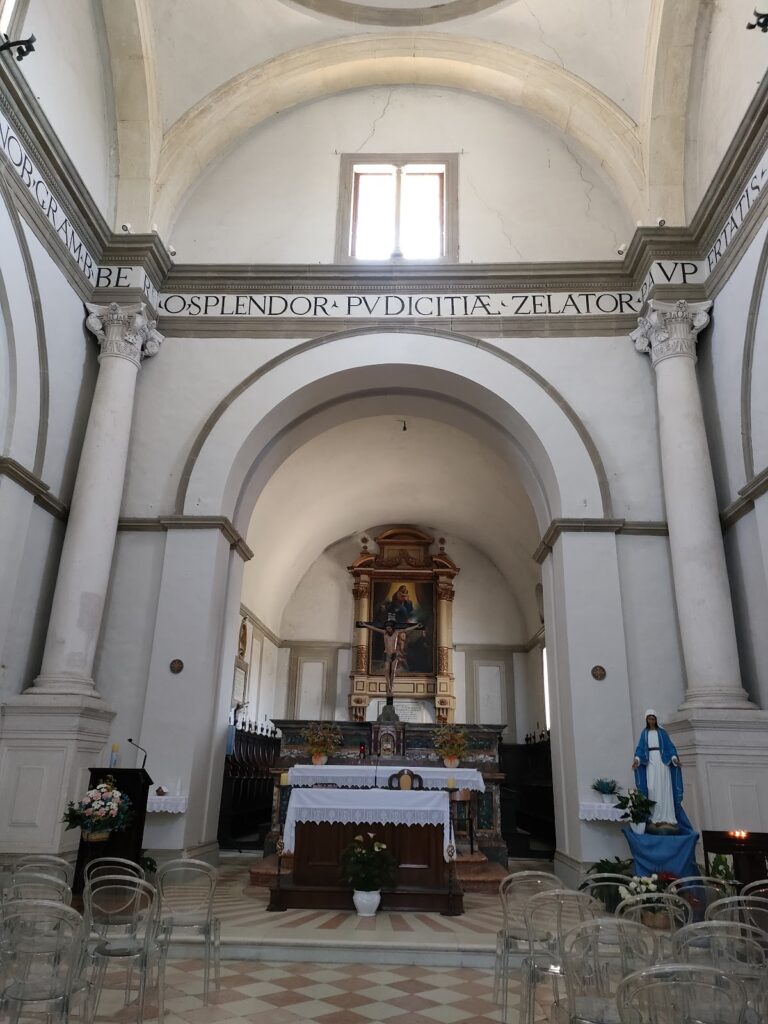
The nave is covered by a double-pitched roof supported by large exposed wooden trusses. Six altars were constructed at different times between the sixteenth and seventeenth centuries, creating a sequence of devotional and artistic features along the interior.
First altar on the left
The first altar on the left contains Miracle of Soriano, a first-half seventeenth-century altarpiece by an anonymous painter of the Neapolitan school. Beside it stands Pietro Tiranni’s 1481 funerary monument for Battista, accompanied by Giovanni Santi’s fresco Christ in the Sarcophagus between Saint Jerome and Saint Bonaventure.
Cappella Tiranni
The second altar on the left forms the Cappella Tiranni, the major work traditionally associated with Giovanni Santi. Beside the chapel is a case containing a fragment of a fresco showing the head of Saint Sebastian, attributed to Santi.
Third altar on the left
The third altar on the left bears the coats of arms of the Della Rovere, an Italian noble family that became the ruling dynasty of the Duchy of Urbino. A fragment of the church’s medieval decoration survives there, alongside a twentieth-century wooden statue of the Madonna of the Rosary in a niche. Nearby, fourteenth-century frescoes emerge beneath the plaster layer applied in 1576.
Presbytery and choir
Apse and main altar
At the center of the apse is the seventeenth-century altarpiece Vision of Saint Hyacinth, painted by an anonymous artist of the school of Federico Barocci. Barocci was a leading painter of the late Renaissance and early Baroque periods associated with Urbino.
Presbytery paintings
To the left of the main altar is a late-sixteenth-century painting of the Virgin and Child with Saints Anthony and Leonard and God the Father. Its style combines Mannerist features, including elongated forms and complex compositions, with influences from the painting traditions of the Low Countries.
A fresco of the Annunciation on the side of the presbytery is attributed to Timoteo Viti, a painter associated with the artistic milieu of Urbino. Another attribution identifies Girolamo Genga, while a later one assigns the work to Viti with the collaboration of Giuliano Presutti, who may have painted God the Father in the lunette.
Right-hand altars and organ
The third altar on the right contains the seventeenth-century altarpiece Salvator Mundi and Dominican Saints. The second right-hand altar holds the eighteenth-century oil painting Christ Showing His Side to Saint Catherine of Siena. The first altar on the right contains Gaetano Lapis’s eighteenth-century altarpiece The Presentation in the Temple.
Near the choir is an organ made in 1853 by Carlo Carletti of Fabriano.
Crypt and underground spaces
Crypt
A staircase beside the Cappella Tiranni leads to the spacious crypt. Seven square pillars made from dressed stone blocks support its groin vaults, which are formed by the intersection of two barrel vaults. Lesenes, or shallow vertical strips of masonry, articulate the walls, while pointed arches connect the supports.
The crypt contains a fresco cycle attributed to Antonio Viviani, an Italian painter active from the late sixteenth into the early seventeenth century. The cycle depicts the Circumcision, Nativity, Visitation, and Annunciation. A small tombstone on the floor marks the remains of Father Michele Arcangelo Nanni of Cagli, who died in the seventeenth century with a reputation for sanctity.
Room beside the apse
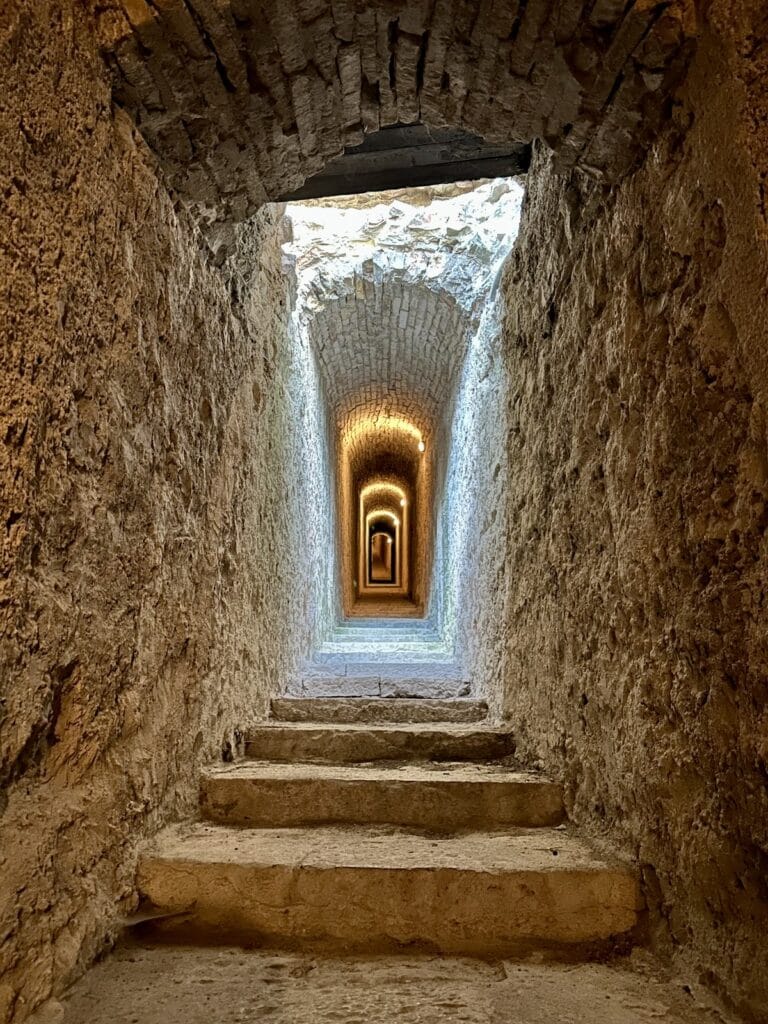
Beside the apse is a room covered by a barrel vault. Its former entrance was an arch that is now blocked. A partially collapsed underground passage is visible in the rear wall.
Scala Santa
The Scala Santa is located beside the crypt. Its name means Holy Staircase, reflecting its role as a sacred or penitential stairway in Catholic devotional practice.