St. John’s Abbey: A Benedictine Monastery in Colchester
Site at a Glance
- Rating
- 4.5
- Popularity
- Very Low
- Country
- United Kingdom
- Primary era
- Medieval
- External website
- Open
- Eras represented
- Medieval
- Civilizations
- Anglo-Saxon, English, Norman
- Site type
- Religious
- Remains
- Fortified Monastery
On this page18 sections
History
St. John’s Abbey was a Benedictine monastery in Colchester, United Kingdom, founded by the Norman royal steward Eudo Dapifer in 1095 and developed in the late eleventh and early twelfth centuries. Dedicated to St. John the Baptist, it stood south of the walled town beside the road to Mersea Island. The monastery became an abbey in 1104 and remained an important religious, landed, and political institution until its dissolution in 1539.
Before the monastery
The site already contained a Saxon church dedicated either to St. John the Baptist or St. John the Evangelist. It was associated with a tradition of miraculous voices, and Siric or Sigeric was its final priest at the time of the Domesday Survey. The church was built from reused Roman rubble and had three cells. Excavations in the 1970s showed that it stood on a former Roman cemetery. An earlier interpretation identified it as a martyrium, a Christian structure linked with the memory of a martyr, but that explanation was later rejected.
After the Norman Conquest, the takeover of England by William, Duke of Normandy, in 1066, the site came into the possession of Eudo Dapifer. As steward to William I and William II, Eudo was closely connected with the new Norman royal administration. He later claimed to have witnessed a miracle at the church in 1095 and used the event as the basis for establishing a Benedictine monastery. Because he was a lay founder, the institution initially operated as a priory rather than an abbey.
Foundation and early development
The monastery’s outline was marked out on 29 August 1096, and building work continued until 1115. Eudo was traditionally said to have laid the first stone. The first monks came from the diocese of Rochester under a leader named Ralph, but they returned after a disagreement with Eudo over the authority of the new house. Abbot Stephen of York then sent thirteen monks from York. Their arrival roughly coincided with Pope Paschal II’s grant of abbey status on 10 January 1104. Hugh, the monks’ leader, became the first abbot after his ordination by the Bishop of London.
Eudo died at Préaux in Normandy in 1120. His remains were brought back to England and buried at St. John’s Abbey on 28 February, alongside those of his wife, Rohais, the daughter of Richard Fitz Gilbert. The abbey’s possessions expanded through a series of royal and ecclesiastical charters. A charter of 1104 confirmed the manors of Weeley and Pitsea, a four-day fair at Colchester held for the feast of St. John, churches at Leatherhead and St. Mary Woolchurch in London, other lands and tithes, and liberties equivalent to those of Westminster. A charter of 1119 added the manor of Mundon and the church of Nieweseles at Barkway in Hertfordshire.
A charter from the reign of William II confirmed grants associated with Eudo and mentioned Brightlingsea, Weeley, Great Hallingbury, Lillechurch, St. Mary Woolchurch, and Leatherhead. Brightlingsea and Great Hallingbury may later have been partly revoked, since they do not appear in the charters of Henry I. Lillechurch remained an abbey possession until the reign of King Stephen, when it was exchanged for land in East Donyland. Henry II later granted the abbey St. Helen’s Chapel in Colchester and a two-day fair held for the feast of the Invention of the Cross.
Rebuilding after the fire
A major fire that affected much of Colchester in 1133 severely damaged the monastery. The rebuilding that followed involved extensive landscaping and a change in the arrangement of the complex. The offices and monks’ quarters were moved from the north side to the south side, while the abbey church was reconstructed on a cruciform plan, meaning that its main length was crossed by transepts to form the shape of a cross.
Lay worshippers were excluded from the abbey church, so a separate parish church was built for the community connected with the monastery. St. Giles’s Church was constructed between 1133 and 1171, replacing the original St. John’s Church. The earlier church was demolished down to its foundations and covered with material from the landscaping. St. Giles’s stood in its own precinct immediately north of the principal monastic enclosure.
About 1170, the abbey received a vial believed to contain the blood of Thomas Becket. Ralph, a monk who had stayed at St. John’s during Becket’s exile, was said to have witnessed Becket’s murder in Canterbury and collected a few drops of blood. According to the tradition surrounding the relic, the vial began to overflow miraculously after arriving at Colchester. It became the monastery’s most treasured relic, and people attributed supernatural healing powers to it.
Lands, dependencies, and charitable foundations
The abbey’s estates included Wickham Skeith, Greenstead manor and church, Little Bardfield, Ardleigh, Boxted, Berechurch, East Donyland, Takeley, Walkern, Hamerton, Aldeburgh, and Hemingstone. Its churches included St. Giles, St. Leonard, St. Nicholas, Holy Trinity, St. Stephen Walbrook, and St. George at Norwich. The monastery also owned Bourne Mill, a water mill on a brook south of Colchester. Henry III granted fifteen oaks for building improvements in 1235.
St. John’s founded a small dependent cell at Writtle called Bedemannesberg, under the monk Robert. Henry II confirmed its possession and granted the monks permission to gather nuts in the surrounding royal forest, on condition that two monks remained there permanently to pray for the king and deceased kings. The abbey also received Snape Priory near Aldeburgh. Its prior and monks remained under the obedience of the abbot and paid an annual pension of half a mark. The abbot was expected to visit twice each year with twelve horses for four days, or more often when necessary.
Eudo also founded St. Mary Magdalene’s Hospital on the road between Colchester’s walled town and its port as a leper hospital at the request of Henry I. The abbey supported it with a grant of £6 from its manor at Brightlingsea. Later, the hospital petitioned Parliament over the abbot’s attempts to control its administration. He demanded its charters and common seal and expelled its master, Simon de la Naylonde, and William de Langham. A subsequent inquest found the abbot innocent of the reported abuses.
Conflict with Colchester and religious discipline
The monastery became involved in prolonged disputes with the townspeople of Colchester during the thirteenth, fourteenth, and fifteenth centuries. It also experienced repeated, sometimes violent, conflicts with the Augustinian St. Botolph’s Priory across the road. In 1253, forty Colchester men destroyed the abbey’s gallows and tumbrels at Greenstead and cut the ropes of its ships at Brightlingsea. The dispute concerned free warren in West Donyland and the extent of the abbot’s jurisdiction. The matter was settled by 1255, although the king ordered the abbot in 1270 to stop distraining Colchester men for bread-and-ale offences outside his authority.
An anti-abbey riot broke out during the Midsummer Fair of 1272 on St. John’s Green. On the following day, the monks brought a body before the coroner and claimed that it was one of their members killed by townspeople. The investigation found that the body belonged to a criminal who had been taken from the town gallows and placed on the Green in an attempt to discredit Colchester’s burgesses.
An episcopal visitation in 1310 found that the monks were failing to observe several Benedictine requirements. These included silence, abstinence from meat except during illness, and stabilitas, the principle that a monk remained attached to the monastery where he had professed rather than moving freely between religious houses. The abbot was also frequently reprimanded for mismanagement, despite holding the right to sit in the House of Lords.
In 1346, the abbot acquired and then sold in London a French prisoner named Berengar de Monte Alto, who was said to be the archdeacon of Paris and had been captured at the Battle of Crécy. This action defied the king’s writ ordering that the prisoner be detained. The Black Death, the devastating plague pandemic that caused extremely high mortality across fourteenth-century Europe, reached Colchester in the winter of 1348 to 1349. As many as 1,500 people died before the outbreak declined in August 1349, including the abbot and prior of St. John’s Abbey. During the fourteenth century, the abbey also pleaded poverty to avoid obligations to the Crown.
The rivalry with St. Botolph’s Priory became particularly serious when the abbot reported to the pope that two hundred supporters of the priory had attacked the monk Thomas Stuckele, besieged the abbey, forced their way inside, and injured the abbot and convent. The cause was not recorded, although it may have involved a pension from St. Peter’s Church in Colchester. The dispute was settled the following year.
Revolt, privilege, and politics
During the Peasants’ Revolt in June 1381, rebels attacked the abbey and carried away its court rolls. The walls and gatehouse were strengthened afterward. In 1391, twelve armed horsemen from the abbey fought townspeople near Colkynge’s Castle, now Balkerne Gate, over grazing rights. A separate conflict between the abbot and his own monks reached St. John’s Green outside the abbey gate in 1392.
John Colschestre, a monk of St. John’s, was appointed bishop of Orkney by Pope Boniface IX in 1396. On 25 February 1399, the pope permitted the abbots of Colchester to wear a mitre and give solemn blessings at the end of Mass and Vespers. The mitre was a ceremonial peaked headdress used by bishops and by abbots granted episcopal-style privileges.
In 1404, the abbot was accused with other leading Colcestrians and the abbot of St. Osyth’s Priory of conspiring to restore the deposed Richard II. He was acquitted in 1405, but legal actions brought by Colchester burgesses continued until 1415. Henry V later censured the abbey for building a defensive tower on royal land. Arguments over the Hythe water mill and other jurisdictional claims continued. In 1429 and 1430, the abbot called Colchester a “nest of Lollards” and claimed that the town owed £228 in arrears for payments to the abbey infirmary. He was also required to pay arrears because he and his predecessors had failed for 130 years to provide a chaplain for Mass three days a week at St. Helen’s Chapel, as a judgment of 1290 required.
The abbey maintained strong pro-Plantagenet and Yorkist sympathies during the Wars of the Roses, the civil conflicts between the rival branches of Lancaster and York. It was closely associated with John Howard, 1st Duke of Norfolk, a Yorkist supporter and constable of Colchester Castle. Howard intervened in the elections of John Canon in 1464 and Walter Stansted in 1468. Richard III visited Colchester several times in 1467 and 1468 and stayed at the abbey.
During the brief Lancastrian restoration of 1470 and 1471, Howard used the abbey’s chartered sanctuary. After the Yorkist defeat at Bosworth Field, the monastery sheltered Yorkists including Viscount Lovell and possibly Richard of Shrewsbury, Duke of York. Its earlier political sympathies were also reflected in a large bequest from Cecily Neville, the mother of Edward IV and Richard III.
Dissolution and the end of the monastery
Henry VII appears to have distrusted the abbey after the Tudor victory, although he stayed there during a visit to Colchester. Catherine of Aragon also stayed at the monastery in 1515. By 1534, divisions had emerged between monks who supported and opposed Henry VIII. Intervention by Thomas Audley, Lord Keeper of the Great Seal, allowed the abbey to survive the first phase of the Dissolution of the Monasteries, Henry VIII’s suppression and seizure of England’s monasteries during the 1530s and 1540s.
The final abbot, John Beche, also known as Thomas Marshall, refused to surrender the abbey to Henry VIII. He was taken to the Tower of London, tried at Colchester before a jury headed by the Earl of Essex, convicted of treason, and hanged on his own demesne lands on 1 December 1539. The monastery was dissolved that year. The monks received small pensions, and the abbey passed to the Crown. Beche’s pectoral cross was rescued by the Mannock family of Stoke-by-Nayland and later given to Buckfast Abbey in Devon.
After the Dissolution
After the monastery was suppressed, the Crown leased the former abbey to Sir Thomas Darcy. The Lucas family bought it in 1548 and built a large manor house within the old precinct. The abbey church was gradually demolished during the late sixteenth and early seventeenth centuries. St. Giles’s Church was retained as a parish church and became the burial place of the Lucas family.
Stone from the demolished abbey was reused in Bourne Mill, built in 1591, and other fragments were scattered around the former grounds. John Speed’s map of 1607 depicts the Lucas mansion and appears to show the abbey’s central tower, including its lantern window, still standing. During the English Civil War siege of Colchester in 1648, Parliamentarian forces expelled Royalist troops from the abbey grounds after prolonged fighting. The Lucas mansion was destroyed, together with St. Giles’s Church, parts of the old precinct wall, and sections of the abbey gate. Sir Charles Lucas, one of the Royalist commanders, had been born at the Lucas manor in the former abbey grounds.
The War Office bought the grounds from the Baring family in 1860, and the land became part of Colchester Garrison. Abbey Fields, south of the former precinct and formerly part of the garrison grounds, preserves the abbey’s name. Excavations by Colchester Archaeological Trust in 2010 rediscovered the abbey church. The excavated building measured approximately 90 metres in length, making it longer than the church of nearby St. Botolph’s Priory.
Remains
The monastic precinct and church
St. John’s Abbey occupied a walled precinct of approximately 13 acres. The abbey church, the abbot’s residence, the chapter house, and other associated buildings stood within this enclosure. A chapter house was the room where the monastic community met to hear rules, conduct business, and make disciplinary decisions. The precinct wall enclosed the north, east, and west sides, while the southern side was apparently open toward the countryside. Sections of the wall survive along Mersea Road, although substantial portions were demolished in the 1970s.
Abbey church
The rebuilt abbey church had a cruciform layout, two western towers, and a low central tower above the crossing of the transepts. A large cylindrical roof lantern crowned the central tower. The building had about seven bays, or repeating structural divisions, and at least two chapels attached to its southern side. Its foundations were rediscovered in 2010, when the church was found to have been approximately 90 metres long. Many of the other monastic buildings have not been archaeologically identified, but contemporary descriptions and images allow part of the church to be reconstructed.
The church contained one of medieval Colchester’s two clocks, the other being at St. Leonard’s-at-the-Hythe. Its religious furnishings included an image of the Blessed Virgin Mary with a sanctuary lamp, a lamp kept burning near a holy altar or image, and the vial regarded as the blood relic of Thomas Becket. The relic’s place in the church connected the building’s material remains with one of the abbey’s most important devotional traditions.
Construction materials
The abbey and its associated buildings were probably made largely from Roman rubble quarried from the ruins of Roman Colchester. Lime kilns found at the site were used to make mortar by baking oyster shells and are associated with the building work. Reused Roman material therefore formed part of the construction process from the monastery’s earliest phases.
Entrance and parish church
Abbey Gate
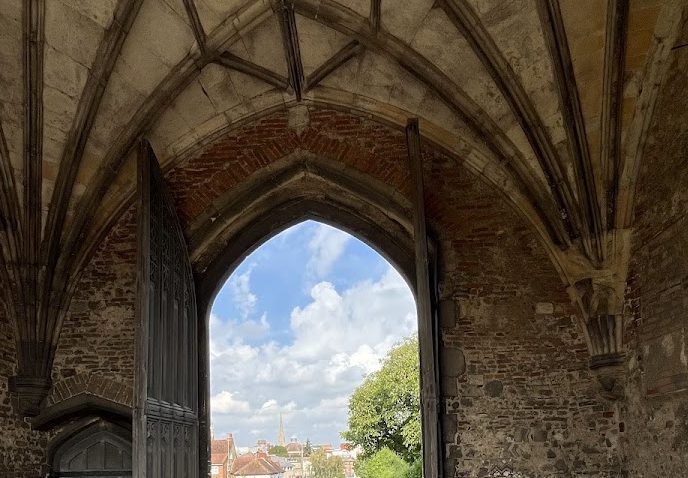
The Abbey Gate formed the principal entrance from St. John’s Green into the monastic precinct. It is an elaborate gatehouse and the principal substantial surviving remnant of the abbey complex. Parts of it were destroyed during the siege of Colchester in 1648, but the gatehouse still stands around the former grounds.
St. Giles’s Church
St. Giles’s Church stood immediately north of the main abbey precinct in a separate enclosure. It served the lay community associated with the monastery after the rebuilding of the abbey church. Its site included an early lay burial ground containing numerous graves lined with Roman rubble. The church suffered heavy damage during the 1648 siege and was rebuilt afterward. Its surviving site is now Colchester’s Mason Centre.
Later fabric and surviving evidence
The post-Dissolution Lucas manor house occupied part of the former monastic grounds. The precinct wall and Abbey Gate were retained around the old enclosure, while fragments of the abbey church were reused in Bourne Mill and other pieces remained scattered across the former precinct. The archaeological foundations, surviving wall sections, gatehouse, reused masonry, and early plans and images together preserve evidence for a complex that was otherwise largely demolished.
Seal and ceremonial objects
The abbey’s circular seal measures three inches in diameter. On its front, St. John the Baptist sits in a canopied niche, holding the Agnus Dei, the Christian symbol of the Lamb of God, on a plaque and pointing toward it. Saints Peter and Paul occupy smaller niches at the sides. Beneath them is a shield bearing the abbey’s arms, a cross within a border overlaid by an escarbuncle of eight staves ending in fleur-de-lis. An escarbuncle is a heraldic pattern formed from radiating ornamental staves. The inscription identifies the common seal of the monastery of St. John the Baptist at Colchester.
The reverse shows St. John the Evangelist seated in a canopied niche, holding a chalice containing a dragon and a palm branch. Angels occupy the side niches. In the outer penthouses, further angels hold shields bearing the quartered arms of France and England and the abbey’s own arms. Beneath them, an abbot kneels under an arch, with additional figures in niches.
At the Dissolution, the abbey’s plate weighed 2,244 and one-quarter ounces. The treasury also contained two mitres decorated with silver and gilt, small seed pearls, and imitation stones or glass. Some of the fittings on these ceremonial headdresses were incomplete when the monastery was dissolved.
Nearby sites