St Augustine’s Abbey: An Anglo-Saxon Foundation and Norman Benedictine Monastery


Site at a Glance
- Rating
- 4.5
- Popularity
- Medium
- Country
- United Kingdom
- Primary era
- Medieval
- External website
- Open
- Eras represented
- Medieval
- Civilizations
- Anglo-Saxon, English, Norman
- Site type
- Religious
- Remains
- Monastery
On this page16 sections
History
St Augustine’s Abbey in Canterbury, United Kingdom, was founded in 598 by the Anglo-Saxon king Æthelberht of Kent for Augustine of Canterbury and his monks. The foundation began as a monastery and burial place on the traditional site of a pagan temple, and its first church was later rebuilt in solid masonry in the early Christian period.
Foundation and early Christian centre
Augustine had arrived in England in 597 as the missionary sent by Pope Gregory I to convert the Anglo-Saxons. Æthelberht’s Christian wife, Bertha, already worshipped as a Christian, while the king continued to use the temple precinct that traditionally became the monastery site. Æthelberht granted the land for a church and monastic residence outside Canterbury’s eastern walls, intending it also as a burial place for abbots, archbishops, and the kings of Kent.
The foundation date of 598 was preserved by the fourteenth-century abbey chronicler William Thorne. The first monastic buildings were probably timber, but the church was constructed in solid masonry after them and was completed and consecrated in 613. Around 624, Æthelberht’s son and successor Eadbald founded a second church dedicated to Saint Mary east of the monastery, also planning it as a burial place for Kentish royalty.
After Augustine’s death, the monastery became known by his name. For about two centuries it was the only major religious house in the kingdom of Kent. It developed into a centre of missionary work and education, combining religious and secular learning with a substantial library and a scriptorium, the workshop where manuscripts were copied and produced.
Benedictine reorganisation and Norman rebuilding
Dunstan, Archbishop of Canterbury from 959 to 988, reorganised the monastery according to the Benedictine rule, a system of monastic discipline based on the Rule of Saint Benedict. He enlarged the buildings and rebuilt the church. In 978 he added Saint Augustine to the original dedication to Saints Peter and Paul, establishing the name by which the abbey was subsequently known.
Danish invaders spared the abbey. In 1027, King Cnut transferred all the possessions of Minster-in-Thanet to the community, including the preserved body of Saint Mildred. Belief in the relic’s miraculous power drew pilgrims from across Europe, and their offerings increased the abbey’s wealth.
After the Norman Conquest of 1066, William the Conqueror respected the abbey’s ecclesiastical property, but its Anglo-Saxon buildings were completely reconstructed as a Norman Benedictine monastery. By 1100 the earlier structures had been replaced by a Romanesque complex. A major fire in 1168 caused further rebuilding and destroyed many of the abbey’s earlier historical records.
Medieval expansion and royal connections
From about 1250, the abbey entered a period of considerable wealth and building activity. Its income came from estates, royal associations, levies, and benefactors. Royal visits and large banquets brought prestige but also heavy expenditure, contributing to serious debts.
The medieval works included a rebuilt cloister, refectory, and kitchen, together with an abbot’s lodging and great hall. In the early fourteenth century, the abbey acquired land for a cellarer’s range, a brewhouse, bakehouse, and walled vineyard. The cellarer managed the monastery’s food supplies and provisioning. A Lady Chapel was also built east of the church.
Abbot Thomas Fyndon rebuilt the abbey gatehouse between 1301 and 1309. The chamber above the entrance served as the monastery’s state bedchamber. Charles I and Queen Henrietta Maria stayed there in 1625 after their marriage at Canterbury Cathedral, while Charles II and the Dukes of York and Gloucester stayed there in 1660 during their journey to London.
In the 1360s, Juliana Leybourne, a fourteenth-century landowner and noblewoman traditionally identified as Countess of Huntingdon, funded St Anne’s Chapel. She endowed the abbey with the manor of Dene in Thanet and established a chantry, an endowed institution for continuing prayers for the dead. After her death, she was buried in the chapel alongside the tombs of the abbots of Bourne and Colwell.
Dissolution and the former royal residence
On 30 July 1538, during the English Reformation, royal commissioners received the abbey’s surrender. The Reformation was the sixteenth-century transformation of England’s religious institutions under the Crown, including the break with papal authority and the dissolution of monasteries. The last abbot and the monks departed, and the abbey’s lands, buildings, goods, and other possessions passed to the Crown, ending more than 940 years of monastic presence.
During Henry VIII’s reign, some buildings were converted into a royal residence. Other parts were dismantled from 1541, and their materials were sold or reused, including stone sent to the fortifications of the Pale of Calais, the English-held territory around Calais in France. The library’s approximately 2,000 manuscripts were destroyed, and the treasury was plundered.
The former royal residence continued to be used intermittently and was leased to successive aristocratic occupants. Elizabeth I visited and stayed there in 1573. After Lord Cobham’s attainder for treason in 1603, the property was granted to Robert Cecil. From 1612, Edward, Lord Wootton of Marley, leased the residence and employed John Tradescant the Elder to lay out formal gardens. After Wootton’s death in 1626, his widow lived there until 1658.
Decline, restoration, and later use
After Lady Wootton’s death, Sir Edward Hales and his son, also Sir Edward Hales, possessed the property and dismantled buildings for stone used at Hales Place. The precinct was progressively degraded from the eighteenth into the nineteenth century. A brewery operated there from 1770 to 1844, part of the property was divided and sold in 1804, and the Great Court was used for bowling and skittles. Ethelbert’s Tower, the remaining tower of the Norman abbey, was demolished in 1822.
Alexander James Beresford Hope bought the ruins in 1844 after finding their condition deplorable. With other donors, and inspired by the missionary work of Reverend Edward Coleridge, he supported restoration and the construction of a missionary college. The college trained missionaries for the British colonies and also encouraged the excavation and preservation of the abbey.
St Augustine’s Missionary College operated until 1947, although a German Blitz raid on the night of 31 May 1942 badly damaged its buildings and ended its operations. The buildings later housed the Central College of the Anglican Communion from 1952 to 1967 and King’s College London’s theological department for final-year ordination preparation from 1969 to 1976. Since 1976, part of the former complex has been used by the King’s School, Canterbury, for boarding houses and a school library, and the school bought this section in 1994.
The abbey ruins were placed in the care of the British government in 1940 and are now managed by English Heritage. St Augustine’s Abbey forms part of the UNESCO World Heritage Site comprising Canterbury Cathedral, St Martin’s Church, and the abbey, inscribed in 1988. It is also protected as a scheduled monument, while numerous structures within the complex are listed buildings.
Remains
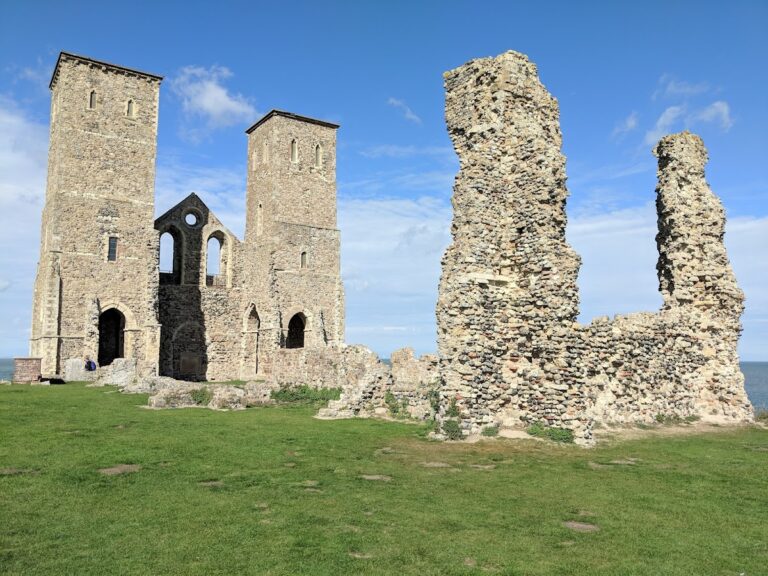
The surviving site combines fragmentary remains of the Anglo-Saxon and Norman churches with later medieval ranges, chapels, and gatehouse structures. The original monastic buildings probably used timber in the Anglo-Saxon building tradition, while Augustine’s first church was a solid masonry building like those he had known in Rome. The ruins preserve the abbey church, the Anglo-Saxon Church of St Pancras, the rotunda and nave of the Church of Saints Peter and Paul, and burial places associated with the earliest Christian community at Canterbury.
Early churches and burial places
Church of Saints Peter and Paul
The Church of Saints Peter and Paul contained the burials of Æthelberht of Kent, Eadbald of Kent, and Eadbald’s consort Emma of Austrasia. Æthelberht’s shrine was later placed above the high altar of the Norman church. The church also received the burials of Theodore of Tarsus, Justus, and Mellitus, while the precinct includes the grave traditionally identified as that of Augustine of Canterbury and graves associated with the early Canterbury archbishops Mellitus, Justus, and Laurence.
Church of St Pancras
The Anglo-Saxon Church of St Pancras forms part of the surviving remains. Its presence preserves a physical element of the monastery’s earliest Christian phase alongside the later rotunda and nave of the Church of Saints Peter and Paul.
Norman and medieval monastic buildings
The Norman rebuilding replaced the Anglo-Saxon complex with a Romanesque Benedictine monastery. Further work followed the fire of 1168, and later medieval construction enlarged the cloister, refectory, kitchen, abbot’s lodging, great hall, cellarer’s range, brewhouse, bakehouse, walled vineyard, and Lady Chapel. The church, cloister, kitchen, and refectory were among the structures engulfed by the deterioration that had overtaken the complex by 1844.
Lady Chapel
The Lady Chapel, also called the Chapel of the Blessed Virgin Mary, stood east of the church. Surviving floor tiles from elsewhere in the church have been relaid on the chapel floor, linking material from the wider church complex with this later medieval chapel.
St Anne’s Chapel
The small square St Anne’s Chapel, also called the Countess’s Chapel, had its own buttresses. It contained the tombs of the abbots of Bourne and Colwell and the burial of Juliana Leybourne, whose endowment supported the chapel and its chantry.
Gatehouse and later precinct
Fyndon Gate
Fyndon Gate, also called the Great Gate, is the rebuilt abbey gatehouse constructed under Abbot Thomas Fyndon between 1301 and 1309. Its upper chamber was the monastery’s state bedchamber. The gate faces the small square known as Lady Wootton’s Green and was so severely damaged by German bombing during the Second World War that it had to be rebuilt.
Lady Wootton’s Green
Lady Wootton’s Green takes its name from Lady Wootton, who lived in the former palace until her death in 1658. Statues of Æthelberht of Kent and Queen Bertha stand in the square in front of Fyndon Gate.
Extensive physical loss followed the dismantling of buildings, removal of stone, demolition, and neglect. The surviving ruins are preserved as historic remains, while part of the former abbey site remains occupied by educational buildings used by the King’s School, Canterbury. Views from the ruins extend toward Canterbury Cathedral.
Nearby sites