St. James’s Cathedral: Riga’s Principal Catholic Church
Site at a Glance
- Popularity
- High
- Country
- Latvia
- Primary era
- Medieval
- Eras represented
- Medieval, Early Modern, Modern
- Civilizations
- Crusader, Holy Roman Empire, Russian
- Site type
- Religious
- Remains
- Cathedral
On this page20 sections
History
A church beyond medieval Riga
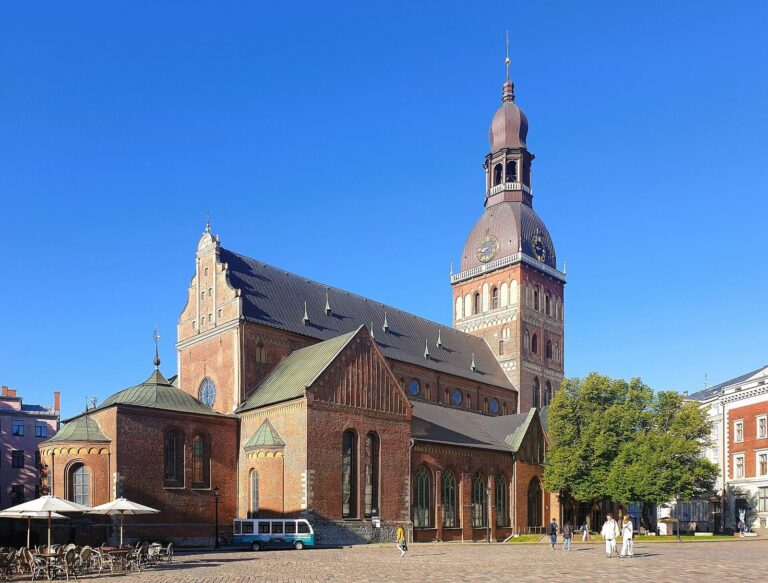
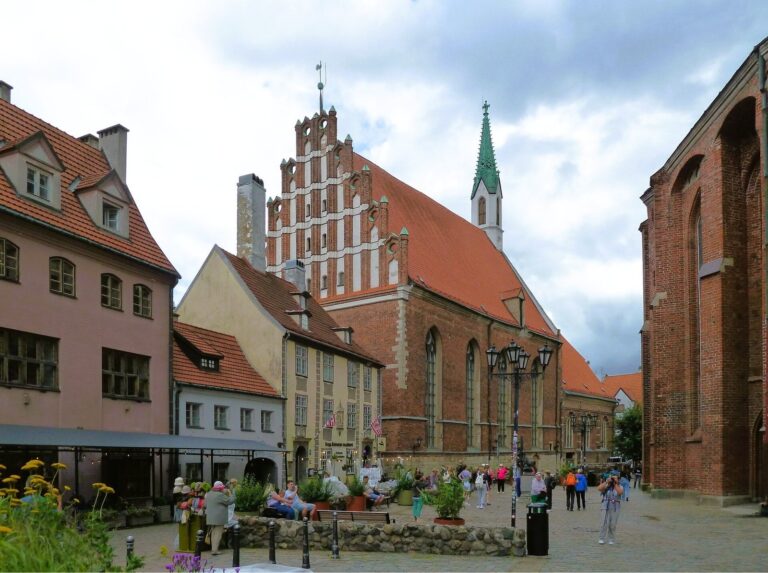
St. James’s Cathedral is a thirteenth-century brick Gothic church in Riga, Latvia, with a design that bridges Romanesque and Gothic forms. It is now the principal Catholic church of Latvia and the cathedral of the Archdiocese of Riga. The church stood beyond Riga’s medieval defenses in a suburb serving the surrounding countryside. It is first recorded around 1225; an inscription on its western façade gives that year as the presumed construction date, and the church was dedicated in 1225.
The church served as a major religious center for Riga’s suburbs. Its congregation included knight-monks of the Livonian Order, a medieval military-religious order that held authority in Livonia, and Cistercian nuns from a nearby monastery founded in 1255. Travelers who reached the city after its gates had closed could receive shelter and spiritual care there. Craftspeople and guilds also worshipped at the church, with guilds maintaining altars and priests devoted to their patron saints. The suburb became part of Riga later in the thirteenth century. On completion, the church belonged directly to the Archbishop of Riga; control passed to the city around 1430.
In the early fifteenth century, construction of the Holy Cross Chapel accompanied the conversion of part of the church into a basilica. The building’s use as a place of worship and community life continued as the city changed around it.
Reformation and Jesuit administration
Lutheran worship began at the church in 1522, when Riga’s council appointed Silvestres Tegetmejers as pastor. In 1523 it became the city’s first church to hold Lutheran services in Latvian, and it had also served as Riga’s second German-language Lutheran church. By 1525 it was the principal church of Livonia’s first Lutheran community. The Lutheran Reformation was a sixteenth-century movement that established Protestant churches.
Anti-Catholic unrest in 1524, part of Riga’s wider religious conflict, devastated the interior and destroyed much of its artistic property. In 1582, after King Stephen Báthory brought Riga under his authority, he returned the church to Catholic use and transferred it to the Jesuits, members of the Catholic Society of Jesus. They established a school connected with the church, where the first books in Latvian were published. Oto Šenkings, bishop of Cēsis, encouraged clergy and nobles to learn Latvian.
Riga’s Calendar Riots of 1584 arose from opposition to the Gregorian calendar, introduced under Pope Gregory XIII to replace the Julian calendar in Catholic territories. During a service, a crowd entered the church, attacked priests, and damaged Catholic furnishings and images. City authorities took control, but the Jesuits resumed management in 1591 and remained until Riga came under Swedish rule.
Swedish and Russian rule
Under Swedish rule, the church became a royal Lutheran church, serving chiefly a Swedish congregation. Services were also held in Finnish and Estonian, and a German Lutheran congregation was established in 1699. In 1621, after Sweden took Riga, King Gustav II Adolf removed the church’s alarm bell and sent it to Stockholm, where it was installed in the Church of Mary Magdalene. The bell had warned the city of floods, fires, and enemy attacks, and had summoned people to public executions. It had sounded in 1605 as forces led by Swedish King Charles IX approached Riga.
During the Russian siege of Riga in 1656, cannonballs struck the church, and some were embedded in its fabric as memorials. From 1675 to 1785, the Royal Lyceum, a secondary school for educating officials for the Swedish administration, operated in the church vestibule. Founded on the basis of the former Jesuit college at the order of Swedish King Charles XI, it taught a humanities-based curriculum. After moving to larger premises at Castle Square in 1785, it was renamed in honor of Peter I. Following the Russian occupation of Riga in 1710, the church became known as the Crown Church, and German-language services continued.
In 1812, Napoleon’s troops used the church to store flour and other food. From June to November, its congregation held services at St. Peter’s Church. The Swedish congregation ended in 1814, and a Latvian congregation was established in 1825. In 1819, a decree abolishing serfdom in Livonia was solemnly read in the church. The Latvian congregation moved to the former Orthodox Church of Saints Peter and Paul in the Citadel in 1918.
Catholic cathedral and present role
The Latvian government assigned the church to the Catholic Archbishop of Riga in 1923 for use as a cathedral, under an agreement with the Vatican. A referendum on transferring churches did not reach the required turnout. The church was reconsecrated on 3 May 1924, when Archbishop Antonijs Springovičs celebrated a Catholic Mass there. Its use changed again during the First World War, when its bells were evacuated to the Russian Empire and lost.
In 1947, Springovičs established a parish intended as a national congregation rather than one defined by territory. It served Latvian Catholics in and around Riga as well as English- and French-speaking Catholics. Pope John Paul II visited in 1993 and renewed devotion to Bishop Meinhard, a missionary and bishop associated with the early spread of Christianity in Livonia and regarded as its apostle. Pope Francis visited in 2018. The cathedral is part of the UNESCO World Heritage Site of Old Riga and is a nationally protected architectural monument.
Remains
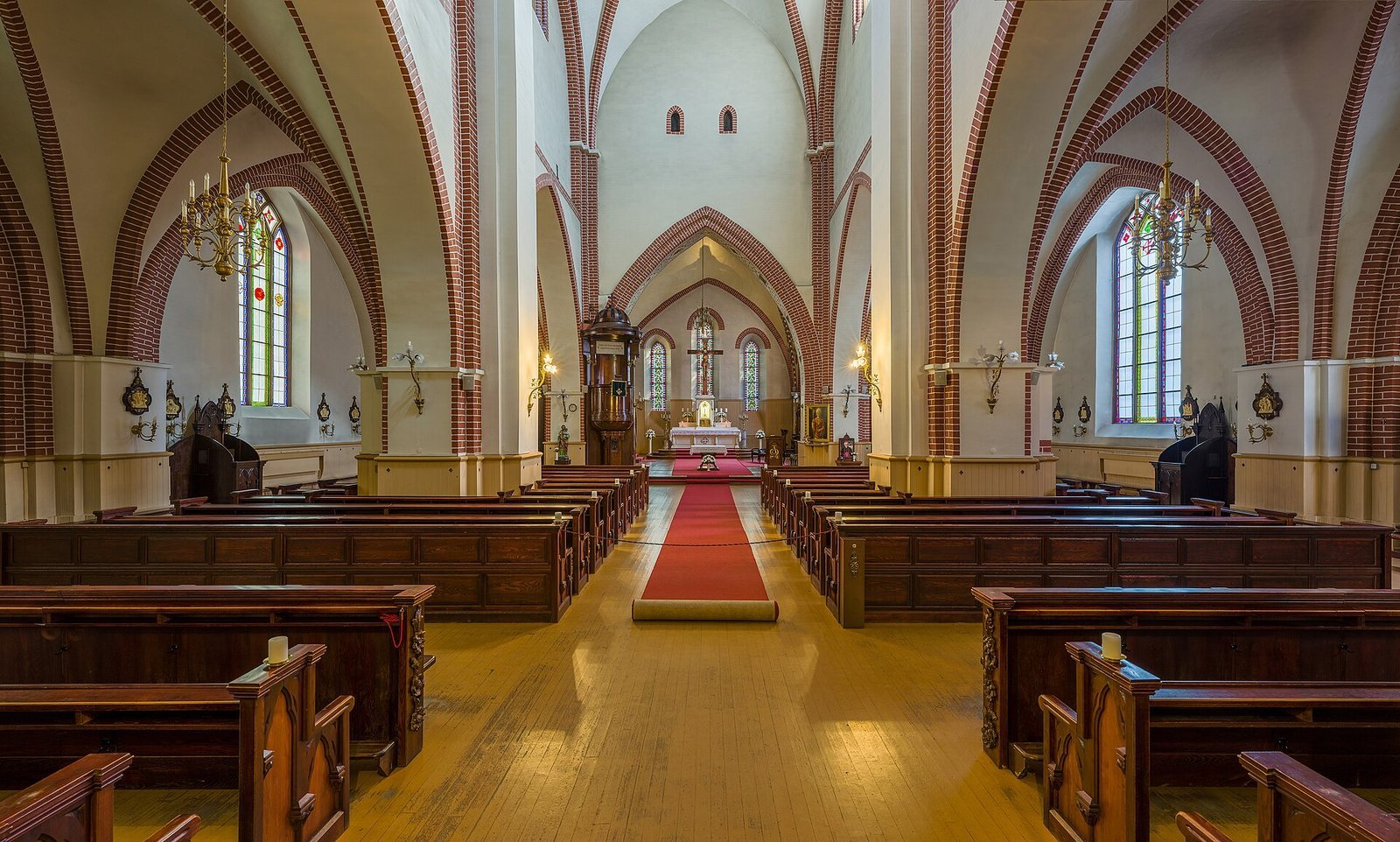
Built of brick, the church is about 50 metres long and approximately 25 metres wide, making it the fourth-largest church in Riga. Its form developed from a hall church into a three-aisled basilica, a church with a central nave and two side aisles. A square-ended choir, a short nave, and a tower above the western part shape its overall plan. The exterior maintains a relatively consistent style, while the interior brings together features from different periods.
Plan and medieval fabric
Choir
The choir has a square plan and is covered by groin vaults, curved ceilings formed where two vaults intersect. These vaults have no ribs, a feature associated with Cistercian architectural influence. Capitals in the choir carry plant ornament, an unusual element in medieval church sculpture in Riga.
Nave and side spaces
The short nave is divided into three bays, or sections, while the main nave is also described as having six equal bays separated by cross vaults and matching cross-shaped columns. A sacristy, a room used by clergy and for church objects, lies on the north side. A pointed arch on that side marks the position of an earlier entrance.
Tower and entrances
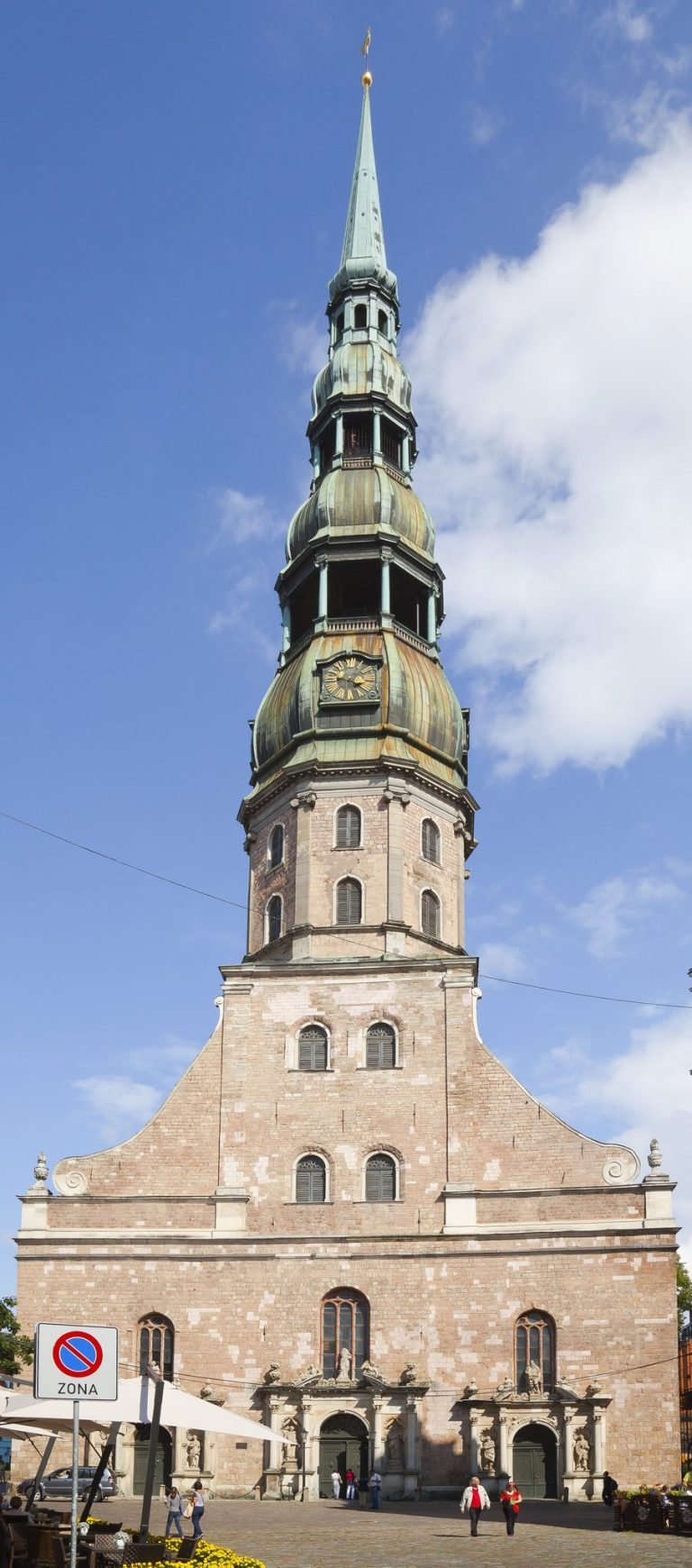
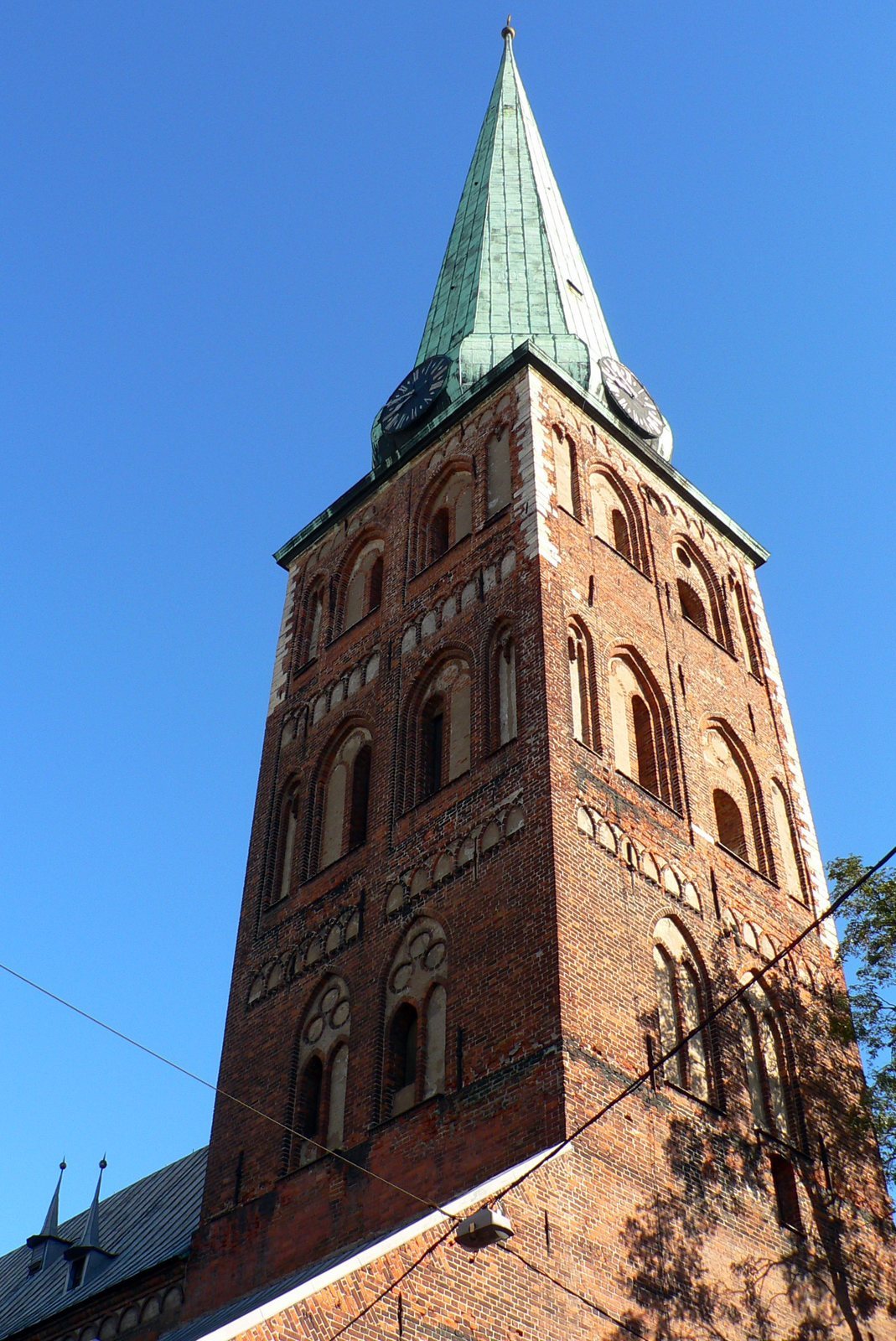
Tower and spire
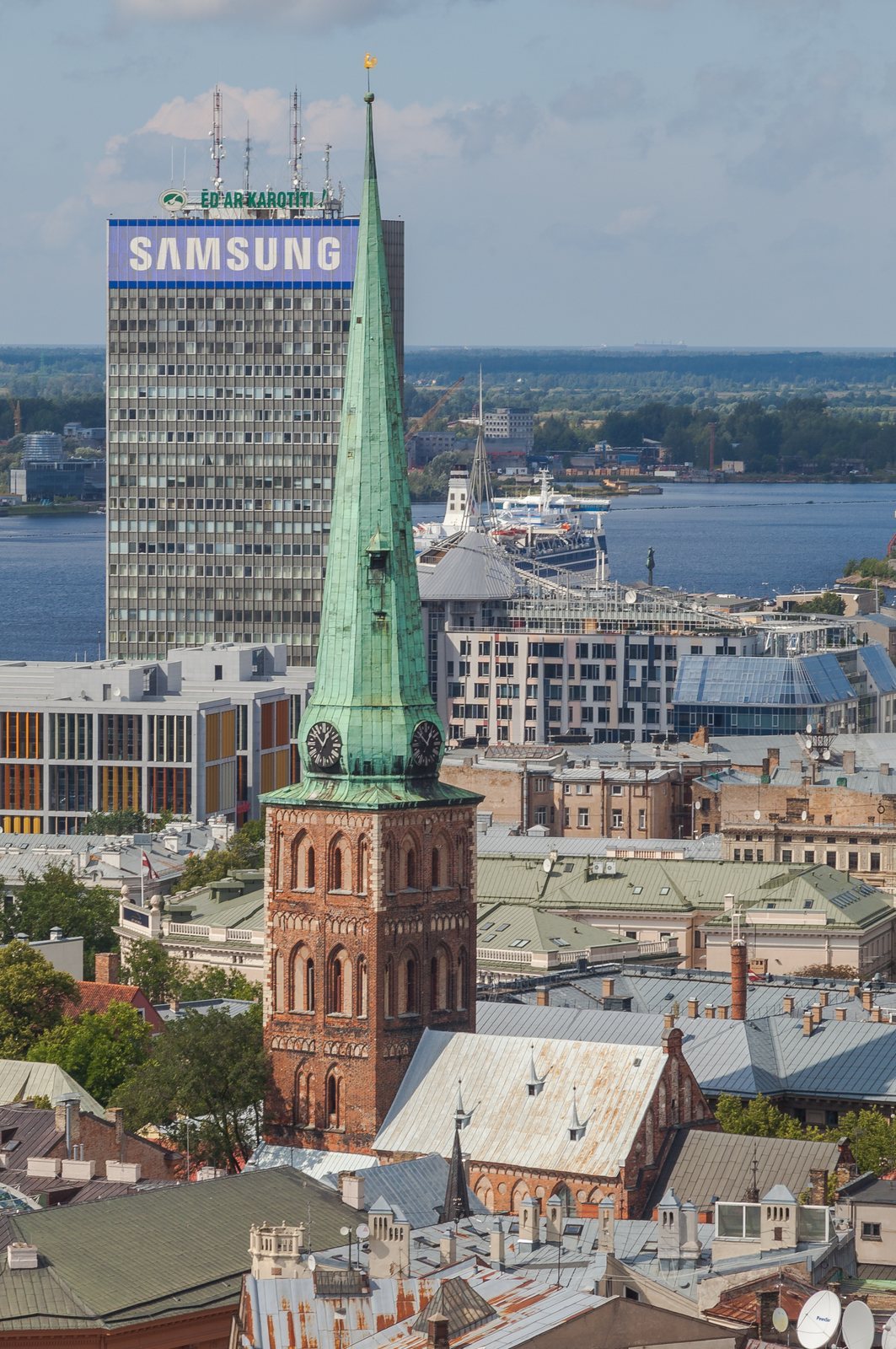
The tower rises above the church’s western section and stands about 80 metres high. Its Gothic spire retains the pyramidal form associated with Riga’s medieval church towers. In 1756, an octagonal, pointed pyramidal spire was added on a Baroque base, and the tower was covered with copper. A rooster weather vane installed on 2 June that year has survived. The tower also held Riga’s oldest clock, installed in 1480; its mechanism was replaced in 1912.
Portals
The main portal was added in 1782. Its inscription translates as, “I will sing of the Lord’s mercies forever.” The former north entrance is indicated by its pointed arch on the north side of the church.
Interior furnishings and decoration
Altars and pulpit
A Baroque altar made in 1680, regarded as the earliest of its kind in Latvia, was dismantled around 1902 and replaced. Its makers are unknown, and carved angels from the altar are now held by the Riga History and Navigation Museum. The replacement altar was made around 1902 by a sculptor and a woodcarver. After the interior was rearranged in 1924, it was moved to a side chapel, then transferred to the Church of St. Mary Magdalene and, in 1997, to a Catholic church in Ogre.
The pulpit, made in 1810 by a master craftsman, is fashioned from a rare red wood. Its surface has inlaid foliage and arabesque designs.
Organ and painted surfaces
Heinrich Andreas Contius built the church’s first organ in 1761. Its wooden façade, painted and gilded in the ornate Rococo style, survives. A new organ was made by E. Martin in 1913. Decorative painting from the fifteenth century was revealed beneath later whitewash in 1886, though its exact date has not been established. A fragment of the original painted vault surface remains visible in the left aisle.
Stained glass and sculpture
Three stained-glass windows made in 1902 in the Art Nouveau style, known for flowing, plant-inspired forms, decorate the choir’s east wall. Their grapevine design, with curling leaves and hanging clusters of grapes, symbolizes Holy Communion. A sculpted religious work known as the Triumphal Crucifix, dated to around 1380–1420, was found in the church attic in 1922. It is considered one of the oldest sculptures in present-day Latvia.
Commemorative features
A plaque commemorating Pope John Paul II’s 1993 visit stands just inside the main entrance, beyond the vestibule. A painting of Saint Meinhard by a Latvian painter hangs to the right of the arch between the nave and choir. Another plaque remembers Father Francis Trasuns, a Catholic priest and political figure associated with Latvia’s national liberation movement.
Burial remains and archaeological finds
Tomb slabs and floor assemblage
A city measure in 1773 prohibited burials inside Riga’s churches to reduce the danger of epidemics. Family vaults in the church were closed, and valuable grave slabs were set into its walls. Among them are slabs dated 1464, 1474, and 1490. In 1983, workers found a group of tombstones beneath the floor. After study, they were covered with sand and ceramic tiles.
Burials and ossuary
Excavations near the cathedral on Klostera Street in 2018 examined nearly 300 burials dating from the fourteenth and fifteenth centuries through the seventeenth and early eighteenth centuries. Most were identified as the burials of Latvians from Riga. The work also revealed an ossuary beside the cathedral’s south wall, the largest known in the Baltic states. These human remains have provided evidence for research into Riga’s past population.