Riga Cathedral: Latvia’s Medieval Cathedral and Lutheran Seat


Site at a Glance
- Rating
- 4.6
- Popularity
- Medium
- Country
- Latvia
- Primary era
- Medieval
- External website
- Open
- Eras represented
- Medieval, Early Modern
- Civilizations
- Crusader, Holy Roman Empire
- Site type
- Religious
- Remains
- Cathedral
On this page15 sections
History
Riga Cathedral is a medieval church in Riga, Latvia, founded in 1211 in the Gothic period with Romanesque elements. It was established on the initiative of Albert of Buxhoeveden, the first bishop of Riga, and became the cathedral of the Diocese of Riga. Today it is the seat of the Archbishop of Riga and belongs to the Evangelical Lutheran Church of Latvia.
Foundation and Medieval Diocese
The cathedral’s cornerstone was laid on 25 June 1211. A document dated 25 July, whose authenticity is disputed, also describes the foundation of a monastery with an adjoining church. The new complex replaced Riga’s first cathedral, a wooden building within the city walls that burned in 1215. Construction or rebuilding of the present church followed the fire, and the building was sufficiently complete in 1226 for a synod attended by William of Modena, a papal legate sent to represent papal authority.
For more than three centuries, Riga Cathedral served the Diocese of Riga, which became an archbishopric in 1255. The church was originally Catholic, while its surrounding monastery formed part of the medieval ecclesiastical centre. The cathedral and monastery stood on a small rise outside Riga’s walls, although later changes to the surrounding streets altered their relationship to the ground level.
Reformation and Political Change
The Reformation brought a major religious and political transformation. On 21 September 1525, Wolter von Plettenberg, land master of the Livonian branch of the Teutonic Order, formally recognized Riga’s Lutheran confession. The Teutonic Order was a military-religious institution with substantial political power in medieval Livonia. In 1561, the Livonian War brought about the dissolution of Old Livonia, and Riga’s first Catholic archbishopric ended in 1563.
Religious change also affected the building’s decoration. Reformation iconoclasm in 1524 destroyed much of the church’s original ornament, and a fire in 1547 caused further losses. The interior that developed afterward became predominantly Mannerist and Baroque in character. The cathedral later served a German-speaking Evangelical Lutheran congregation.
Floods, Fire, and Later Alterations
Riga Cathedral was repeatedly affected by the Daugava. Floodwater reached approximately human height in 1709 and again in 1744. Troops of Tsar Peter the Great damaged the building during the siege of 1710. Burials inside the cathedral ended in 1772, after which the interior floor was raised. The ground level continued to rise over the centuries, leaving the present entrance sixteen steps below the earlier approach.
The former cathedral monastery now houses the Museum of the History of Riga and Navigation, founded in 1773. From 1881 to 1914, the Riga Society of History and Antiquity Researchers carried out alterations and renovations to the church and cloister. These works gave the complex much of its present general appearance.
Modern Institutional History
During the Soviet period, from 1959 to 1962, the cathedral was converted into a concert hall. The altar was removed, and the seating was arranged to face the organ. In 1923, the Latvian state confirmed ownership of the cathedral by the Evangelical Lutheran Church of Latvia, which had been constituted in 1920 to 1922. The cathedral remains the church’s principal episcopal seat.
Riga Cathedral is regarded as one of Latvia’s most important monuments and as the largest medieval church in the Baltic states. It stands in Riga’s historic centre on Cathedral Square near the Daugava, within the urban setting shaped by the city’s long religious and civic history.
Remains
Riga Cathedral is a Gothic brick church whose oldest surviving elements are Romanesque. The complex includes the church, a south-side cloister, and the former monastery. During rebuilding after the 1215 fire, natural stone was retained at the corners while brick was used elsewhere. Repeated raising of the surrounding streets to limit flooding from the Daugava left the cathedral and cloister below modern street level.
Church Fabric and Exterior
Choir, Transept, and Nave
The Romanesque choir and transept, the crosswise part of the church that intersects the nave, are the oldest parts of the cathedral. The nave uses pointed arches, and its piers have columns and capitals at mid-height. Late-medieval work added the western cross-arm of the nave, raised the side walls of the central nave, and created two side chapels. An octagonal pyramidal spire also belonged to this phase. A representation by Sebastian Münster from 1559 shows the spire at approximately 140 metres.
Portals and Tower
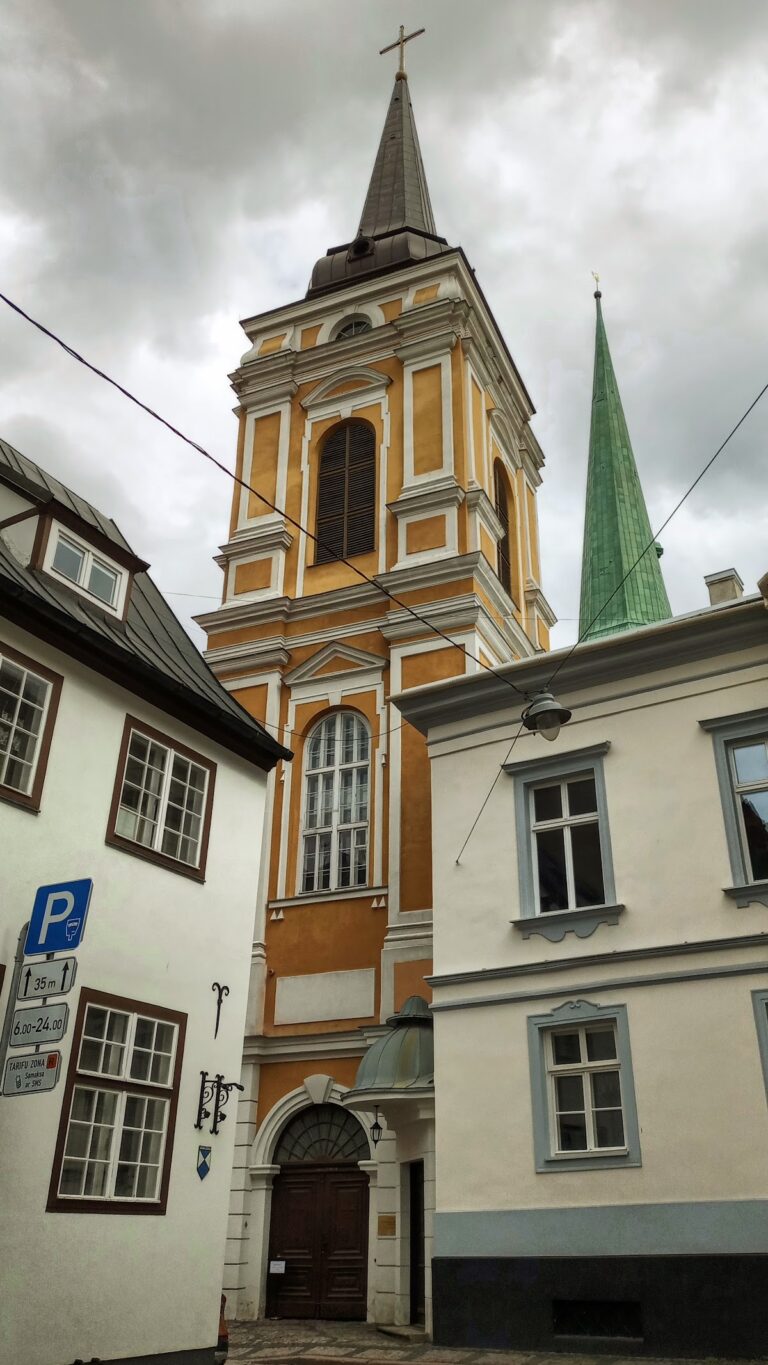
The Gothic north portal was formerly the principal entrance and remains a notable exterior feature. The original plan called for two towers, but financial limitations allowed only one to be built. That first tower burned in 1547. A partly wooden replacement, approximately 140 metres high, was erected in 1595 with a pyramidal spire and two galleries.
Decay in the wooden structures made the replacement tower unstable, leading Riga’s council to order a new tower in 1775. The present Baroque cap and lantern, a raised structure that admits light above a roof, were added in 1776. The resulting tower is 90 metres high. Modern restoration renewed its copper roof and the grilles of its two galleries, installed a new weather vane, and added automatic fire suppression and climate-control systems. The nave’s copper roof was replaced in 2011, while the tower exterior was re-clad and its timber structure renewed in 2015.
Cloister and Historic Furnishings
Cloister and Monastery Complex
The cloister on the south side dates from the time of Bishop Albert. A cloister is a covered walkway, usually arranged around an enclosed courtyard. Its preserved elements form part of the cathedral’s medieval complex, while the former monastery has a later institutional use as the Museum of the History of Riga and Navigation. The cloister also preserves the first weather vane, made in 1595.
Interior Objects and Memorials
The cathedral contains a late-twelfth-century baptismal font from the church at Ikšķile, identified as the first church in what is now Latvia. It was installed in the central aisle of the nave during the 2009 renovation. Beside the left wall of the choir is the tomb of Meinhard, the first bishop of Livonia, the medieval church territory in which Riga’s early Christian institutions developed.
A wooden pulpit carries Baroque carvings dating to around 1641, and a memorial stone of the Small Guild dates from the nineteenth century. The church windows were created by the art glazier Adolf Kahlert. Two fifteenth-century wooden statues, representing the Virgin Mary and Adam and Eve, are preserved among the cathedral’s historic remains.
Organ and Bells
Walcker Organ
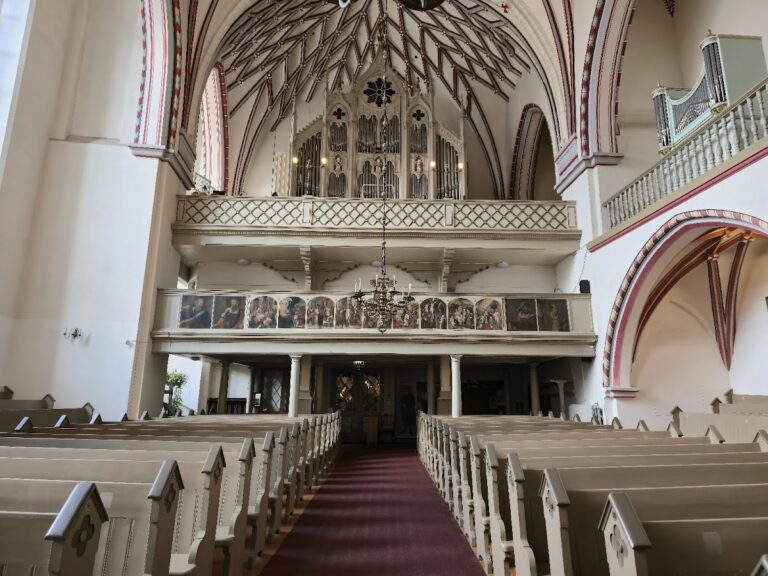
The present organ was built by the Walcker workshop of Ludwigsburg in 1882 and 1883 and inaugurated on 31 January 1884. It has four manuals, a pedalboard, mechanical action, 116 registers, and 6,718 pipes. At its inauguration, it was considered the world’s largest organ.
The instrument retains the richly decorated Early Baroque case of its predecessor. Jakob Raab of Lübeck completed the central section in 1601, including three crowning turrets and a separate rear organ division placed behind the player. Andreas Contius added the pedal towers on both sides in 1733 and connected them to the earlier case with concave pipe fields. The case is regarded as the oldest surviving organ facade in the Baltic states; in 1829 it reportedly contained 52 registers.
Franz Liszt, the nineteenth-century Hungarian composer and pianist, prepared an arrangement of the chorale “Nun danket alle Gott” for the inauguration ceremony, although he neither saw nor played the organ. Hermann Eule Orgelbau of Bautzen thoroughly repaired the instrument in 1962 and replaced pipes lost during the Second World War. Flentrop of the Netherlands restored it from 1981 to 1984. The organ has a second console on the lower gallery for the fourth manual and swell pedal, along with cone chests, a pneumatic mechanism assisting the heavy key actions, 18 fixed combinations, and a free combination facility.
Bell
A bell manufactured in 1926 and 1927 at Morgenröthe in Saxony weighs 8.5 tonnes, measures 2.50 metres in diameter and 3.00 metres in height, and is described as the largest bell of its type made there.
Nearby sites