St. George the Martyr Church, Zagreb: A Medieval Catholic Church in Planina Donja


Site at a Glance
- Rating
- 4.8
- Popularity
- Very Low
- Country
- Croatia
- Primary era
- Early Modern
- Eras represented
- Medieval, Early Modern
- Civilizations
- Habsburg, Hungarian
- Site type
- Religious
- Remains
- Church
On this page9 sections
History
St. George the Martyr Church is a Catholic church in Planina Donja, Zagreb, Croatia, whose oldest parts date from the thirteenth century and preserve a Gothic architectural detail. The locality of Planina was first mentioned in historical sources in 1209. The church developed from a chapel established during the first half of the thirteenth century, when Planina belonged to the Order of the Holy Sepulchre of Jerusalem, a medieval Christian religious order associated with the Church of the Holy Sepulchre in Jerusalem.
Medieval origins and parish administration
The thirteenth-century chapel was dedicated to St. George, a Christian martyr traditionally portrayed as a soldier who defeated a dragon. The church continued as a local religious foundation, and a canonical visitation in 1423, an inspection by church authorities of a church and its administration, furnishings, buildings, and religious life, recorded St. George at Planina as a filial church of the Kašina parish.
Jesuit administration and eighteenth-century form
Planina came under Jesuit ownership at the beginning of the seventeenth century. The Jesuits, members of the Society of Jesus, were a Catholic religious order known for educational and missionary work. Their administration lasted until 1773, when the order was suppressed, and the church acquired its present form during this period.
Canonical visitations in 1757 and 1777 described a masonry church with a sanctuary, vault, vestibule, wooden choir loft, sacristy, and a flat wooden ceiling over the nave. The building had a stone-paved floor, a shingle roof, and a wooden tower. Its wooden altars were dedicated to St. George, St. Blaise, and the Blessed Virgin Mary. St. Blaise was a Christian bishop and martyr traditionally associated with protection against throat ailments.
Bell tower, earthquake, and restoration
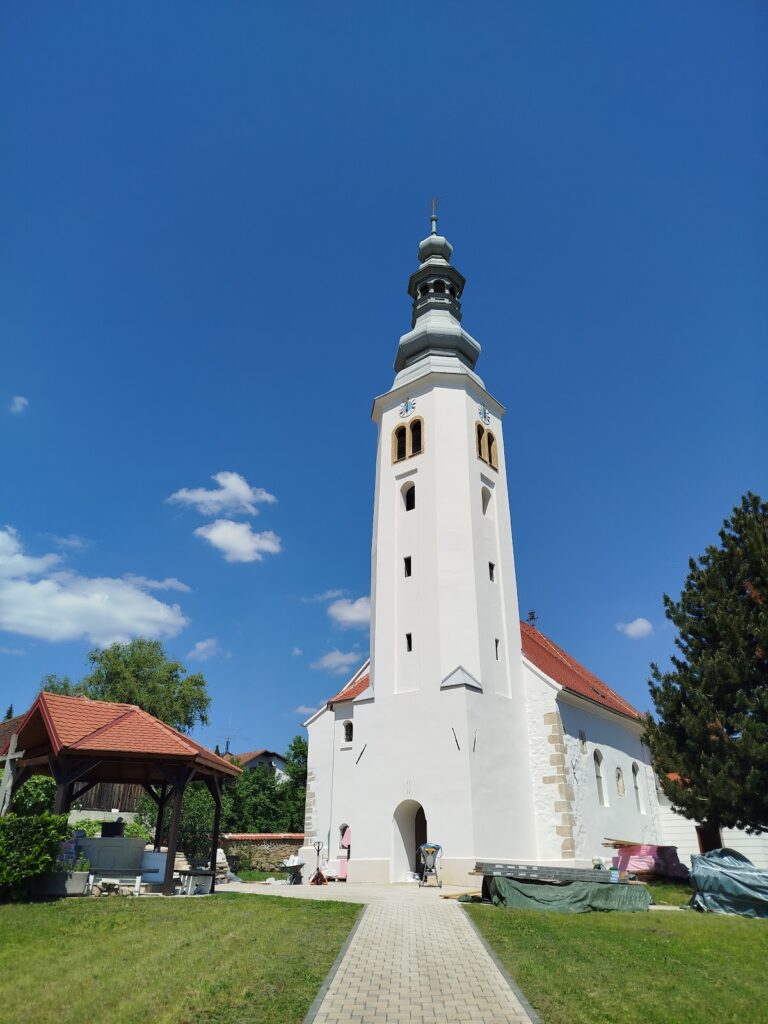
A substantial masonry bell tower was erected in front of the facade in 1797. The church was severely damaged by the Zagreb earthquake of March 2020. It was later restored with support from the European Union Solidarity Fund and the state budget.
St. George the Martyr Church is protected as an individual immovable cultural property of the Republic of Croatia, meaning a legally protected fixed heritage site or structure. It is listed in the national Register of Cultural Goods under registration number Z-717.
Remains
The church stands on a hill in the foothills of Medvednica, the mountain range north of Zagreb, and is enclosed by a wall. A cemetery occupies the northeastern side. The present building has a single nave, the main body of the church, with a square sanctuary, the area around the principal altar. A bell tower rises before the western facade, while the sacristy, a room for vestments and liturgical objects, stands south of the sanctuary.
Medieval fabric and exterior additions
Surviving medieval fabric includes the massive walls of the nave and vestibule and the Gothic-profiled stone doorjamb of the entrance portal. The later masonry bell tower forms the main exterior addition, standing directly before the western front. A secondary entrance is set into the southern side wall, beside a wall painting of St. Blaise that recalls the former eighteenth-century altar dedicated to him.
Interior and devotional features
Sanctuary and sacred images
The sanctuary is narrower and lower than the nave and is covered by a domed vault. Its wooden altar carries a painting of St. George, with side statues of St. Peter and St. Paul, leading apostles of early Christianity. In front of the sanctuary are wall paintings of the Sacred Heart of Jesus and the Heart of Mary, Catholic devotional symbols representing the love of Jesus and Mary. A side altar dedicated to Our Lady of Lourdes contains a statue.
Nave, sacristy, and choir
The nave has a flat ceiling decorated with a representation of the Eye of God. Its side walls bear paintings of the Last Supper and the Sermon on the Mount. Above the sacristy entrance is a wall painting of the expulsion of Adam and Eve from Paradise. The interior also contains Stations of the Cross, folk religious paintings, paintings of saints, and a choir, the gallery or area for singers. The interior arrangement dates from 1992.