St Edmund’s Church, Southwold: A Fifteenth-Century Parish Church


Site at a Glance
- Rating
- 4.6
- Popularity
- Very Low
- Country
- United Kingdom
- Primary era
- Medieval
- Eras represented
- Medieval, Early Modern
- Civilizations
- English
- Site type
- Religious
- Remains
- Church
On this page14 sections
History
St Edmund’s Church is the Church of England parish church of Southwold, United Kingdom. Dedicated to St Edmund, the seventh-century East Anglian king and Christian martyr traditionally regarded as East Anglia’s patron saint, it belongs to the Diocese of St Edmundsbury and Ipswich. The present building was constructed during the fifteenth century, from the 1430s to the 1490s, when Southwold had grown from a small fishing hamlet into an important and prosperous town.
From hamlet to prosperous town
The church replaced a smaller thirteenth-century building that was destroyed by fire. That earlier church served the people of Southwold when the settlement beside Reydon was still a fishing hamlet. The construction of the present church took approximately 60 years. Its rebuilding belonged to a period in which Southwold had gained greater power and wealth, allowing the parish to create a much larger building than its predecessor.
The church’s medieval religious imagery suffered during the seventeenth century. In 1644, William Dowsing, an English iconoclast associated with the removal of religious images, destroyed all of the medieval glass. The loss altered the appearance of the building while leaving its principal medieval structure and other furnishings in place.
Restoration and wartime damage
The roofs were restored in 1857 by Edward Lushington Blackburne and again in 1866 and 1867 by Richard Phipson. The chancel was restored in 1885. These nineteenth-century interventions formed part of the building’s later history of repair and conservation.
During the Second World War, a German bomb narrowly missed the church but destroyed houses in nearby Hollyhock Square. The blast blew out most of the church’s windows, and the building was quickly tidied so that funerals could take place for those killed in the bombing. Damage to the lead roof led to its complete replacement with copper in 1948. The copper later deteriorated, partly because of the seaside environment. A decision taken in 2013 returned the entire roof to lead, and the work, including replacement of the flèche, was carried out in 2015.
St Edmund’s remains in religious use, with regular bell ringing for Sunday services, weddings, and other special occasions. It is a Grade I listed building, the highest category of statutory protection for a building of exceptional architectural or historic interest in England. The church also forms part of the Sole Bay Team of Churches, a group that includes Holy Trinity Church at Blythburgh, St Margaret of Antioch’s Church at Reydon, St Andrew’s Church at Sotherton, St Lawrence’s Church at South Cove, St Mary’s Church at Uggeshall, St Andrew’s Church at Walberswick, and St Peter and St Paul’s Church at Wangford. St Edmund’s Hall behind the church was destroyed during the Second World War and later rebuilt.
Remains
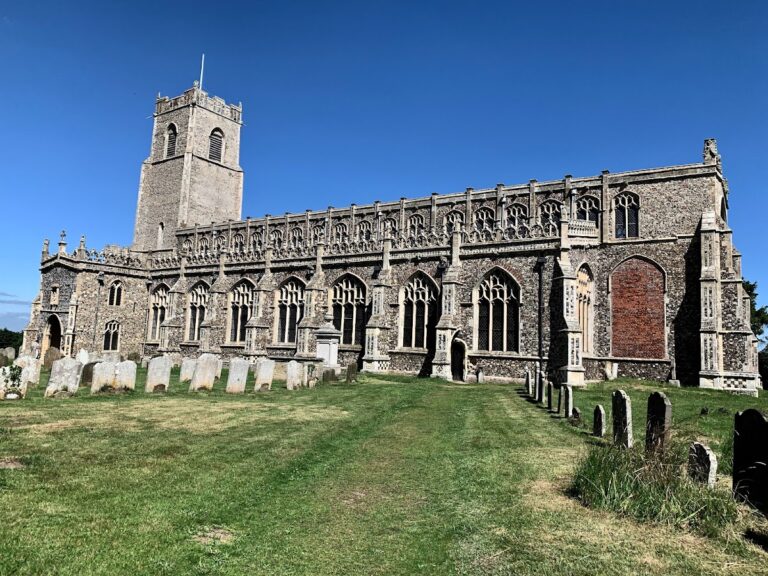
St Edmund’s Church is a long, broad building beneath one continuous roof. It measures 144 feet, or 44 metres, from end to end and 56 feet, or 17 metres, across. The tower rises to 96 feet, or 29 metres. Its high nave roof makes the tower appear shorter than its actual height, while the tall painted chancel roof helps create an open interior.
Exterior and roof
Flintwork tower
The tower is distinguished by East Anglian flushwork, a regional technique that combines flint and dressed stone in patterned surfaces. Its designs use both knapped flint, deliberately fractured to create a smoother dark face, and unknapped flint, which retains a rougher surface. Large bell openings are set in the tower, whose upper form has no parapet.
West window and roof fittings
Curving flint-set letters surround the west window. They read “SCT. EDMUND ORA P. NOBIS,” meaning “St Edmund, pray for us,” and each letter is crowned. The present roof is lead, and the clerestory, the upper row of windows lighting the central part of the church, contains eighteen windows. Above it stands a flèche, a slender decorative spirelet that has never contained a bell.
Interior furnishings and glass
Rood and parclose screens
The rood screen is regarded as one of Suffolk’s finest. A rood screen separates the chancel from the nave and was traditionally associated with a representation of the Crucifixion. At St Edmund’s, the arrangement extends across the full width of the church and comprises three screens: the main screen across the chancel arch and parclose screens, which enclose or separate parts of the side aisles, across the north and south chancel aisles.
Font and stained glass
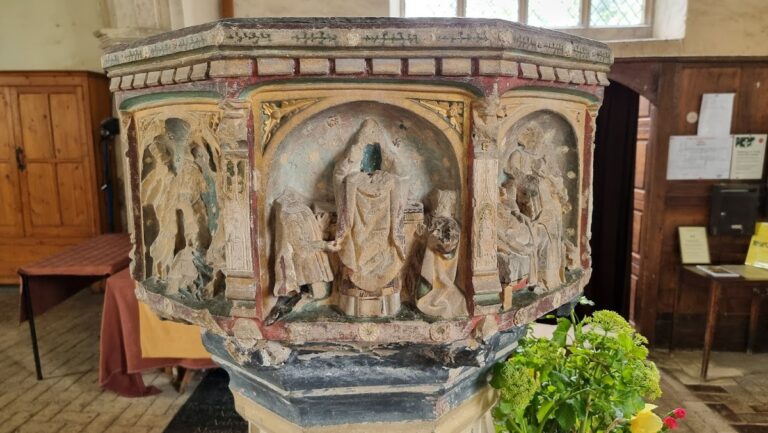
The font has been badly mutilated but retains a large and ornate cover. The surviving stained glass includes the east windows above the altar, made in 1954 by Sir Ninian Comper, an ecclesiastical designer, and the west window beneath the tower. In the north chancel, a 1971 engraved window by the New Zealand-born glass artist John Hutton depicts St Edmund at the moment of his death and martyrdom.
Clock and bells
Southwold Jack
At the west end stands a fifteenth-century clock jack, an automaton figure that strikes a bell to mark the time. Known as Southwold Jack, the figure holds an axe and a bell. It has a twin at Blythburgh and is also one of the symbols of Adnams, the Southwold brewery.
Ring of eight bells
The tower contains eight bells hung for change ringing, the systematic ringing of tuned bells in changing mathematical sequences. Five bells were recorded in 1553, and the present ring developed through recasting and additions. The fourth and fifth are probably recasts of original bells made in 1668 by John Darbie of Ipswich. The third dates from 1820 and was made by William Dobson of Downham Market. In 1828 another bell was recast and two were added; the recast bell is the present tenor, also by Dobson.
The sixth and seventh bells probably came from All Saints, South Elmham. Both are medieval: William Barker cast the sixth around 1538, while Brasyers of Norwich cast the seventh around 1513. The two treble bells date from 1881 and were made by Moore, Holmes and Mackenzie of Redenhall, Norfolk. An Oxford Treble Bob Major peal rung on 26 July 1858, however, shows that the tower already had eight bells before the treble bells were made.
The tenor is the largest bell, weighing 10.75 hundredweight, approximately 546 kilograms. The treble weighs about half as much. The bells hang in a timber frame installed in 1897 by George Day and Son of Eye, Suffolk, and were rehung on new fittings by the Whitechapel Bell Foundry in 1990, when the frame was also strengthened. The clock uses the seventh bell to strike the hours. The ringing chamber is about 52 steps up the tower and contains mementos of earlier bell-ringing achievements. The tower is affiliated with the Suffolk Guild of Ringers.
Organ and former tower fitting
The church has a three-manual pipe organ originally built in 1887 by J. W. Walker and Sons Ltd. It was rebuilt in 1966 by Cedric Arnold, Williamson and Hyatt of Thaxted, following a specification drawn up by Sir Frederick Ouseley, an English composer, organist, and music scholar.
The tower formerly carried a flagpole topped by a golden weathervane shaped as a sailing longshore fishing vessel. The pole was later replaced and the weathervane removed.