St Catherine’s Fort: A Palmerston Coastal Defence on St Catherine’s Island


Site at a Glance
- Rating
- 4.3
- Popularity
- Low
- Country
- United Kingdom
- Primary era
- Modern
- External website
- Open
- Eras represented
- Modern
- Civilizations
- British
- Site type
- Military
- Remains
- Fort
On this page13 sections
History
St Catherine’s Fort is a nineteenth-century Palmerston Fort on St Catherine’s Island at Tenby, Wales, United Kingdom. Built during Britain’s Victorian coastal-defence programme, it was intended to protect the Royal Dockyard at Pembroke Dock and the anchorage at Milford Haven from a possible French invasion.
Defence planning and construction
The fort followed the recommendations of the Royal Commission on the Defence of the United Kingdom, a body established in 1859 by Prime Minister Lord Palmerston to assess the country’s vulnerability to invasion. Britain feared that forces under Napoleon III, emperor of France from 1852 to 1870, might land on the southern Pembrokeshire coast and attack the dockyard and anchorage from the landward side.
The commission proposed a chain of coastal artillery forts between Tenby and Freshwater West, but St Catherine’s Fort was the only one built. The Government purchased St Catherine’s Island from the Corporation of Tenby for £800 in 1866. Clearance and preparatory work began in 1867, and construction was completed in 1870 at a cost of £40,000, although the fort initially had no guns.
Local builder George Thomas of Pembroke carried out the work under the supervision of Royal Engineers Colonel W. Llewelyn Morgan, Captain Fredrick Clements, and Sergeant Gibbs. The design is attributed to Colonel William Jervois, a Royal Engineers officer associated with British military fortifications.
Armament and military service
Gun shields were installed in 1886 for the fort’s artillery. In the same year, a Defence Committee report judged its 9-inch guns to be “useless,” reflecting doubts about their military value. In 1895 control passed to the Royal Naval Reserve, a naval reserve force whose members combined civilian work with naval service. The reserve installed a single BLC 5-inch gun, meaning a breech-loading converted weapon, on a Youngman’s compression platform, apparently for training.
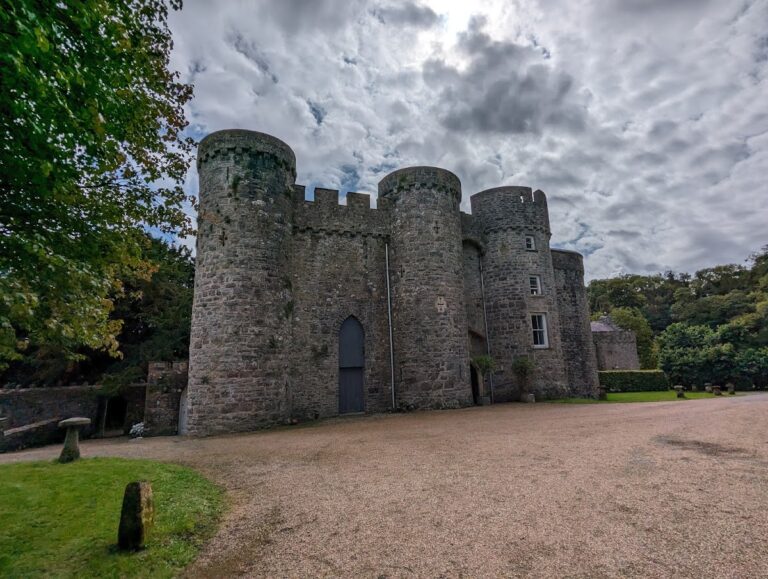
The fort was decommissioned in 1907 and sold into private ownership. In 1914, J. P. James purchased it on behalf of steel merchant Edward Windsor-Richards, who converted the building into a private house for his granddaughter, Lillian Windsor-Richards. The original gun shields were replaced with windows, and the interior was lavishly decorated. The army apparently used the fort as a garrison during the First World War.
Wartime reuse and later changes
Lillian Windsor-Richards was declared bankrupt in 1940. Harrods sold the contents of the house, after which the property was advertised for sale and then placed under a compulsory military purchase order. During the Second World War, an anti-aircraft battery was built in front of the fort. Royal Marines, the Royal Artillery’s 4th Defence Battery and a Light Anti-Aircraft Battery, a Belgian Army detachment, the Home Guard, and an RAF Air Sea Rescue detachment served there at different times. The Home Guard was Britain’s wartime volunteer defence force.
After the war, the fort was again decommissioned and sold to a local solicitor, who let it to several tenants, including author Norman Lewis. It was sold again in 1962 and opened as a zoo in 1968. The zoo moved to new premises in 1979, leaving the fort empty.
Protection and reopening
St Catherine’s Fort became a Grade II* listed building in 1951. The listing recognised it as an important later nineteenth-century naval fort that was regarded as exceptionally well built and prominently located.
In May 2015, the Pembrokeshire Coast National Park Authority approved plans to reopen the site, including restoration, a nature walk, boat landings, and commercial and catering facilities. The fort was closed to the public in August 2016 after its future was described as uncertain, and it reopened on 12 April 2017. In 2016, the island was used for filming “The Final Problem,” the third and final episode of the fourth series of the BBC television drama Sherlock.
Remains
St Catherine’s Fort stands beside Castle Rock on St Catherine’s Island. It is a simple rectangular structure built from limestone and granite, rising to about 14 metres. The fort was planned for a garrison of 150 men and combines enclosed artillery chambers, roof-mounted gun positions, defensive approaches, and underground storage.
Artillery positions
Casemates
Three casemates, or fortified chambers for artillery, occupy each of two opposite sides of the fort. They were designed for RML 7-inch guns, meaning rifled muzzle-loading weapons loaded from the front but fitted with rifled barrels. The guns fired through iron shields. When the fort became a private house, the shields were removed and replaced by windows.
Roof gun platforms
Three further gun platforms survive on the roof. They were intended for RML 9-inch, 12-ton guns. The north-facing positions covered Tenby Harbour and the beach towards Saundersfoot, while the south-facing positions covered the beach towards Penally.
Entrance and internal spaces
Drawbridge and caponiers
The western entrance, facing the land, is reached by a drawbridge over a dry ditch. Two three-storey caponiers, or flanking galleries, defend this approach. Their loopholes allowed small-arms fire to be directed along the ditch and towards attackers approaching the entrance.
Magazine and shell store
The powder magazine and shell store occupy the basement at the eastern end of the fort. Their position formed part of the building’s internal arrangement for storing ammunition below the main artillery and accommodation areas.
Private-house alterations
The conversion of the fort into a private residence changed its appearance and interior arrangement. Windows replaced the original gun shields, while the inside was given lavish decoration. The wartime anti-aircraft battery was later constructed in front of the fort, adding a twentieth-century military feature to the surrounding site.