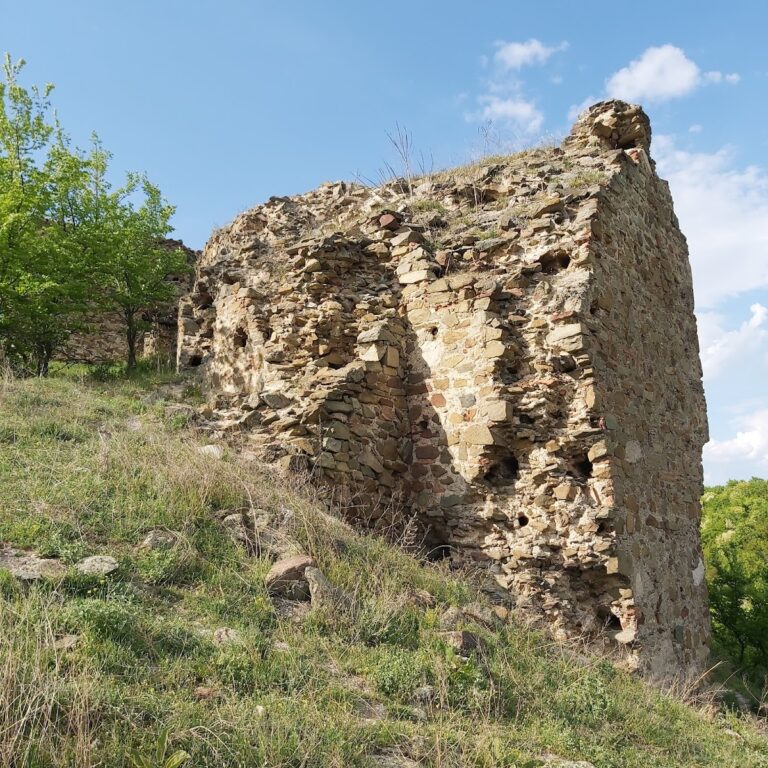
Veta Monastery: A Serbian Orthodox Monastery in Serbia


Site at a Glance
- Rating
- 4.8
- Popularity
- Very Low
- Country
- Serbia
- Primary era
- Modern
- Eras represented
- Modern
- Civilizations
- Ottoman, Serbian
- Site type
- Religious
- Remains
- Monastery
On this page10 sections
History
Veta Monastery is a medieval Serbian Orthodox monastery in Serbia, dedicated to the Dormition of the Mother of God and belonging to the Diocese of Niš. Its reliable foundation date is unknown, but traditions place its origins either in the Byzantine period or in the fourteenth century, when it was supposedly founded by the Mrnjavčević brothers, a prominent Serbian ruling family of the medieval Serbian state. The monastery probably suffered destruction after the Ottoman conquest of the region in 1386.
Early traditions and seventeenth-century rebuilding
The oldest tradition connects Veta Monastery with the Byzantine period. A separate tradition attributes its foundation to the Mrnjavčević brothers, although no secure foundation record confirms that claim. The monastery does not appear in the last surviving Ottoman census of 1595, compiled during the reign of Murat III. This supports the likelihood that its first post-medieval rebuilding took place during the seventeenth century.
The earliest surviving written evidence dates from 1686, when the monastery was rebuilt. On 22 February of that year, a hieromonk named Silvester wrote information about the monastery and its buildings in a handwritten liturgical collection. The rebuilding probably included a monastic residence, although the form of the complex at that time is not known.
Another tradition states that local inhabitants later built a new church of a different form on the same site. After its completion, a parish was established for Veta, Toponica, Kosmovac, and Tamnjanica, linking the monastery with the religious life of several settlements below Suva Planina.
Destruction and nineteenth-century revival
Veta Monastery was destroyed in 1737 during the Austro-Russian-Turkish War of 1735–1739, a conflict in which Austria and Russia opposed the Ottoman Empire. The monks reportedly abandoned the monastery during the Serbian migration of that year. An account of the destruction was preserved in an inscription on a book that was later transferred to Sremski Karlovci.
Historian Borivoje Rajković associated an attempted restoration in the nineteenth century with Hajduk Veljko Petrović during the First Serbian Uprising, the Serbian revolt against Ottoman rule that began in 1804. In this interpretation, the monastery was intended to serve as a protected religious place in the forested Suva Planina, where hajduks, irregular armed fighters active during periods of Ottoman rule, could come to pray. Ottoman opposition prevented the attempt from succeeding.
The monastery was substantially rebuilt in 1869 on the initiative of Mladen Stojić. During the Ottoman period, the priest Spasa served at the church, followed by his son Bogdan Popović, who remained there until 1890. Bogdan built a monastic residence, brought a brotherhood to Veta, and helped establish a school beside the church. Teachers included Nikola from Tetovo, a man named Sreten, and the monk Veljko. For a period, Veta Monastery therefore served as an important religious and educational center for the communities below Suva Planina.
Resistance activity and parish life
In 1877, shortly before the liberation of southern Serbia from Ottoman rule, the Niš Committee secretly met at Veta Monastery. Led by Nikola Rašić and Prota Petar Ikonomović, the committee sought to disrupt the Ottoman army through armed activity in its rear.
After Bogdan Popović left in 1890, neighboring parishes administered the Veta parish until 1901. Bogdan’s brother Ilija Popović served as parish priest from 1894 to 1899, followed by the priest Stanko Zlatanović of Gornja Studena. From 1901, the parish again belonged to Veta Monastery, and the monastery’s superiors also served as parish priests. Recorded superiors and clergy included the hieromonks Joakim, Vićentije, Serafim, and Jakov, as well as the abbot Danilo Sinko.
Wartime destruction and restoration
During the First World War, the Bulgarian occupying army looted the monastery. The hieromonk Lukijan, who served there during the war, was captured by Bulgarian forces in 1916 and imprisoned until 1919. He returned to Veta Monastery and continued serving there until his death in 1932.
The monastery became involved in local conflict during the Second World War after the first Ravna Gora headquarters for Niš and its surroundings was established in the Veta–Kosmovac area. Ravna Gora was the Serbian royalist resistance movement associated with Draža Mihailović. Abbot Danilo Sinko cooperated with the headquarters’ officers, offering moral and material assistance, collecting weapons through trusted villagers, and speaking in surrounding villages in support of Ravna Gora organizations.
In May 1942, Bulgarian occupation forces discovered weapons and ammunition hidden at the monastery by followers of Mihailović’s Chetnik movement. They burned the monastic residence to its foundations, destroyed the church roof, and blew up the bell tower. Danilo Sinko and six other monks were sent to the Crveni Krst camp in Niš.
After the war, Danilo Sinko returned to the devastated monastery, and the church was repaired soon afterward. Local resident Jovan Milenković completely repaired its roof. Sinko died in 1959 and was buried at Veta Monastery. After his death, the hieromonk Jakov Blagojević became abbot and, together with the monastery administration, began rebuilding the complex in 1972.
Recent conservation
The hieromonk Georgije Žunić came to Veta Monastery from Poganovo Monastery in June 2003 and worked there until August 2008. During that period, he repaired the church, narthex, bell tower, and residences, replaced the church roof, repaired the residences, added a bathroom, and brought water from a well dug on the hillside above the church.
Under the later leadership of the hieromonk Stefan, the monastery commissioned architect Saša Buđevac to design a new residence. Construction was delayed by a lack of funds, and larger-scale work began in 2011, continuing intermittently afterward. Electricity and a water connection reached the monastery in 2016, ending its earlier reliance on candles and an oil lamp for lighting and on the monastery spring for water.
Veta Monastery is protected as a Serbian cultural monument of great importance under listing SK 230. The Institute for the Protection of Cultural Monuments in Niš administers its protection.
Remains
Veta Monastery occupies a wooded and difficult-to-reach area on the northern slopes of Suva Planina, southwest of Veta, at approximately 680 metres above sea level. It lies below Trem, the mountain’s highest peak, which rises to 1,810 metres. The monastery was formerly situated beside the Roman Via Militaris, the road that linked the central Balkans with Constantinople and Asia Minor. The complex includes the Church of the Dormition of the Mother of God, a bell tower, two residences, a monastic cemetery, and a spring on the monastery property.
The church
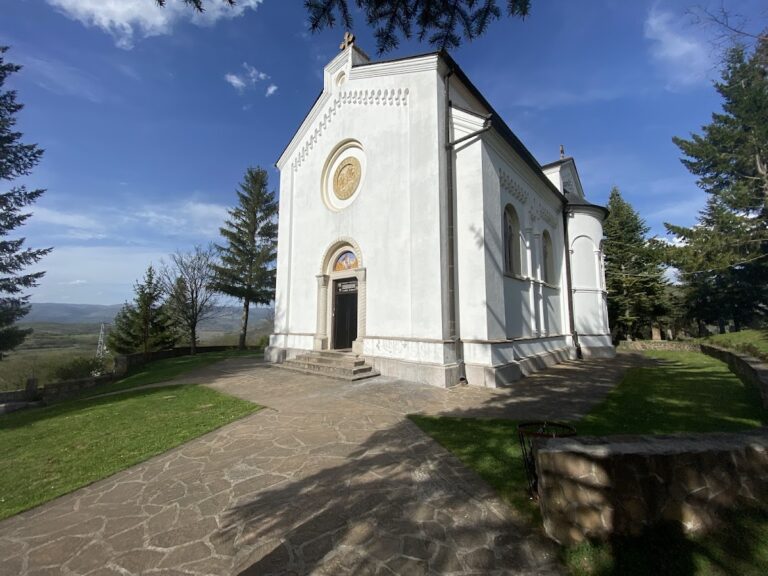
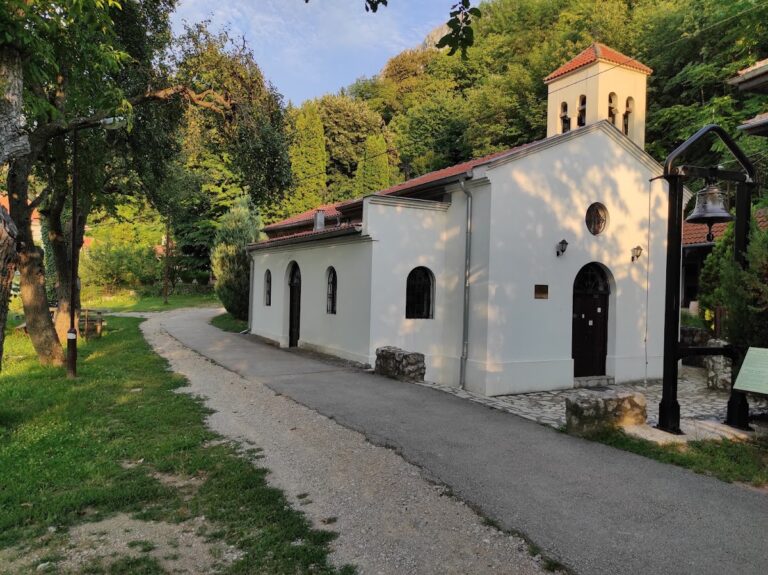
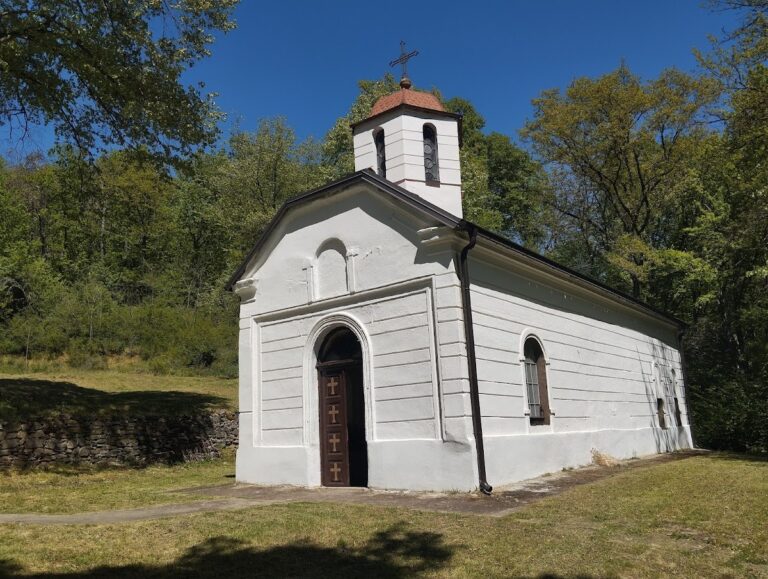
The church is a modest single-nave building with a semicircular apse, the rounded eastern end of the sanctuary, and an open narthex, an entrance porch at the west end. The building is not assigned to a particular architectural style. Its nave is covered by a barrel vault, a continuous semicircular ceiling, supported on side pilasters. Rough and dressed stone form the church walls, while the narthex is built of brick. The gabled roof is covered with tiles.
The narthex opens westward through a porch formed by three simple arcades. It measures 5.55 metres in length and 5.62 metres in width. The doorway and its arcade measure 1.18 metres in width and 2.53 metres in height. The left western arcade is 1.07 metres wide and 2.24 metres high, while the three southern arcades each measure 0.92 by 1.96 metres. Their supports and the low brick parapet retain the small-scale construction described in the monastery’s architectural record.
The church and narthex together measure 13.04 metres along the south wall when the semicircular apse is excluded, and 14.19 metres when it is included. The western wooden-plank door is 1.64 metres high and 0.85 metres wide. A former northern doorway was blocked by the hieromonk Georgije. Two southern windows and one apse window provide the interior light. The floor is made of wooden boards.
The wooden iconostasis, the screen separating the sanctuary from the nave in an Eastern Christian church, was made after the burning of the church and residences. Its upper section contains icons of the Holy Apostles. Below, an icon of the Mother of God with the infant Jesus stands to the left of the royal doors, the iconostasis’s principal central doors, while a large icon of Jesus Christ stands to the right. A wooden cross surmounts the screen.
Bell tower
The bell tower stands south of the church on the same platform. It is a two-storey wooden-and-mud structure known as a kovanica, a local type of small bell tower whose walls slope inward toward the top. The tower has a hipped tiled roof topped by a metal cross. Its rectangular base measures 3.00 by 2.77 metres. The walls converge in a pyramidal form, and the tower is 5.50 metres high including the roof and 4.20 metres high without it.
The lower storey is a 2.10-metre-high windowless room with a door. Villagers call it Valerij’s Cell because the Russian monk Valerij Žiber lived there. The open upper storey is also 2.10 metres high and has a railing. A ladder on the east side leads to it, and the church bell hangs from wooden beams beneath the roof.
The tower contains one bell, cast specifically for the monastery in 1893 at the Military Technical Institute in Kragujevac. It bears the inscription “Administration of the Military Technical Institutes in Kragujevac,” the coat of arms of the Kingdom of Serbia, and the lower-rim inscription “Church of the Dormition of the Mother of God in Veta, 1893.”
Liturgical objects and monastic grounds
The monastery preserves a chalice dated 1854. Russian soldiers donated it for the repose of their comrades who died in the war of liberation against the Ottoman Empire. During renovation, a damaged Russian lithograph of the Dormition of the Mother of God was found among the older icons. The image depicts the holy monks of the Kiev Pechersk Lavra, a historic Orthodox monastic complex in Kyiv, from its foundation to the present and is regarded as a protector of the lavra.
The monastic cemetery and spring form part of the surrounding grounds, alongside the church, bell tower, and residences. Together these elements preserve the physical arrangement of a small mountain monastery whose buildings have repeatedly been repaired, rebuilt, and adapted after periods of destruction.
Nearby sites