Skoger Old Church: A Medieval Romanesque Church in Drammen, Norway
Site at a Glance
- Country
- Norway
- Primary era
- Medieval
- Eras represented
- Medieval, Early Modern, Modern
- Civilizations
- Danish, Norwegian
- Site type
- Religious
- Remains
- Church
On this page19 sections
History
Foundation and medieval origins
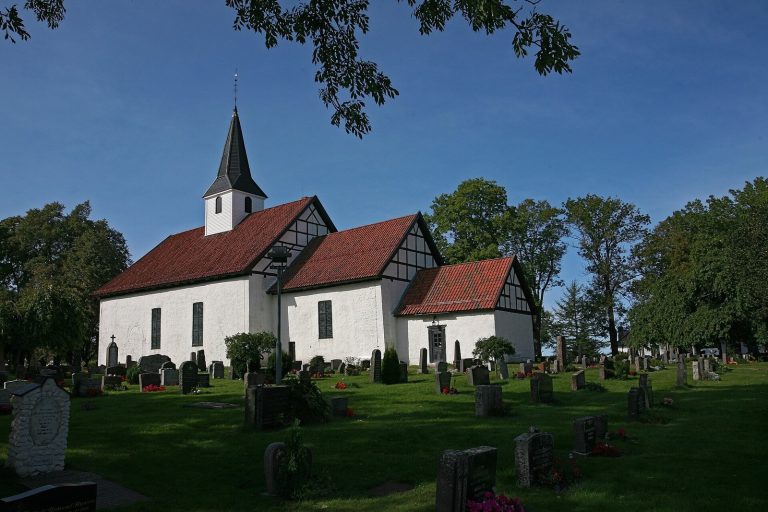
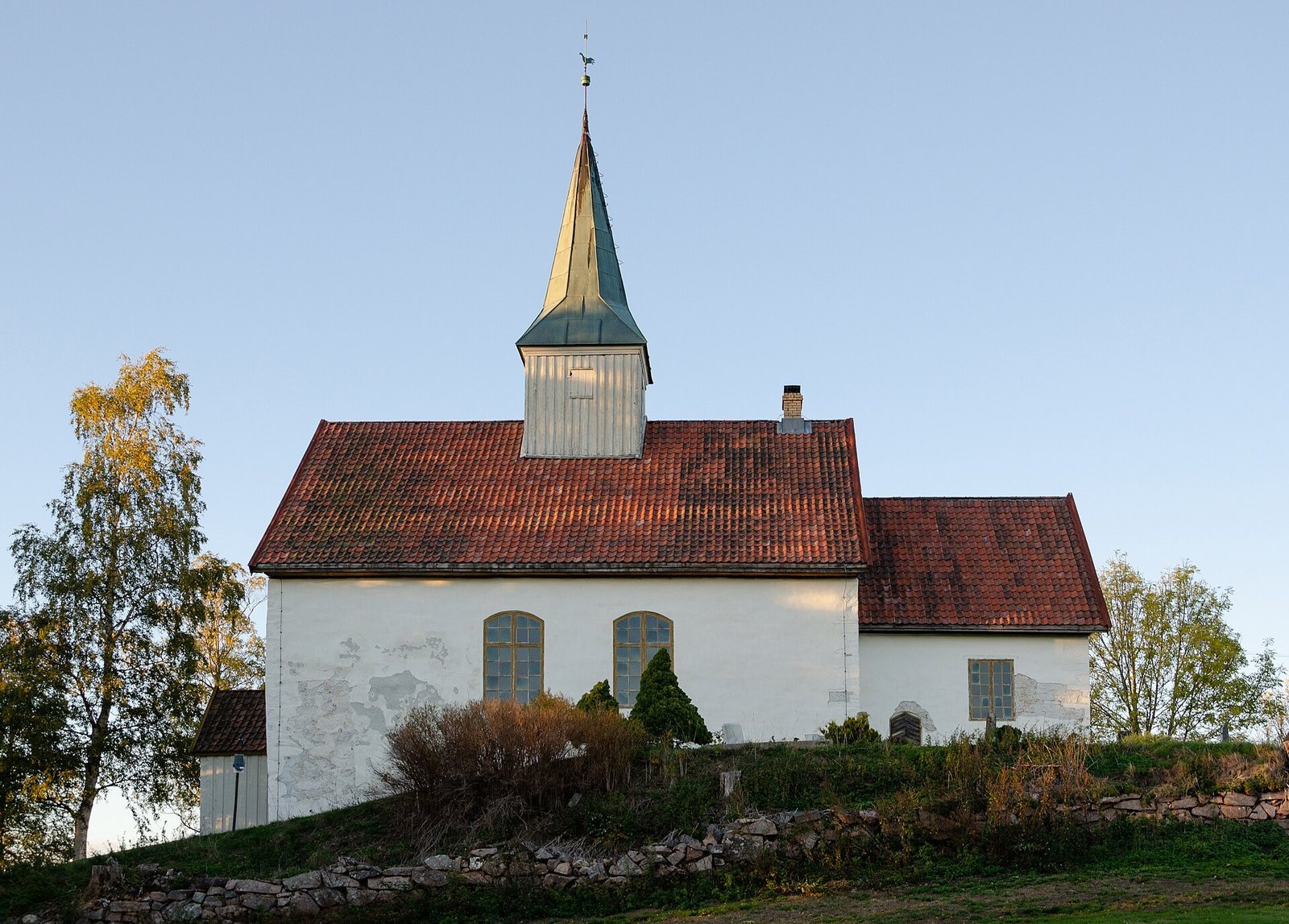
Skoger Old Church is a Romanesque stone-and-wood church in Drammen, Norway, built around 1200–1220. Romanesque architecture is a medieval European style associated with substantial masonry and rounded arches. The church is among Drammen’s oldest buildings and is dedicated to St Olav, a Norwegian king venerated as a Christian saint.
The church stands on land given by Hanaval farm. The farmer’s baptism may have influenced the choice of site. Tree-ring analysis of the original roof timbers dates the oldest wood to 1192 and the youngest to 1218. The building campaign is estimated to have lasted about 25 years, with consecration probably around 1220.
Charred wood beneath the west wall points to an earlier timber building. It may have been a stave church, a medieval wooden church built around timber posts, or a place of pagan worship. It may also have been the area’s first building after Christianity arrived from Denmark, well before the end of the tenth century. Its destruction may have followed an accident, unrest during the rule of King Sverre, a Norwegian monarch of the late twelfth century, or a decision to replace it with a better church.
Changes after the Reformation
After the Reformation, the sixteenth-century movement that led to the establishment of Protestant churches, the monarch acquired the churches. A major renovation at Skoger took place in the 1620s, when galleries, a pulpit, and an altarpiece were added. The galleries were later altered in size. In 1652, wooden roof covering was replaced by Dutch glazed tiles, and gallery paintings and ornaments were produced or added.
Ownership and eighteenth-century events
Following debts incurred after the Great Northern War, a major early-eighteenth-century conflict in northern Europe, the monarch sold the churches in 1723. A local count bought Skoger, but the church’s income did not cover its costs. It owned land and seven cows, and proceeds from milk and other produce helped support it. In 1754 the count sold the church to local farmers, who paid according to the income of their farms. The cows were sold in 1885, and the local congregation now owns the church.
Lightning struck on the night of 21 July 1748. Heavy rain prevented a fire, but the nave roof was destroyed and had to be rebuilt. The count secured royal financial support from Copenhagen, and some of the old timber was reused. The medieval bell survived, and a second bell was added in 1754. The altarpiece was restored in 1753. During the eighteenth century, the church also served as a votive church, associated with a vow or religious offering.
Nineteenth century to the present
A major overhaul in the 1820s enlarged the windows, removed the side altars, and added a porch at the main entrance. The bell tower was reconstructed in 1829. That year the 1631 pulpit was removed and destroyed, possibly because its corner figures showed scantily clothed women as angels. The church’s organ was installed in 1825. Over a span of 150 years, only three organists served there; the second began in 1830 at age 15 and remained in the post for 70 years.
When the new Skoger Church opened in 1886, the old church ceased to be used regularly and became a reserve church for special occasions. Major restoration campaigns followed in 1926, 1972–1973, and 1999–2001. Work in 1926 removed gray paint from gallery paintings, while the 1972 restoration removed it from paintings on the baptismal font. The church remains part of the Church of Norway, the country’s Evangelical Lutheran church, and is used for summer services and annual Olsok services. Olsok is a Norwegian feast in honor of St Olav, traditionally observed on 29 July.
Remains
Plan and construction
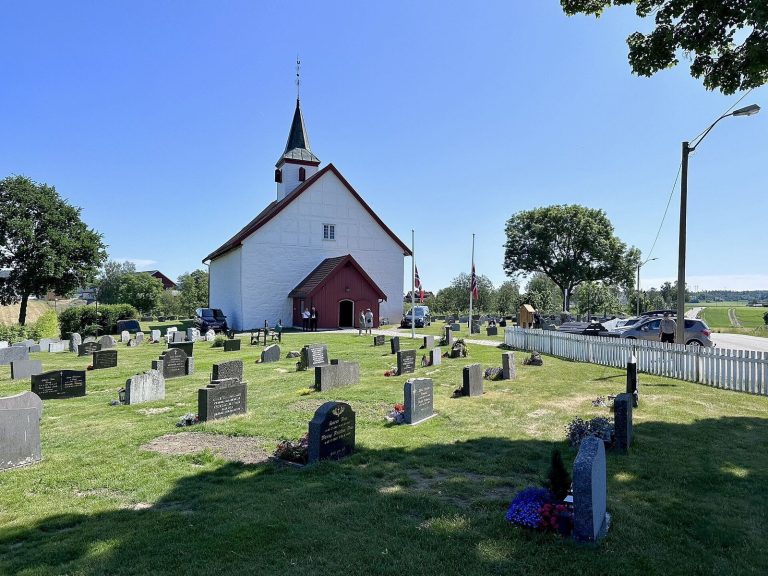
The church is a long building of stone and timber, with one elongated nave, the main space for the congregation, and a narrower, straight-ended chancel at the altar end. A churchyard lies beside it, and the building has seating for 100. A bell tower stands above the nave. The church occupies a conspicuous position in the landscape and is built over a water source, probably beneath the altar. Water from the source has repeatedly contributed to rotting boards.
The building contains about 1,200 tonnes of stone, with individual blocks weighing roughly 200–300 kilograms. The stone probably came from steep hills at Mælen, a few kilometres away, and was hauled by sled in winter, when roads were unsuitable for wheeled traffic. The work is estimated to have required about 500 journeys. Timber came from surrounding forests, while lime was brought from Asker and Bærum. The original medieval timber framework supporting the chancel roof survives, as do consecration symbols drawn in wet plaster on the north wall.
Entrances and service space
Doorways
The western doorway has been altered and is now fronted by a porch. The southern doorway in the nave has been blocked but remains visible in the wall. The southern doorway in the chancel was modified during the eighteenth century.
Sacristy
A timber sacristy is attached to the north side of the chancel and has a doorway into it. The room later also served as a meeting place for church wardens, lay officials responsible for church property and affairs. The inscription from the destroyed 1631 pulpit was found in the attic in 1999 and is now kept in the sacristy.
Interior furnishings and objects
Galleries and altar
The galleries date from 1624 and have painted fronts and ornament. Their paintings include King David, the biblical king of ancient Israel, dated 1652, and St Olav, dated 1753. Ornaments beneath the galleries were probably painted in 1652 by the artist responsible for the gallery-front paintings. The altarpiece, dated 1631, carries an Eye of God motif, heraldic decoration, and other ornament. A medieval stone altar is also preserved.
Baptismal font
The baptismal font is made from a pine log and may be medieval. Its paintings of the baptism of Jesus date from the seventeenth century. The earlier tin and second bowls became damaged and leaked. A silver bowl donated in 1739 is now used at the new Skoger Church.
Crucifixion group
A crucifixion group dated to about 1250–1275 is mounted above the chancel arch, which marks the division between nave and chancel. It depicts Christ, Mary, and John, and was originally fixed to a horizontal beam. The group may have been dismantled in the 1620s, after which Mary and John were stored in the attic above the chancel. The cross was later cut to fit the enlarged arch during the 1820s. Mary and John were found in 1909, and the group was restored; the cross was completed at the Directorate for Cultural Heritage’s restoration workshop.
Other devotional objects
The nave candlestick bears an inscription dating it to May 1692, and its chain is dated 1693. A crucifix above the sacristy door dates to 1713 and bears a donor’s motto dedicating it to the church’s beauty and God’s glory.
Later furnishings
Organ and heating
Installed in 1825, the organ is described as the second-oldest church organ still in use in Norway. It has been restored several times; a thorough overhaul would be needed for it to function as a concert organ. The first stove was installed in 1832, and the present stoves were donated in 1868.
Benches and cabinet
The benches may have been installed after the 1748 lightning strike, when falling masonry may have damaged the furnishings. They may have come from the old stave church at Hillestad, demolished around the same time. The name of the farm that paid for each bench appears on its end, and the amount paid determined its place in the rows. Supports in the north row have cone-shaped bases, while those in the south row are a newer, square form.
A cabinet stands at the back of the seating. Its purpose is uncertain. It may have been intended for the count and his family, although he rarely attended services because he lived in Larvik. Other possibilities are that it held prisoners who needed supervision during services or provided reserved seats for the priest’s family.
Warship model
A model warship was given to the church in 1819 by a sailor from Tangen, who probably served in the Danish-Norwegian fleet, the joint navy of Denmark and Norway during their political union, in the Napoleonic Wars. These early-nineteenth-century conflicts involved France under Napoleon and shifting coalitions. The model represents ecclesia militans, the Church militant, a Christian idea of the Church engaged in spiritual struggle and originally opposed to the papacy. A concealed fishing line holds the model on course. Another sailor from Tangen restored it in the late 1940s.