Nakagusuku Castle: A Ryukyuan Gusuku Fortification in Japan


Site at a Glance
- Rating
- 4.5
- Popularity
- Medium
- Country
- Japan
- Primary era
- Medieval
- External website
- Open
- Eras represented
- Medieval
- Civilizations
- Ryukyu Kingdom
- Site type
- Military
- Remains
- Castle
On this page9 sections
History
Nakagusuku Castle is a Ryukyuan gusuku, a fortified site combining defensive, residential, administrative, and religious functions, in Japan. Its present form dates to around 1440 and is associated with the Kingdom of Ryukyu. The castle stands within a landscape shaped by the political and military struggles of fifteenth-century Okinawa.
Early development and Gosamaru’s expansion
Several generations of the Sachinakagusuku Aji, local chiefs, had built the southern, western, first, and second baileys by the late fourteenth century. A bailey was an enclosed section of a fortified complex. These earlier enclosures formed the core of the castle before its major fifteenth-century expansion.
In 1440, King Shō Taikyū asked Gosamaru, a prominent Ryukyuan commander and local lord, to strengthen Nakagusuku as a barrier between Amawari’s stronghold at Katsuren Castle and Shuri, the royal capital of the Ryukyu Kingdom. Gosamaru moved his seat from Zakimi Castle in Yomitan and added the third and northern baileys. These works created the castle’s present overall arrangement. Gosamaru had previously helped Shō Taikyū’s father invade Hokuzan in 1416. Hokuzan was one of the three major political centers in Okinawa before the Ryukyu Kingdom was unified.
The conflict with Amawari
In 1458, Amawari, the lord of Katsuren Castle and Gosamaru’s principal military adversary, attacked Nakagusuku from the east. Gosamaru was defeated and committed suicide at the castle. The attack may have been connected with a ploy by the royal court at Shuri, which had become suspicious of Gosamaru’s loyalty. After his defeat, Nakagusuku became the residence of the “Prince of Nakagusuku.”
Later political and administrative uses
Following the Satsuma invasion of Ryukyu in 1609, Nakagusuku served as a guard post, and its use continued into the early seventeenth century. The Satsuma Domain was a powerful Japanese feudal domain that invaded Ryukyu. During the Edo period, the era of rule by Japan’s Tokugawa shogunate, Satsuma officials secluded themselves at the castle when envoys from Qing China arrived for missions to formally invest Ryukyuan kings. This practice helped preserve the appearance of Ryukyu’s independence.
Commodore Matthew C. Perry visited Nakagusuku in March 1853 during his expedition to press Japan to end its policy of national seclusion and establish relations with the United States. He described the castle’s walls and arched gates, observing that the walls appeared designed to absorb cannon fire.
Modern history and protection
After the Meiji Restoration and the establishment of Okinawa Prefecture in 1879, the castle became the Nakagusuku village office, a use that continued until the end of the Second World War. Nakagusuku suffered relatively little damage during the Battle of Okinawa and was restored after the war. In 1955 it was designated an Okinawa Important Cultural Property, Historic Site, and Place of Scenic Beauty.
The Japanese central government has protected the castle as a National Historic Site since 1972. Plans to build a Nakagusuku Kogen Hotel in the main enclosure for the 1975 Okinawa Ocean Exposition caused controversy, and the hotel was never completed. The associated hotel ruins lie less than 50 metres from the castle site. In 2000, Nakagusuku became part of the UNESCO World Heritage property “Gusuku Sites and Related Properties of the Kingdom of Ryukyu,” inscribed under criteria ii, iii, and vi. In 2006, the Japan Castle Foundation included it among Japan’s Top 100 Castles.
Remains
Hilltop layout and courtyards
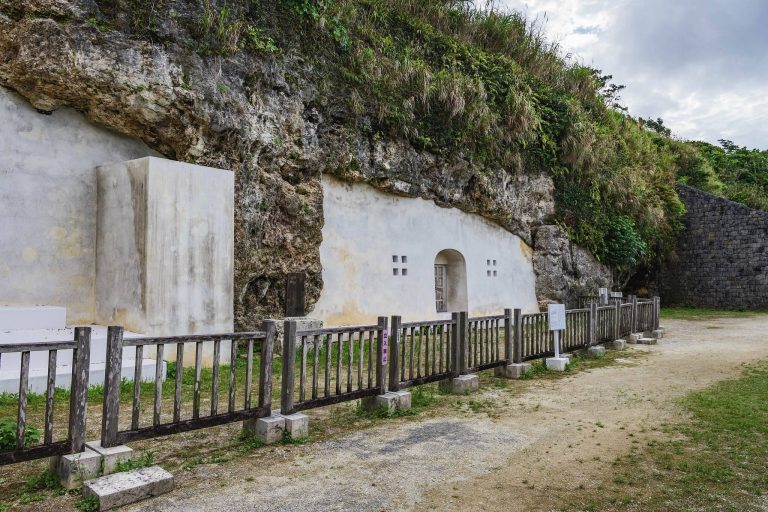
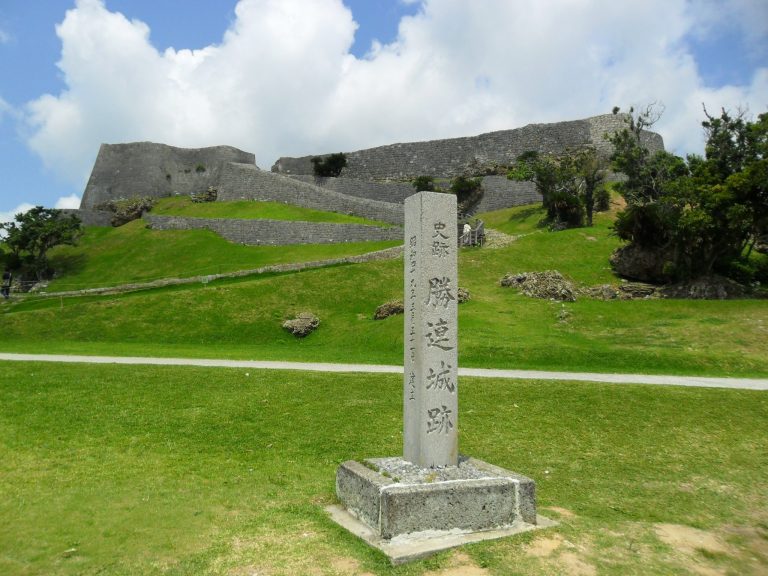
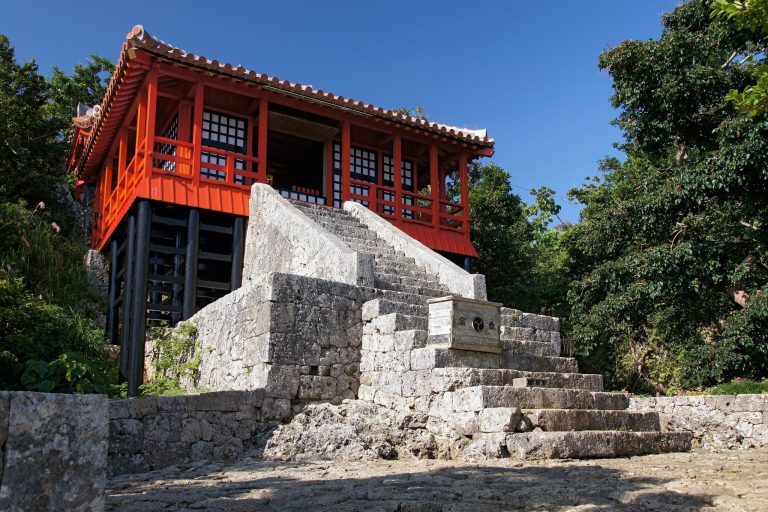
The ruins occupy a hill approximately 160 metres high, with the eastern cliff edge extending from northwest to south of Nakagusuku Village. This steep edge provided a natural defensive feature. About two kilometres away lay the former trading port of Yagi Port. The castle is organized as six courtyards, or baileys, enclosed by successive stone walls. From south to north, the principal sections are the southern, western, first, second, third, and northern baileys. The first bailey contained the palace, while the third and northern baileys belong to Gosamaru’s expansion.
Stone walls and gates
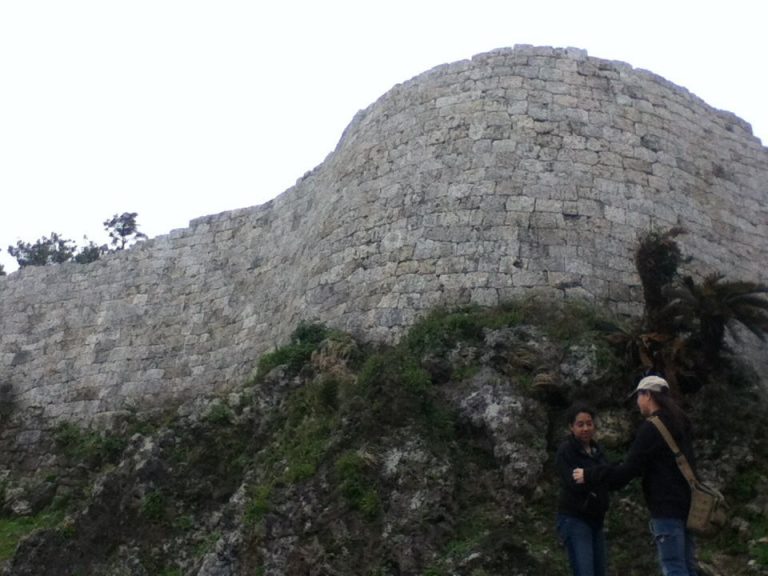
The walls added by Gosamaru were built with aikata-zumi, a dry-stone masonry technique in which stones are carefully fitted without mortar. Elsewhere, roughly cut stones were piled into walls reaching about 10 metres high. The castle’s gates formed part of this defensive arrangement. Two gates leading to the first bailey, apart from the rear gate, were arched, and the first bailey’s gate was remodelled in an arched form at the same time.
Materials and surviving condition
Ryukyuan limestone and wood were used in the construction. Nakagusuku now survives as ruins, with its stone walls and six-courtyard arrangement forming the principal visible remains. The designated area covers 110,473 square metres, of which 14,473 square metres are occupied by the castle grounds. The surviving enclosures preserve the physical organization of a major gusuku fortification whose form developed through successive building phases.