Shah-i-Zinda: A Medieval Necropolis and Mausoleum Ensemble in Uzbekistan


Site at a Glance
- Rating
- 4.8
- Popularity
- Medium
- Country
- Uzbekistan
- Primary era
- Medieval
- Eras represented
- Medieval, Early Modern, Modern
- Civilizations
- Karakhanid, Timurid
- Site type
- Religious
- Remains
- Tomb
On this page25 sections
History
Shah-i-Zinda is a medieval necropolis and ensemble of mausoleums in Samarkand, Uzbekistan, founded under the Turkic Muslim Karakhanid dynasty in the eleventh century and developed through the medieval and later periods. The complex grew for roughly eight to nine centuries, from the eleventh to the nineteenth century, into a group of more than twenty buildings associated with the Karakhanid and Timurid aristocracies.
Origins and sacred association
Before the sixteenth century, the site was known as the Mazar of the Shah. From the sixteenth century, it became known as Shah-i-Zinda, meaning “the Living King.” The name refers to Qutham ibn Abbas, a cousin of Muhammad and an early preacher of Islam in Central Asia. A local religious tradition says that opponents attacked or martyred Qutham ibn Abbas, after which he escaped or hid in a cleft or well called the Garden of Paradise. According to the tradition, he continues to live there, and burials gathered around his tomb because of the saint’s supposed blessing.
The area may also have had an earlier pre-Islamic cult connected with a Sogdian ruler regarded as a “living king,” although this interpretation remains uncertain. Its later Islamic identity centered on the shrine of Qutham ibn Abbas. Excavations on the eastern slope of the Afrasiab settlement uncovered remains of mausoleums from the eleventh and twelfth centuries. The earliest structures are represented mainly by foundations and tombstones, while most standing buildings belong to the Timurid period of the fourteenth and fifteenth centuries.
Timurid expansion
The complex was affected by the Mongol invasions, but the burial place of Qutham ibn Abbas was spared. In the following centuries, Timurid aristocrats erected mausoleums at the site, often building over the ruins of earlier monuments. The Timurids were the dynasty founded by Timur, the Central Asian conqueror whose empire was centered in Central Asia during the late fourteenth and fifteenth centuries. Their rulers and nobles made Samarkand a major center of monumental mausoleum construction.
In 1333, the traveler Ibn Battuta described residents of Samarkand and Tatars visiting the shrine on Sunday and Thursday evenings. They brought votive offerings for the hospice and the holy tomb, showing that the site already functioned as an active place of pilgrimage during the medieval period.
Shah-i-Zinda incorporates cultural layers connected with Afrasiab and preserves evidence of almost twenty-five centuries of Samarkand’s history. Its buildings therefore reflect successive religious, funerary, and political uses rather than a single moment of construction.
Modern transformations
On 27 March 1945, the Uzbek Soviet government transferred Shah-i-Zinda, along with six other heavily visited mazars that had previously been closed by the state, to the Religious Administration of Muslims of Central Asia and Kazakhstan. Burials at the complex ceased in 1977. During the Soviet period, the site was converted into a museum of atheism. Pilgrims returned after Uzbekistan became independent.
A major restoration ordered by the government of Uzbekistan took place in 2004 and 2005. The work removed a wall along the mausoleum alley and exposed an area containing a mosque, an early-medieval madrasa from the eleventh century, and traces of earlier mausoleums. In 2001, Shah-i-Zinda was included with other ancient monuments of Samarkand on the UNESCO World Heritage List. Since 2021, the ensemble has also formed part of the Afrasiab archaeological zone within the UNESCO World Heritage property “Samarkand, Crossroads of Cultures.”
Remains
The ensemble lies in northeastern Samarkand, south of the southern part of the Afrasiab necropolis. Its surviving core consists of eleven mausoleums, while the wider complex contains more than twenty structures dating from the eleventh to the nineteenth centuries. The buildings are arranged in lower, middle, and upper groups, linked by arched, domed passages known as chartaks. A chartak is an arched and roofed gateway or passage. The principal route includes a multi-step staircase called the “staircase of paradise,” around which the tombs are organized.
Entrance and lower group
Darvazakhana and first chartak
The entrance is formed by a south-facing monumental gate known as the Darvazakhana, or first chartak. Built under Ulugh Beg in 1434 and 1435, it provides access to the staircase leading among the mausoleums. Ulugh Beg was a Timurid ruler, astronomer, and patron of scholarship and architecture.
Qadi-Zade Rumi mausoleum
The lower group occupies a terrace near the entrance and includes the double-domed mausoleum of Qadi-Zade Rumi, built by Ulugh Beg over the tomb in 1434 and 1435. The building dates from the first third of the fifteenth century and reaches a height comparable with the domes of the royal mausoleums. Its two chambers lie beneath tall blue domes. The larger chamber is square and contains four iwans, vaulted halls or recesses open on one side, arranged in a cross. Excavations found the bones of two women in the structure rather than those of Qadi-Zade Rumi.
Middle group
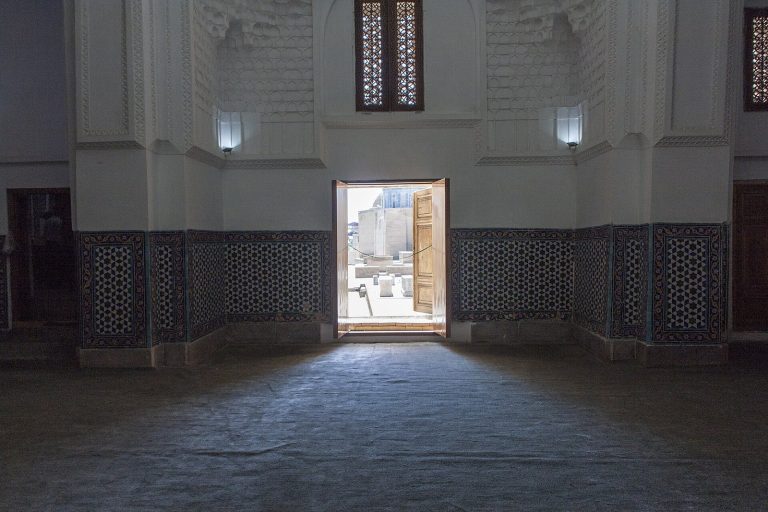
The middle group is composed chiefly of Timurid mausoleums built from the last quarter of the fourteenth century to the first half of the fifteenth century. They contain the burials of Timur’s relatives and of prominent military and religious figures. Most are cubic buildings with domes set on tall drums, the cylindrical or polygonal supports that raise a dome above the main structure. Their portal facades use muqarnas, tiered three-dimensional ornamental vaulting, together with richly worked ceramic surfaces.
Shadi-Mulk-Aka mausoleum
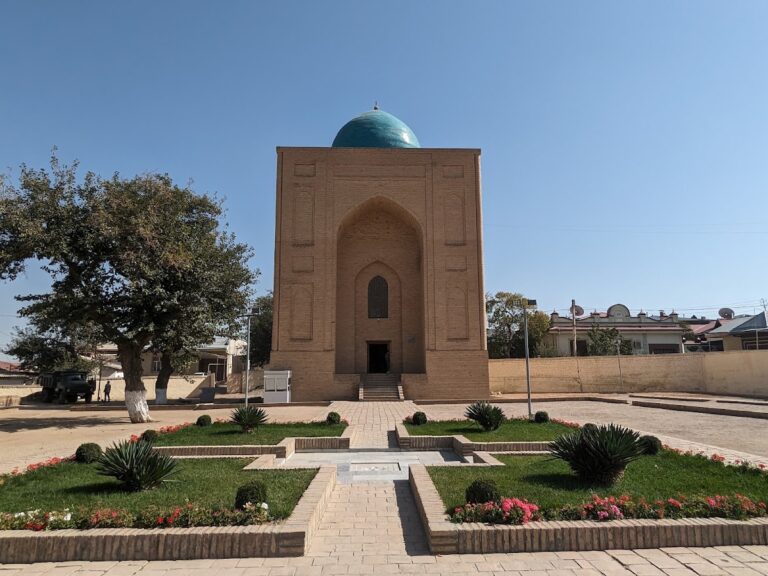
The mausoleum of Shadi-Mulk-Aka, also called Turkan-Aka, was built in 1371 and 1372 for Timur’s niece. Shamseddin, Baredin, and Zainuddin Bukhari are identified as its architects. The building is a small, single-chamber structure with a domed portal and is identified as the first Timurid building in Samarkand. Its principal facade is organized around a richly decorated portal.
Shirin-Bika-Aka mausoleum
The mausoleum of Shirin-Bika-Aka was built in 1385 and 1386 for Timur’s sister. Its dome rests on a sixteen-sided drum, and openings beneath it are closed by stucco arrangements incorporating glass in different colors. The interior walls are finely decorated. Together with the Shadi-Mulk-Aka mausoleum, it is among the best-preserved buildings in the complex, and its main facade is covered by an elaborately ornamented portal.
Amir-Zade and Tuglu-Tekin mausoleums
The mausoleum of Amir-Zade dates from 1386, while the mausoleum of Tuglu-Tekin dates from 1376. Two mausoleums identified as those of Emir Hussein and Amir-Zade stand opposite one another. Fragments of columns and mausoleum fabric, including material associated with Tuglu-Tekin and a noblewoman’s mausoleum, survive as architectural remains.
Ali Nassafi mausoleum
The Ali Nassafi mausoleum, named for its architect, dates to around 1385. Star motifs decorate its exterior, while the interior contains stalactite-like ornamental forms.
Ulugh Sultan Begum and Emir Burunduk mausoleums
The mausoleum of Ulugh Sultan Begum dates to around 1385. The mausoleum of Emir Burunduk, identified as the tomb of one of Timur’s generals, dates from the 1380s.
Octagonal mausoleum
An octagonal mausoleum near the Shirin-Bika-Aka mausoleum dates from the first half of the fifteenth century. Its sides have open openings and decoration made from glazed bricks arranged as mosaics. The building was probably originally covered by a dome set on a tall cylindrical drum. Its octagonal form was an unusual architectural type in the region.
Upper group
The upper group contains three mausoleums facing one another around a shaded courtyard. The buildings define the courtyard on its northern, eastern, and western sides and represent both the mid-fourteenth-century and Timurid phases of construction.
Khodja-Ahmad mausoleum
The Khodja-Ahmad mausoleum closes the northern side of the courtyard. It dates from the middle of the fourteenth century.
Unnamed noblewoman’s mausoleum
An unnamed mausoleum on the eastern or western side of the courtyard is dated to 1360 and 1361. It is also identified as the mausoleum of a noblewoman from that period.
Tuman-Aka complex
The mausoleum of Tuman-Aka was built in 1404 and 1405, or in 1405. The complex includes both a mausoleum and a commemorative mosque and is associated with one of Timur’s wives.
Qutluq-Aka mausoleum
The mausoleum of Qutluq-Aka, another of Timur’s wives, dates from 1360 and 1361.
Qutham ibn Abbas complex
Mausoleum and entrance door
The central feature of Shah-i-Zinda is the complex associated with Qutham ibn Abbas. Its mausoleum is among the oldest components of the ensemble. A door leading into the complex bears the date 1404 and 1405, carries carved decoration, and was originally inlaid with ivory.
Qutham ibn Abbas mosque
The complex includes a sixteenth-century mosque. The Qutham ibn Abbas mosque is a rectangular, three-domed building whose mihrab, the niche indicating the direction of prayer, is decorated with blue faience mosaic. An eleventh-century mosque was also exposed among the excavated remains elsewhere in the ensemble.
Pilgrims’ chamber and tomb
The pilgrims’ chamber has glazed-tile decoration and a dome divided into eight panels. In the mortuary chamber, Qutham ibn Abbas’s tomb is covered with colored majolica, a glazed ceramic surface.
Later structures and decoration
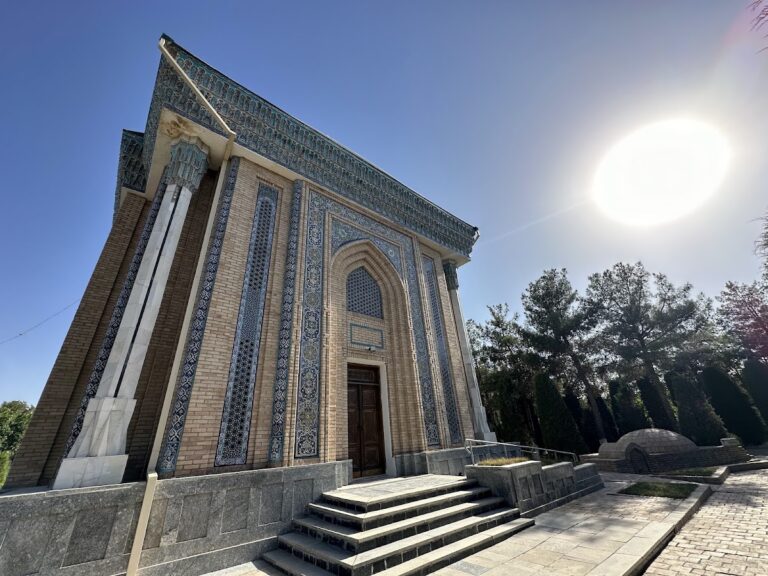
The mausoleums generally use turquoise decoration or dark-blue tilework with floral patterns. Their portals combine glazed and carved ceramics, glazed bricks, Arabic and Persian calligraphic inscriptions, and floral and geometric designs. Other structures include the Abdal-Aziz chartak, dated 1434 and 1435, the upper chartak from around 1405, the Kusamiya madrasa, the Davlet Kushbegi madrasa built in 1813, and the Summer Mosque built in 1909 and 1910.