Sevanavank: An Armenian Apostolic Monastery on Lake Sevan


Site at a Glance
- Rating
- 4.7
- Popularity
- Medium
- Country
- Armenia
- Primary era
- Medieval
- Eras represented
- Medieval, Early Modern
- Civilizations
- Armenian
- Site type
- Religious
- Remains
- Monastery
On this page15 sections
History
Sevanavank is an Armenian Apostolic monastery in Armenia, near the town of Sevan on the shore of Lake Sevan. Founded in 874 by Princess Mariam Bagratuni, it belongs to the medieval Armenian Christian tradition and was established during the renewed political importance of the Bagratuni dynasty, an Armenian ruling house that regained power in the ninth and tenth centuries. The monastery became a religious and cultural center in the historic Gegharkunik canton of Syunik province.
Earlier religious foundations
The site had a long religious history before the present monastery. A pagan sanctuary was established there in 305, and a fourth-century monastery associated with Saint Gregory the Illuminator later occupied the location. Arab forces destroyed that earlier monastery. In the late eighth and ninth centuries, monks returned to the island, establishing cells and a chapel before a larger monastic complex was built.
A foundation tradition connected with the future Catholicos Machtots relates that twelve Apostles appeared above Lake Sevan and indicated the place where the monastery should stand. A catholicos is the highest-ranking bishop in several ancient Christian churches, including the Armenian Apostolic Church. The thirteenth-century historians Stepanos Orbelian and Kirakos of Gandzak associated Machtots with the foundation of Sevanavank, while historical and epigraphic evidence places Princess Mariam’s foundation in 874.
Medieval monastery and fortress
Princess Mariam was the daughter of Ashot I Bagratuni and the wife of Vasak V, prince of Western Syunik. Under her patronage, the monastic settlement developed into a fortified religious complex with churches, monastic cells, service buildings, defensive walls, and a watchtower with a gate. The monastery was also associated with a fortress whose walls were destroyed during the sixteenth or seventeenth centuries.
Sevanavank was connected with the military history of the Armenian kingdom. King Ashot II Iron of Armenia stayed at the monastery when Arab forces approached the shore of Lake Sevan. He fought them near the monastery’s walls, with the monks taking part in the battle. The community regarded the victory as an act of Providence, reinforcing the monastery’s religious and political importance.
Restoration and later religious use
The monastery’s buildings were restored during the seventeenth and eighteenth centuries. In the eighteenth century, Sevanavank was an active center for producing illuminated manuscripts. A later tradition tells that monks, ashamed of the poor condition of some manuscripts before a visit by the Catholicos, threw them into the lake. The monastery subsequently entered a period of decline.
During the nineteenth century, Sevanavank served as a strict penitential retreat for monks from Etchmiadzin. Jean-Marie Chopin, who visited in 1830, described rules prohibiting wine, meat, young people, and women. At that time, the monastery possessed five villages, four mills, a ruined dairy, forty-six farms, gardens, and fields. Another visitor recorded that manuscripts were still being copied by hand in 1850.
Soviet transformation and continued worship
Soviet authorities destroyed much of the monastery during the 1930s, and the last monk left the island in 1930. The two surviving churches were restored in 1956 and 1957. The lowering of Lake Sevan’s water level during the Soviet period reduced the lake by approximately 20 metres and changed the former island into a peninsula.
Sevanavank is now associated with the Vazkenian Theological Academy of the Armenian Apostolic Church. Its churches continue to serve worshippers from the seminary and the nearby town of Sevan, preserving the site as an active religious complex as well as a medieval historical monument.
Remains
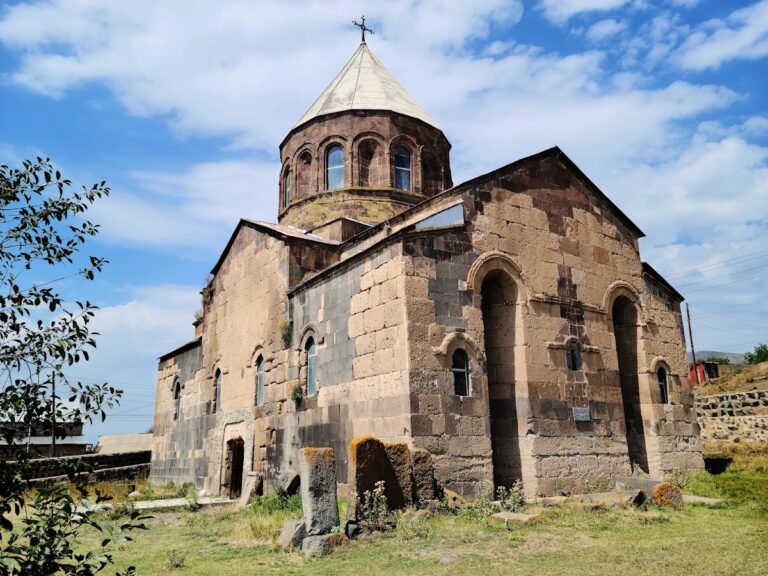
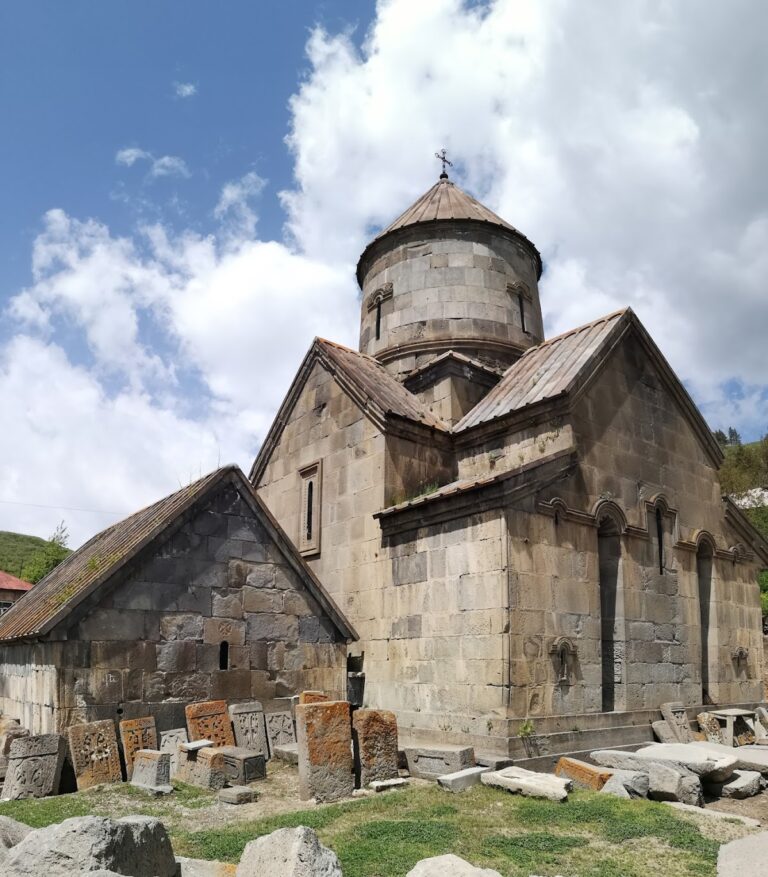
The surviving complex stands at approximately 2,000 metres above sea level on the southwestern part of the former island, now the southern part of the Sevan Peninsula. It occupies the southern part of the peninsula on the northwestern side of Lake Sevan. The principal remains are two small cruciform, three-apsed, domed churches, Surp Arakelots, or Holy Apostles, and Surp Astvatsatsin, or Holy Mother of God. Their broadly similar forms belong to an early stage in the Armenian transition from a free-cross plan to an inscribed-cross plan, in which the cross-shaped interior is more closely enclosed within the building.
The surviving churches
Surp Arakelots
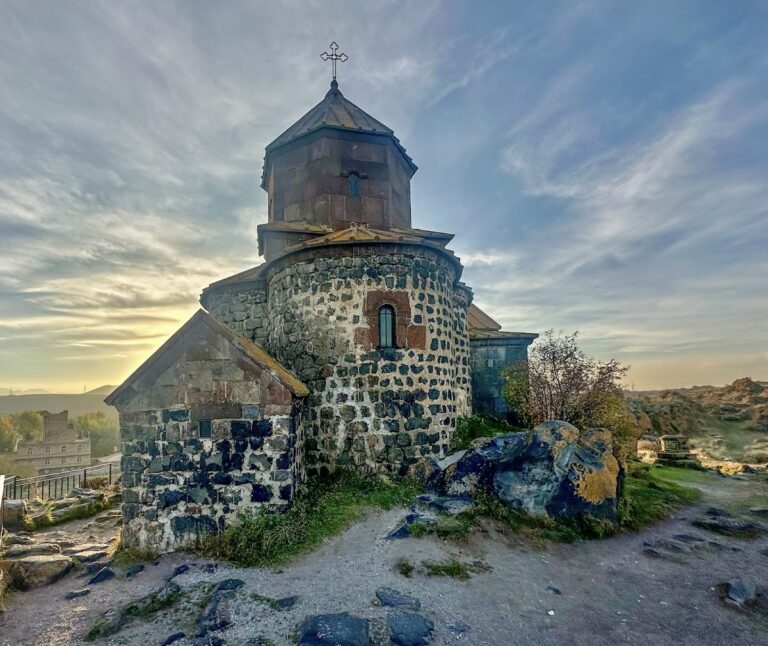
Surp Arakelots is the smaller of the two churches. Its triconch plan, meaning a central space with three projecting apses, places semicircular apses to the north, east, and south. A chapel occupies the southeast side, while a porch stands to the southwest. The central square is carried by squinches, architectural devices that turn a square space into a form capable of supporting a dome. Here they transform the drum into an octagon.
The drum has four windows and supports a steeply sloping conical roof. Its inclination was increased during the seventeenth- and eighteenth-century renovations. The church is built of irregular masonry, with more carefully finished upper sections. Light-colored mortar traces remain from the restoration work, and the building has a restrained exterior without recorded decorative carving.
Surp Astvatsatsin
Surp Astvatsatsin stands southeast of Surp Arakelots. It originally had a similar triconch form, but additional spaces were later added to the northeast and northwest, together with a southeastern chapel. The additions were covered with white plaster at an uncertain date. Southern and western entrances provide access to the church.
Its drum has an irregular shape resembling a cube with rounded corners. Rolled arches and pendentives, which transfer the weight of a dome onto supporting walls, formed its support system. The arrangement appears to have compensated for structural weakness in the original design. Renovations in the seventeenth and eighteenth centuries added khachkars, carved Armenian stone cross monuments, and narrow windows, while also making the roof steeper. The church is otherwise described as undecorated.
Carved doors and khachkar
Two carved walnut doors associated with Surp Astvatsatsin are preserved in the History Museum of Armenia in Yerevan. One dates from before 1176 and shows a cross surrounded by motifs arranged in a manner resembling a khachkar. The other was made by Abraham in 1486. It depicts Pentecost, the Christian feast commemorating the descent of the Holy Spirit, with an upper section showing Christ in a theophanic vision.
Inside Surp Astvatsatsin is a so-called living khachkar dated 1653. Trdat carved it in a naive style, arranging the Descent into Limbo below, the Crucifixion in the center, and Christ in a theophanic vision above. The sequence gives the stone cross a vertical narrative structure within the church.
Gavit and associated remains
Western vestibule
The ruins of a gavit, an Armenian monastic vestibule or assembly hall, are attached to the western facade of Surp Astvatsatsin. The contemporary building was destroyed in the 1930s. It was square, had a roof supported by wooden columns, and was topped by an erdik, a lantern-like opening in the roof. Khachkars remain among the ruins.
Wooden capitals
Four carved wooden capitals survive from the gavit. Two are held by the History Museum of Armenia and two by the Hermitage Museum in Saint Petersburg. Dating to the ninth century, they show paired half-palmettes shaped like chalices, with two doves set against a vegetal background. Their carving preserves an element of the monastery’s early architectural decoration beyond the surviving church walls.
Additional chapels and church foundations
Foundations near the two surviving churches mark additional buildings in the former monastic complex. They include two chapels and a third church, Surp Haroutioun, or Holy Resurrection. Surp Haroutioun stood at a higher level and was already ruined in the nineteenth century. A carved stone cross made by Grigor in 1448 came from its western wall and is now preserved in the History Museum of Armenia in Yerevan.
Fortified setting and surrounding buildings
The former defensive enclosure included a wall around the island and a watchtower with a gate. The wall was built on a rock-cut ledge formed around the island, while the defensive structures were destroyed in the sixteenth or seventeenth centuries. The changed shoreline now places the monastery on a peninsula rather than an island.
Modern buildings near the monastery include a Writers Union building, a residence of the Armenian presidency, and the Vazkenian Theological Academy. A beach has been established below the monastery on its southern side, while the churches and surviving fragments continue to define the historic religious complex above Lake Sevan.
Nearby sites