Selsey Abbey: The Anglo-Saxon Monastery and Bishopric of Sussex


Site at a Glance
- Rating
- 4.3
- Popularity
- Very Low
- Country
- United Kingdom
- Primary era
- Medieval
- External website
- Open
- Eras represented
- Medieval
- Civilizations
- Anglo-Saxon, Norman
- Site type
- Religious
- Remains
- Monastery
On this page10 sections
History
Selsey Abbey is an Anglo-Saxon monastery in the United Kingdom, at Selsey in West Sussex, founded around AD 681 by St Wilfrid of Northumbria. It stood on a royal estate granted by Æðelwealh, king of Sussex, and became the seat of the South Saxon bishopric. The foundation formed part of Wilfrid’s missionary work among the South Saxons during a period when Christianity was still becoming established in the region.
Wilfrid’s foundation
The estate given to Wilfrid contained a royal vill, meaning a king’s administrative and economic residence, and 87 hides. A hide was an Anglo-Saxon unit of land assessment linked to the resources needed to support a household or community, although its precise area varied. According to Bede, Wilfrid freed 250 enslaved people attached to the estate, baptized them, and undertook episcopal work among the South Saxons.
Wilfrid arrived in Sussex in 681 and remained for about five years, preaching and baptizing local people. Bede states that Æðelwealh and leading members of his kingdom had been baptized in Mercia, the Christian kingdom ruled by Æðelwealh’s wife Eafe’s father, Wulfhere. Bede specifically identifies Eafe as baptized, while the region may also have contained earlier British churches. Wilfrid’s community was Benedictine, following the Rule of Saint Benedict, although its dedication may have been to Saint Peter and remains uncertain.
Political conflict and the South Saxon see
The foundation was drawn into the political struggles of seventh-century southern England. Cædwalla, a West Saxon prince exiled by King Centwine, formed a spiritual compact with Wilfrid before invading Sussex. He killed Æðelwealh, was temporarily driven out by Berthun and Andhun, and later reconquered Sussex, killing Berthun. Cædwalla then made Wilfrid his supreme counsellor over the kingdom. Archbishop Theodore eventually settled Wilfrid’s dispute with ecclesiastical authorities, allowing him to return north around 686.
After Wilfrid’s departure, probably around 686, Selsey was absorbed into the West Saxon ecclesiastical system under the bishops of Winchester. The Selsey see, the institutional center of a bishop’s jurisdiction, was formally established in 709, when the large West Saxon diocese was divided during the reign of King Ine. Eadberht, abbot of Selsey, was consecrated as its first bishop by a synodal decree, a formal decision issued by an ecclesiastical council.
Selsey remained the seat of the South Saxon bishops for approximately 370 years, from Wilfrid’s period until the transfer of the see after the Norman Conquest. Around twenty-two bishops held the see during this time. By the end of the period, Selsey was probably the poorest bishopric in England, and the early history of the community is difficult to reconstruct because many surviving records are later copies or forgeries and episcopal lists are incomplete.
The plague tradition
In 681, while Eappa was abbot, plague severely affected the monastery. The monks responded with three days of fasting and prayer. Bede, an early eighth-century Northumbrian monk and historian, preserved a tradition that Saints Peter and Paul appeared to a sick newly converted boy. They announced that the other afflicted monks would recover, but foretold the boy’s death and his entry into heaven through the intercession of Saint Oswald.
Transfer to Chichester
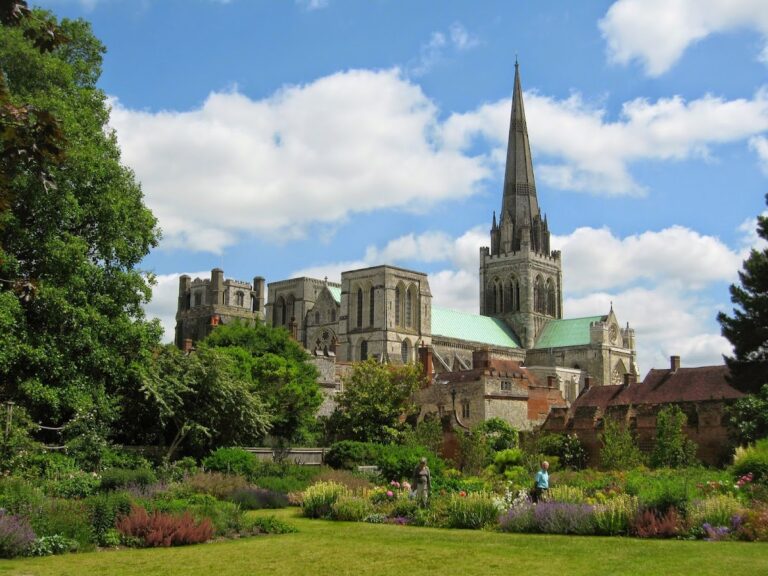
The Council of London in 1075 decreed that bishoprics should be centered in cities rather than villages. Selsey’s community and bishopric were consequently transferred to Chichester after the Norman Conquest. The move probably took several years, and construction of the new cathedral did not begin until the 1090s. Stigand may have continued to use the title Bishop of Selsey until 1082.
Remains
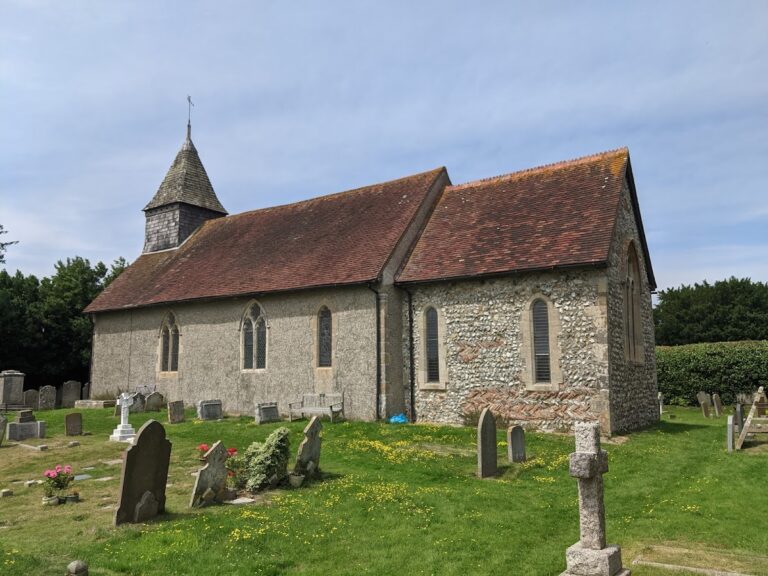
The exact position of Selsey Abbey and its former cathedral church remains uncertain. The most likely location is the site of the former parish church at Church Norton, just north of modern Selsey, associated with the present St Wilfrid’s Chapel. The physical evidence includes substantial stone foundations, a defensive earthwork, a separate tower tradition, and carved stone fragments connected with the early ecclesiastical community.
Church Norton and the former cathedral site
An excavation in 1911 investigated a mound beside St Wilfrid’s Chapel. It revealed substantial stone foundations belonging to a square tower, together with the remains of a ringwork, a defensive earthwork formed mainly from a raised bank and surrounding ditch. A tenth-century bronze belt tab, of a type associated with ecclesiastical settings, was also found. These remains have been used to support the identification of Church Norton with the site of the former cathedral and monastery.
The square tower was probably built in the eleventh century or earlier as a fortification rather than as part of the church. The associated ringwork may have been established soon after 1066, perhaps to protect Wilfrid’s seventh-century church while Selsey continued to serve as the seat of the bishopric. The separate tower survived until 1602, when it blew down. A replacement tower was built in 1662 and attached to the church instead of standing separately.
Church images and surviving traditions
The former church appears on a thirteenth-century seal of Chichester Cathedral’s chapter, the body of clergy responsible for administering the cathedral and its religious affairs. It is also shown in a sixteenth-century painting by Lambert Barnard. The image presents a Saxon-style church with a separate tower and depicts the church and bell tower at Church Norton as they appeared in the sixteenth century.
A churchwarden’s record from 1662 stated that the church itself had never possessed a steeple and that the nearby tower had formerly belonged to a ruined castle where the bells were hung. The separate tower’s defensive character and its relationship to the church therefore remained part of local historical memory long after the structure had disappeared.
Cross fragments and burial associations
Stone artifacts found in the area include remnants of a palm cross believed to have stood outside Wilfrid’s cathedral. Its surviving design resembles the Bewcastle Cross, and the Selsey cross has consequently been considered similar or identical in design. The feature also retained a place in the later history of the churchyard. Geoffrey Thomson, rector of Selsey, requested burial beside the palm cross in 1545.
Bishop William Reade’s will of 1382 requested burial before the high altar of the church at Selsey, which he described as the former cathedral church of his diocese. This reference connects the later church with the memory of Selsey’s episcopal role, even after the bishopric had moved to Chichester.
The drowned cathedral tradition
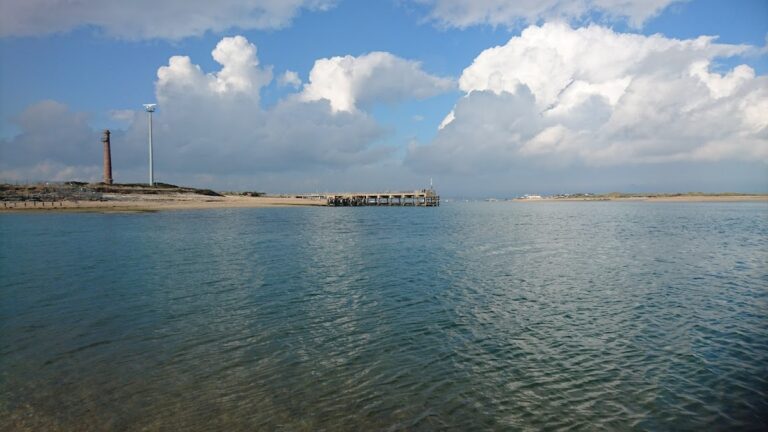
Local traditions place the cathedral beneath the sea and claim that its bell can be heard during rough weather. A possible basis for the story is The Mixon, a reef now submerged but habitable in the eleventh century. Another proposed underwater location is The Park, a former deer park belonging to the bishops of Chichester. These traditions preserve uncertainty about the final form and position of the early church, while the Church Norton evidence provides the principal land-based candidate for Selsey’s ecclesiastical center.