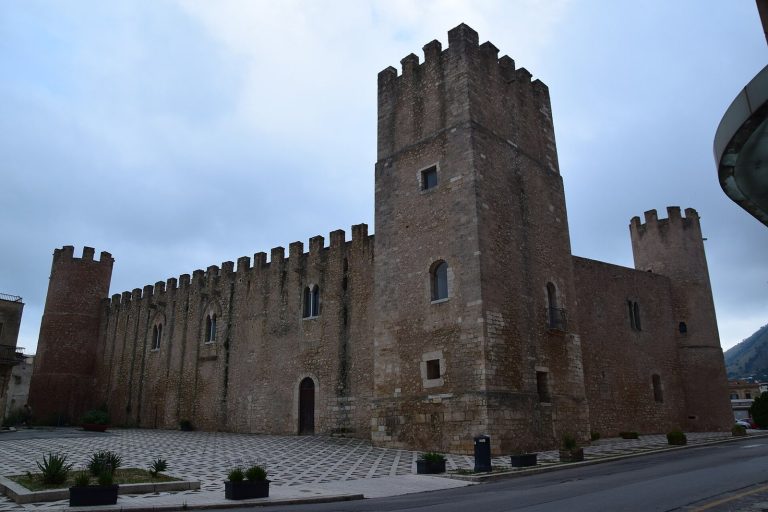
Palazzo Crociferi: A Baroque Municipal Palace in Castellammare del Golfo
Site at a Glance
- Rating
- 4.5
- Popularity
- Very Low
- Country
- Italy
- Primary era
- Early Modern
- External website
- Open
- Eras represented
- Early Modern, Modern
- Civilizations
- Italian, Kingdom of Sicily, Spanish
- Site type
- Civic
- Remains
- Palace
On this page10 sections
History
Palazzo Crociferi, also known as Palazzo del Comune, is a Baroque palace in Castellammare del Golfo, Italy, built between 1659 and 1660 and completed for the Crociferi Fathers in 1663. Its design includes elements of the Tuscan order, a relatively plain classical tradition derived from Roman architecture. Together with the town’s castle and Mother Church, it remains a local point of reference and is now the seat of the municipality.
Foundation for the Crociferi Fathers
The palace was commissioned by Francesca Balsamo, Princess of Roccafiorita, after she purchased the barony of Castellammare del Golfo from Luigi Guglielmo Moncada, viceroy of Sicily, on 31 August 1641. She died before the work was finished, but the building followed her wishes. Her will of 1648 assigned money for its construction and stated that ownership should pass to San Bartolomeo Hospital in Palermo if the Crociferi were suppressed or removed.
The Crociferi, also called the Camillians, were a Catholic religious order devoted to caring for the sick and dying. They settled in Castellammare in 1641, initially living in the countryside in the area still known as Contrada Crociferi. They stayed there for more than two decades and built a small church that no longer survives. Giuseppe Mariani designed the palace, while the Palermitan builder Marco Serio carried out the construction.
From 1663 until 1870, the Crociferi occupied the palace and provided spiritual, medical, and nursing assistance. Their work included caring for poor patients taken from the streets and people left on the shore by passing sailing vessels. The convent’s infirmary occupied the eastern side of the complex and part of the internal atrium, now known as the Arena delle Rose. Through these activities, nursing and hospital assistance became established in the town.
The foundling wheel
From the beginning, a foundling wheel stood to the right of the main entrance. Infants could be placed into the wheel anonymously, after which the Crociferi arranged their care with wet nurses. The children were later entrusted to childless families living outside Castellammare. They were baptized immediately and received surnames connected with devotion or the circumstances of their arrival.
During the first half of the nineteenth century, Vita Di Stefano, known locally as “za Vita la rutara,” received infants placed in the wheel and turned them into the building. The Crociferi entrusted her with this responsibility. Her role preserves a particular part of the palace’s history as a religious and charitable institution.
Transfer to civic use
After the period of Savoy rule in Sicily and the suppression laws of 1866, the Crociferi were forced to leave the palace and their church. Both buildings were transferred to civil use, and the palace was granted to the municipality. A judgment dated 17 December 1869, published on 11 February 1870 and upheld on appeal on 16 September 1870, instead recognized San Bartolomeo Hospital in Palermo as the exclusive owner.
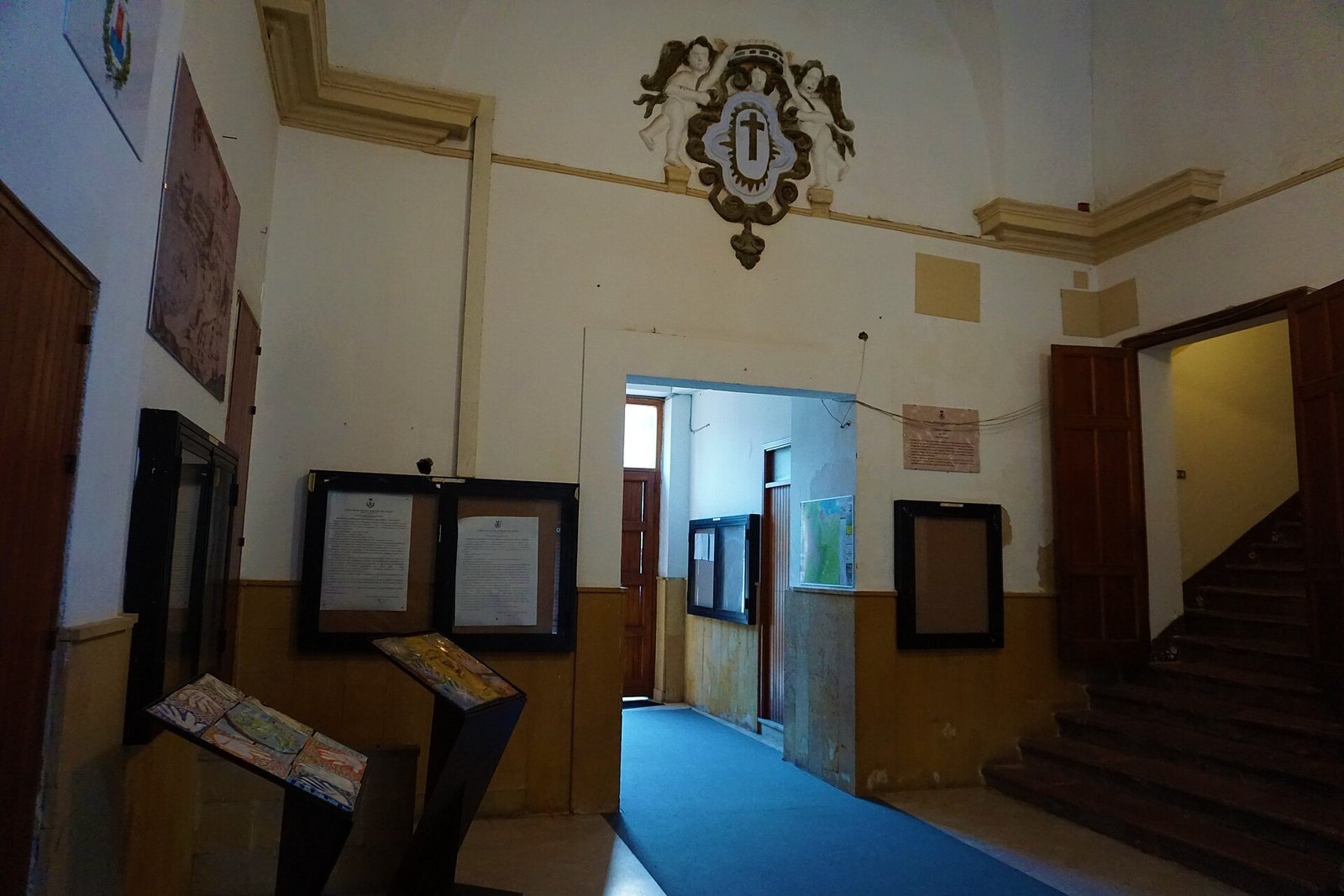
The municipality acquired the building through a settlement deed dated 1 April 1887, concluded before the notary Salvatore Briguccia and registered in Castellammare, for 55,000 lire. The palace’s interior was then reorganized for municipal functions, ending its use as a convent. The adjoining Church of Maria Santissima degli Agonizzanti, formerly the spiritual center of the Crociferi, was closed for worship and adapted as the municipal council chamber.
Palazzo Crociferi was declared unusable after the 1968 earthquake, and the municipal offices were temporarily moved elsewhere. The adjoining church was also closed because of serious structural damage. Since the 1920s, the building has additionally served theatrical purposes: its ground floor has housed the town theatre since 1926, while the former convent atrium was adapted from the 1980s onward as the open-air Arena delle Rose. The palace is currently used for municipal, theatrical, and auditorium functions.
Remains
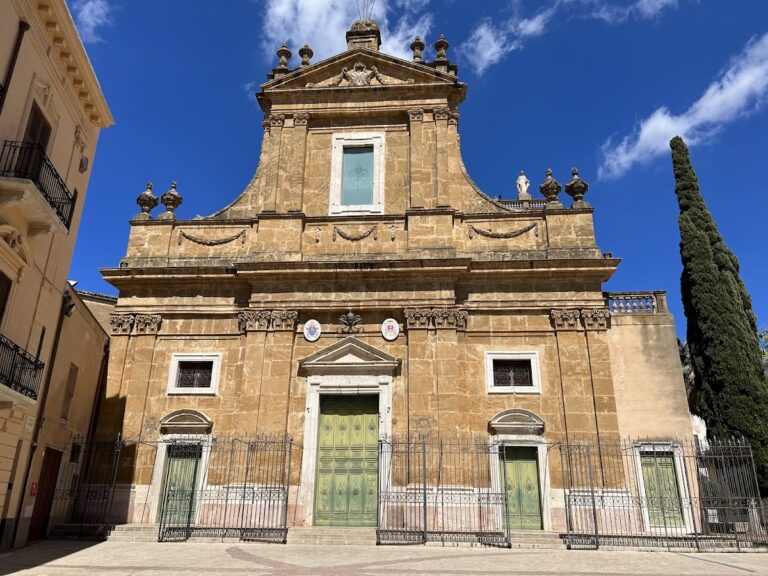
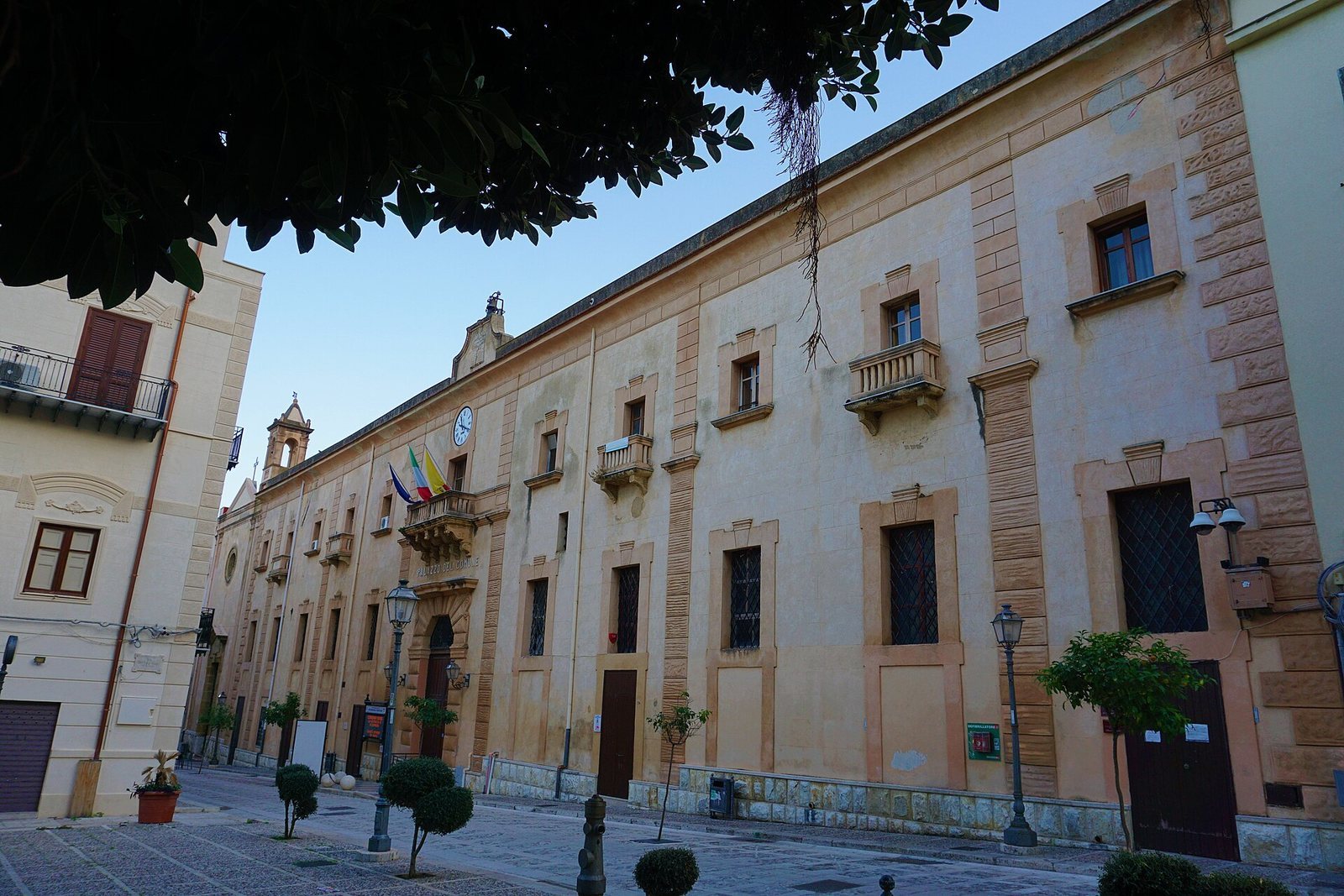
Palazzo Crociferi stands on Corso Bernardo Mattarella opposite Villa Regina Margherita. Its north-facing facade runs along the street and, together with the adjoining Church of Maria Santissima degli Agonizzanti, forms the largest building on that road. The three-level palace retains the composition attributed to Giuseppe Mariani, although it has undergone later restoration and internal changes.
Facade and entrance
The facade is organized into three horizontal levels of windows and balcony openings, centered on the main portal, principal balcony, and clock. Four doors on the eastern side of the ground floor lead to the Teatro Apollo, while two western doors open toward municipal offices. The second level has four barred windows on either side of the central axis. On the third level, three windows alternate with two small balconies on each side, and the balconies rest on decorated brackets.
The late-Baroque portal consists of two pilasters supporting an arch-like form and an architrave inscribed “Palazzo del Comune.” Above it, the principal balcony rests on five Baroque brackets and provides a place for three institutional flags. A clock is set above the opening onto the balcony. The cornice carries a distinctive crown-like feature with a bell and a representation of the city symbol. The portal and its carved decorations were made in 1707 by the Palermitan carvers Stefano Curto, Domenico D’Acquario, and their associates.
Former convent and associated spaces
Arena delle Rose
The former convent contained an internal atrium with a centrally positioned well that supplied water to the building. The cloister was later adapted as the Arena delle Rose, an open-air theatre named for the numerous rose bushes that grew there. It can be reached through the principal entrance on Corso Bernardo Mattarella or through a secondary entrance on Via Alcide De Gasperi.
Teatro Apollo Anton Rocco Guadagno
The ground-floor section adjoining the church contains the Teatro Apollo Anton Rocco Guadagno. Built in the Liberty style, the Italian expression of Art Nouveau, it has 198 seats and presents prose and musical performances. Its four entrances open onto Corso Bernardo Mattarella. The theatre is dedicated first to Apollo and subsequently to the musician Anton Rocco Guadagno, who was born in Castellammare in 1923.
Church of Maria Santissima degli Agonizzanti
The former Church of Maria Santissima degli Agonizzanti remains physically associated with Palazzo Crociferi. Once the spiritual center of the Crociferi community, it was adapted as the municipal council chamber after the complex entered civic use.