Schuttern Abbey: A Benedictine Monastery and Baroque Parish Church in Germany
Site at a Glance
- Rating
- 4.8
- Popularity
- Very Low
- Country
- Germany
- Primary era
- Early Modern
- External website
- Open
- Eras represented
- Medieval, Early Modern
- Civilizations
- Holy Roman Empire
- Site type
- Religious
- Remains
- Monastery
On this page13 sections
History
Schuttern Abbey is a former Benedictine monastery in Germany, located in Schuttern, part of Friesenheim in Baden-Württemberg. Its early medieval origins probably date to the sixth or seventh century, while the present abbey church belongs to the Late Baroque period and was built between 1767 and 1772. Dedicated to Saint Mary and Saints Peter and Paul, the abbey became one of the early monastic foundations of the Ortenau and developed an important religious, economic, and political position.
Early foundation and Benedictine development
The abbey’s own tradition placed its foundation in 603 and attributed it to a founder named Offo. No contemporary evidence confirms this account. An early religious cell called Offoniswilare or Offonis Cella probably arose during the sixth or seventh century as Christianity spread along the right bank of the Rhine. Its development was connected with Irish-Scottish missionary activity and the growing influence of the Diocese of Strasbourg, although the identification of Offo as the historical founder remains uncertain.
By the Carolingian period, the community had probably been placed under royal or imperial protection. Between 746 and 753, Saint Pirmin, an eighth-century missionary and monastic reformer, subjected it to the Benedictine Rule, the monastic code associated with Saint Benedict of Nursia. This helped establish the community within the wider Benedictine tradition and supported its economic growth.
Schuttern’s wealth was already notable in 817, when it appeared among the sixteen richest imperial monasteries listed for military service under Louis the Pious. Its intellectual life is reflected by the Schuttern Gospels, commissioned by Abbot Bertrich and written by the deacon Liutharius. The manuscript preserves evidence of a highly developed writing school and is now held by the British Library in London.
Imperial status and medieval conflicts
In 975, Emperor Otto II granted the monastery an immunity privilege. This removed it from the jurisdiction of regional secular authorities and confirmed the monks’ right to elect their abbot. In 1007 or 1009, the future Emperor Henry II transferred Schuttern, together with Gengenbach Abbey, to the newly founded bishopric of Bamberg. During a visit in 1016, he also granted the monastery the neighboring parish church of Friesenheim.
From 1025 onward, the monastery generally appears under the name Schuttern or Scutera. The connection between this change of name, its position as a Bamberg-dependent monastery, and the Cain-and-Abel mosaic created at the beginning of the eleventh century remains uncertain. Fires in the twelfth and thirteenth centuries probably destroyed the Romanesque monastery buildings and much of the written record. Further destruction caused by war, looting, and arson is associated with events in 938, 1153, 1166, 1169, 1240, 1334, and 1520.
A secular bailiwick, meaning a protective jurisdiction exercised by a lay official over an ecclesiastical institution, is recorded at Schuttern from 1235. The Lords of Geroldseck apparently used this office to take substantial monastic property. After the Diersburg line died out, the bailiwick returned to the main Hohengeroldseck line in 1277 and 1278.
The settlement of Schuttern received town status in 1327. The Geroldsecks used their position to build a castle there, which became a strongpoint during the early fourteenth-century conflict between the Habsburg and Wittelsbach dynasties over the succession to the German kingship. Strasbourg’s citizens destroyed both the monastery and the town in 1334 and 1335.
Reform, war, and political change
The Palatine counts of the Rhine annexed the Geroldseck territory in 1486 and acquired the bailiwick of Schuttern between 1486 and 1495. Emperor Maximilian I removed the bailiwick from their control during the Bavarian War in 1504. From that year, the abbey’s political orientation turned toward Austria, even though it formally remained subject to the Church of Bamberg.
Schuttern joined the Bursfeld Congregation in 1490. This was an association of Benedictine monasteries formed to coordinate religious observance and reform. The abbey remained affiliated with it until the Strasbourg prince-bishop forced its withdrawal in 1623. In 1624, pressure from the same prince-bishop led Schuttern to enter the newly founded Strasbourg Benedictine Congregation, with reform efforts involving Weingarten, Ochsenhausen, and Saint Blaise.
The Peasants’ War affected the monastery in 1525, and a major fire reduced it to ruins in 1548. The settlement lost its town rights during these upheavals. Despite this decline, Schuttern retained an important constitutional position. It was admitted at Worms in 1521 as an old imperial monastery and quasi-immediate abbey, meaning that it held its territory directly from the Holy Roman Emperor rather than from a regional prince. It received one curial vote on the Swabian Bench of Prelates and was listed in 1532 as a member of the Swabian Imperial Circle with its own military contingent.
Swedish forces destroyed the monastery in 1633 during the Thirty Years’ War, a wider European conflict that involved religious divisions and struggles among major political powers. The monks were expelled under Abbot Tobias Rösch. By the late seventeenth and early eighteenth centuries, the abbot had effectively become a member of the Estates of Further Austria, although the monastery formally remained connected to Bamberg.
Baroque rebuilding and dissolution
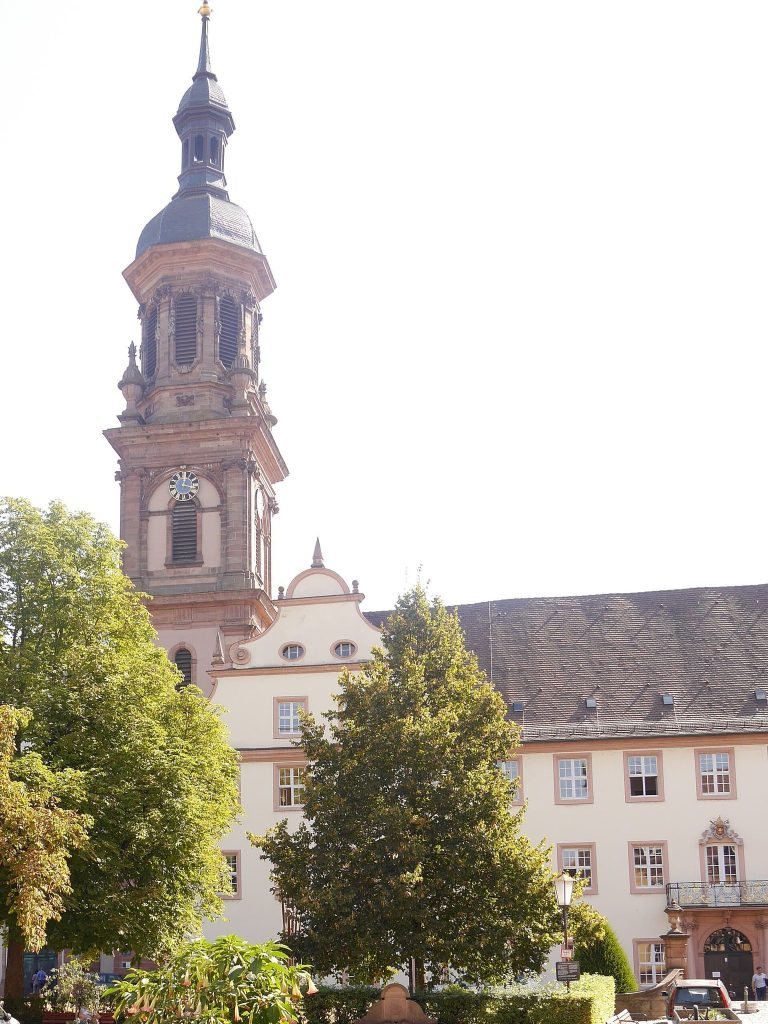
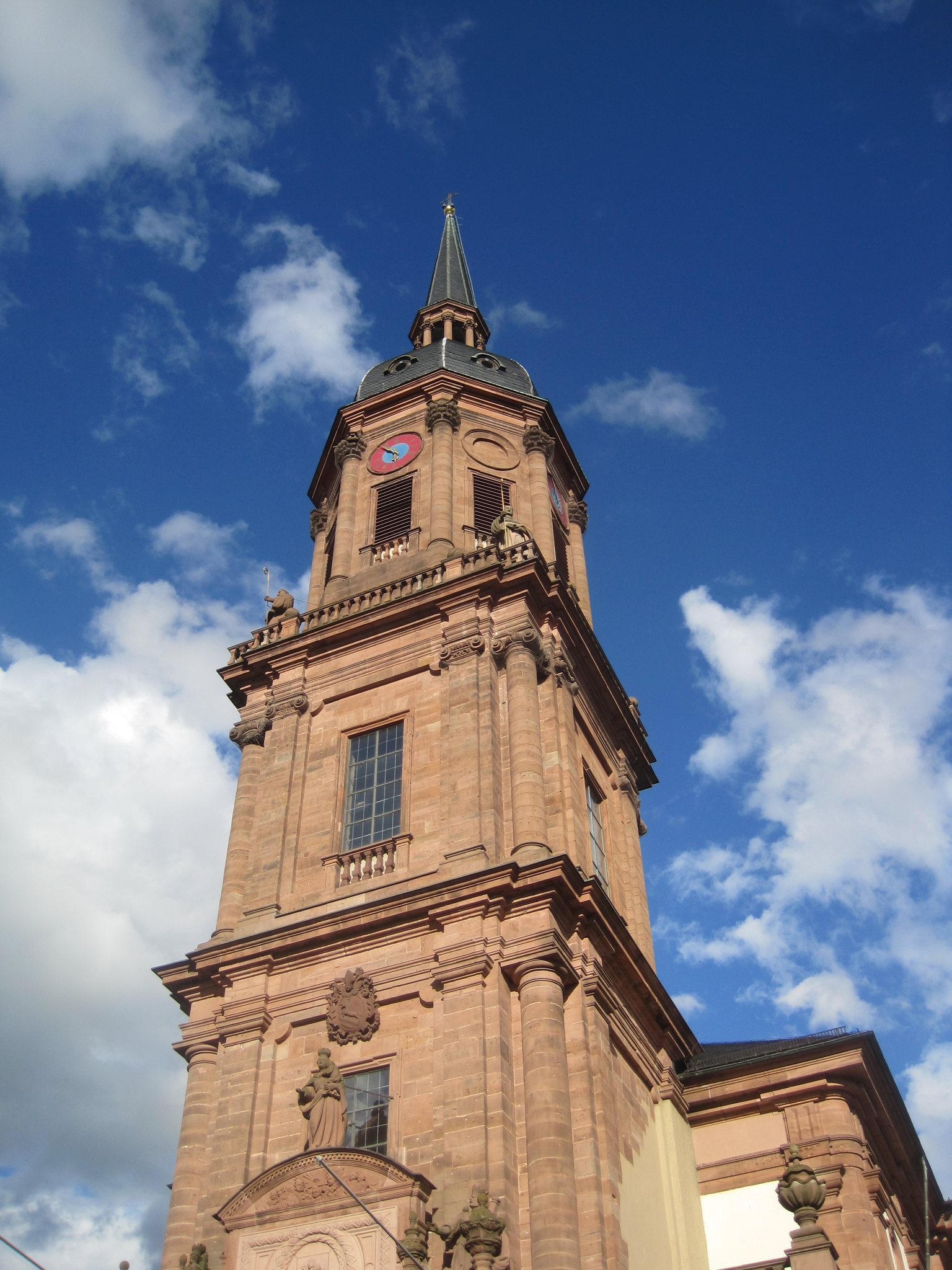
Under Abbot Placidus II Hinderer, the church tower was built in 1722 and 1723, and construction of a new Baroque monastery complex began in 1722. The tower shows French stylistic influence, and its construction is attributed to the Vorarlberg architect Peter Thumb, although the attribution is not sufficiently documented. Austrian troops suppressed unrest among the peasants of Schuttern in 1743.
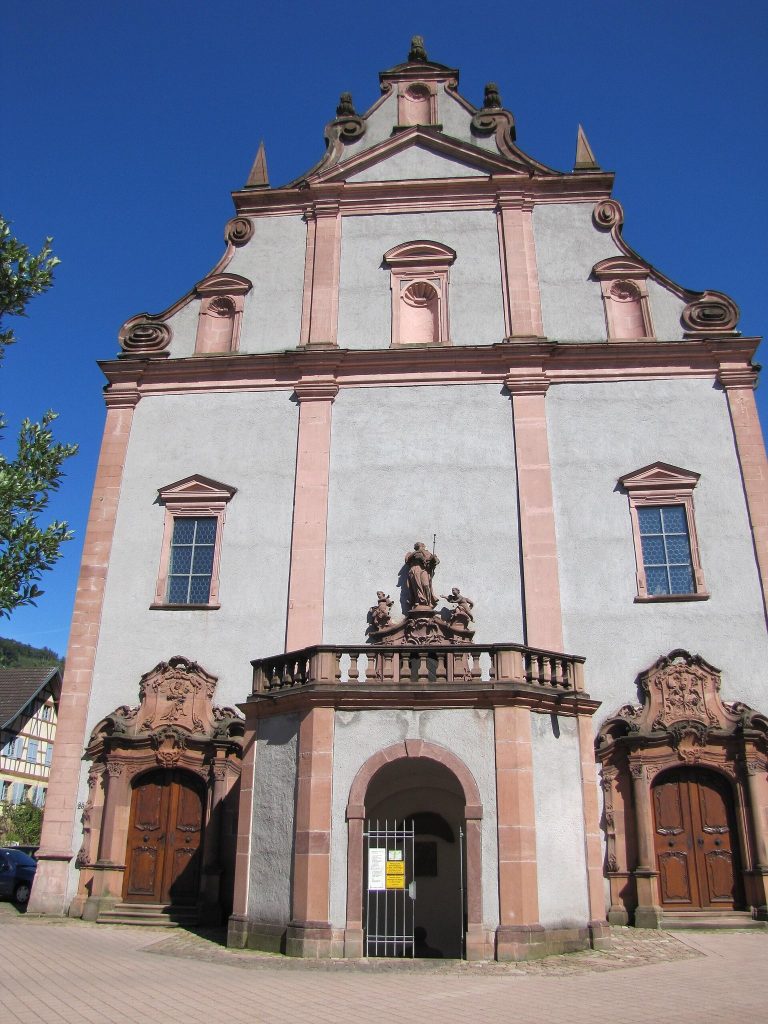
Under Abbot Karl Vogel, the abbey entered a final period of prosperity. The present Late Baroque abbey church was built between 1767 and 1772 by Joseph Michael Schnöller and consecrated in 1772. On 6 May 1770, Marie Antoinette, the daughter of Empress Maria Theresa and future queen of France, spent her last night on German soil at Schuttern while travelling from Vienna toward Versailles for her marriage to Louis XVI.
The Treaty of Lunéville in 1801 transferred Schuttern and the Austrian Breisgau to the Duke of Modena. In 1803, the monastery came into the possession of the Order of Saint John. The Treaty of Pressburg in 1805 then transferred the territory to Baden. Baden dissolved the Benedictine community in 1806 under its last abbot, Placidus III Bacheberle. The former monastery’s lands in the Ortenau, Breisgau, Alsace, Swabia, and Lorraine also passed to Baden.
After secularization, the monastery church became the parish church of Schuttern. Most of the Baroque monastery buildings were demolished, and much of the complex disappeared during the nineteenth century. Archaeological investigations directed by Karl List between 1972 and 1975 examined the church basement and exposed remains of earlier buildings. A general restoration of the church in the late 1970s incorporated extensive archaeological work and made surviving medieval remains accessible to the public.
Remains
Church and archaeological remains
Late Baroque abbey church
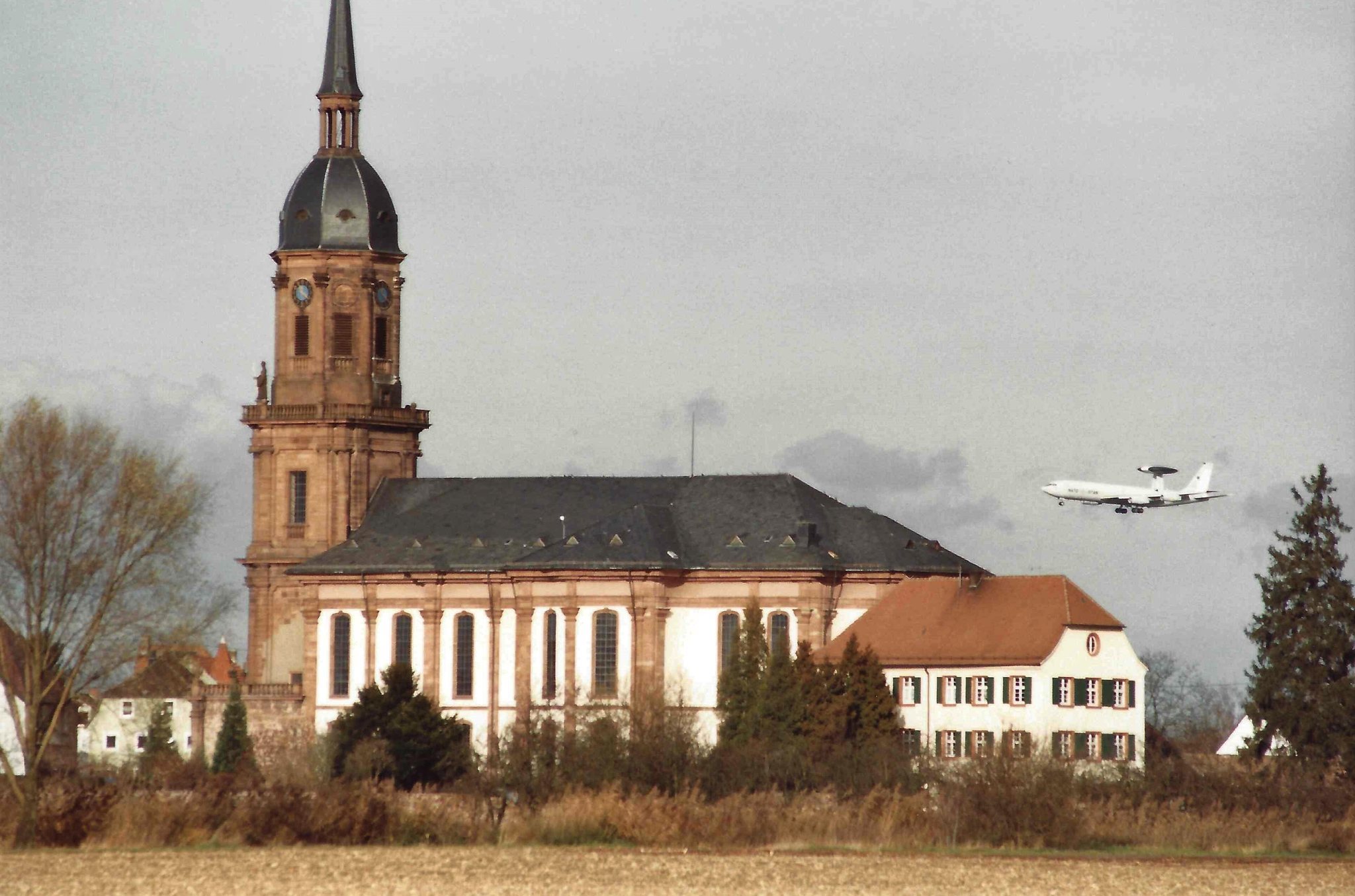
The former abbey church is now the parish church of the Assumption of the Virgin Mary and is the principal surviving part of the monastery. Its building incorporates earlier phases. The tower, erected in 1722 and 1723 under Abbot Placidus II Hinderer, is associated with Peter Thumb and displays French stylistic influence. The nave was constructed from 1767 to 1772 by Joseph Michael Schnöller, while Christian Eitel created the interior stucco furnishings in 1770.
The church originally possessed a crossing dome, but this was demolished in 1821. A fire in 1853 destroyed the Baroque interior furnishings. The surviving church therefore combines the fabric of the eighteenth-century rebuilding with later changes that altered its original appearance.
Crypt mosaic and predecessor buildings
The church basement or crypt contains the surviving portion of an early eleventh-century floor mosaic showing Cain killing Abel. A floor mosaic is a decorative pavement formed from small pieces of stone, glass, or similar materials. The scene depicts the biblical story in which Cain kills his brother Abel. The mosaic was laid at a memorial site possibly associated with the traditional founder Offo and is regarded as the oldest surviving example of its type in Germany, although it is no longer complete.
The church stands on the site of a Roman settlement, probably a relatively large and richly appointed fourth-century villa rustica, a Roman rural estate with agricultural facilities and a substantial residence. Architectural fragments from that settlement were reused in the church and in the construction of graves. Parts of several predecessor buildings remain preserved in the church basement following the excavations of 1972 to 1975.
Former monastic complex
Conventual and service buildings
The former monastery extended well beyond the church. Surviving components include the present presbytery, which was part of a large conventual building containing the refectory, or communal dining hall. The former chancellery, the tithe barn, several ancillary buildings, and sections of the monastery wall also remain. Together, these structures preserve parts of the administrative, residential, agricultural, and enclosed areas of the former abbey.
Geroldseck castle
A castle erected by the Lords of Geroldseck at Schuttern served as a military strongpoint during the early fourteenth century. The former moated castle continued to exist from the fifteenth to the seventeenth century, reflecting the settlement’s changing relationship with the secular lords who held the abbey’s bailiwick.
Written and reused evidence
The Schuttern Gospels remain an important surviving record of the monastery’s intellectual activity. Written in 817 by the deacon Liutharius for Abbot Bertrich, the manuscript reflects the quality of the abbey’s writing school and is preserved at the British Library in London. At the site itself, reused Roman building materials and the early medieval mosaic connect the later monastery with earlier Roman and Christian phases of occupation.