Gengenbach Abbey: A Benedictine Imperial Abbey in Germany
Site at a Glance
- Rating
- 4.8
- Popularity
- Low
- Country
- Germany
- Primary era
- Early Modern
- External website
- Open
- Eras represented
- Medieval, Early Modern, Modern
- Civilizations
- German, Habsburg, Holy Roman Empire
- Site type
- Religious
- Remains
- Monastery
On this page13 sections
History
Gengenbach Abbey was a Benedictine monastery in Gengenbach, Germany, founded in the eighth century by Saint Pirmin with the support of the Frankish count Ruthard. Established on royal land at the entrance to the Kinzig Valley on the edge of the Black Forest, it became an important religious, political, and economic institution. The monastery later held the status of an imperial abbey, subject directly to the Holy Roman Emperor, and remained a Catholic Benedictine foundation until its secularization.
Foundation and Carolingian connections
Saint Pirmin, an eighth-century missionary bishop and monastic founder, established Gengenbach probably after 748. Monks from Gorze Abbey settled the new community, which adopted the rule of Chrodegang of Metz in 761. Chrodegang’s rule helped regulate communal religious life before the widespread adoption of the Benedictine Rule, which emphasized prayer, obedience, and disciplined community living.
The community grew to about 100 members during the ninth century and maintained close relations with the Carolingian rulers. Gengenbach served as a right-bank support point of the Frankish realm, and Odilo, Duke of Bavaria, was buried there. Through its connections with the Carolingian monarchy, the monastery developed into a royal or imperial foundation.
Reform and medieval lordship
In 1007, Emperor Henry II transferred Gengenbach to the newly founded Prince-Bishopric of Bamberg. The monastery became the bishop’s own foundation while retaining the freedom to elect its abbot and protector, together with its royal liberty, under a papal privilege of 1139. Its protectors later included the Zähringen, the Staufen rulers from 1218, the bishops of Strasbourg from 1245, and the lords of Lichtenberg.
These protective rights were connected with the Ortenau imperial bailiwick, an administrative territory governed on behalf of the emperor. Rudolf of Habsburg established the bailiwick, although neighboring rulers usually held it in pledge until 1551 or 1556. Papal confirmations in 1139, 1235, 1252, and 1287, as well as imperial confirmations in 1309, 1331, and 1516, supported the abbey’s possessions and privileges.
During the Investiture Controversy, the conflict between the papacy and secular rulers over the appointment of bishops and abbots, Gengenbach supported the German rulers. The abbots Poppo, Ruotpert, and Willo were connected with the reform monastery of Michelsberg in Bamberg. Willo and his successor Hugo I were temporarily expelled by supporters of the Gregorian reform, which sought greater independence for the Church from secular control.
A further reform began around 1117 under Abbot Theoger of Saint George’s Abbey and Bishop Otto I of Bamberg, with the participation of Abbot Friedrich I. It followed the Hirsau and Saint George’s traditions, reform movements that promoted stricter Benedictine observance. The earlier abbey church was demolished and replaced in 1120.
Town, territory, and imperial status
The settlement around the monastery had developed into a town by 1231 and became an imperial city in 1360. The abbot appointed the town’s imperial reeve, a secular official with administrative and legal responsibilities. During the thirteenth and fourteenth centuries, the abbey also encouraged Gengenbach’s economic development, while the settlement of Zell am Harmersbach was founded on abbey territory.
Gengenbach’s landed lordship grew from its original estates along the lower and middle Kinzig into the wider Ortenau and the Neckar region. It rested on demesne agriculture and manorial administration. The abbey held patronage rights over churches in Gengenbach, Biberach, Steinach, Niedereschach, and elsewhere, as well as over the pilgrimage chapel of Saint James on the Bergle, consecrated in 1294. Some of these churches were incorporated into the abbey.
Gengenbach became an imperial abbey in 1334. Under Abbot Lamprecht von Brunn, who served from 1354 to 1374, the monastery entered a period of prosperity. Lamprecht was also chancellor to Emperor Charles IV and later bishop of Brixen, Speyer, Strasbourg, and Bamberg. He reorganized the abbey’s finances, opposed the neighboring lords of Geroldseck, and introduced a guild constitution in the town.
Reformation, war, and dissolution
During the fifteenth century, the monastery followed a largely secular collegiate way of life dominated by aristocratic conventuals. In 1461, admission was restricted to nobles. Attempts to turn the monastery into a collegiate foundation and to introduce the Bursfeld Reform, which sought stricter observance and cooperation among Benedictine houses, failed at the beginning of the sixteenth century.
After Gengenbach adopted Lutheranism in 1525, the abbey’s religious future became uncertain. Abbot Melchior Horneck von Hornberg converted to Calvinism with the support of Landvogt Count Wilhelm von Fürstenberg. In the same year, Fürstenberg and several town councillors detained the abbot and some monks while seeking the abbey’s dissolution. The monastery survived, remained Catholic after the Augsburg Interim of 1548, and the town later returned to Catholic observance.
After the Ortenau pledge was redeemed, the territory returned to the Habsburgs in 1551 or 1556. Gengenbach joined the Bursfeld Union in 1607, but pressure from Strasbourg Bishop Archduke Leopold of Austria and the involvement of Jesuits led the abbey to withdraw. In 1618 it joined the newly founded Strasbourg Benedictine Congregation.
The town and monastery suffered severe damage during the Thirty Years’ War, the long European conflict that began in 1618, and during the War of the Palatine Succession in 1689. Repairs followed under the Baroque master builder Franz Beer in 1693 and Johann Jakob Rischer from 1702. Gengenbach remained a directly imperial Benedictine abbey in the Swabian Imperial Circle, with one curial vote on the Swabian Bench of Prelates in the Imperial Diet.
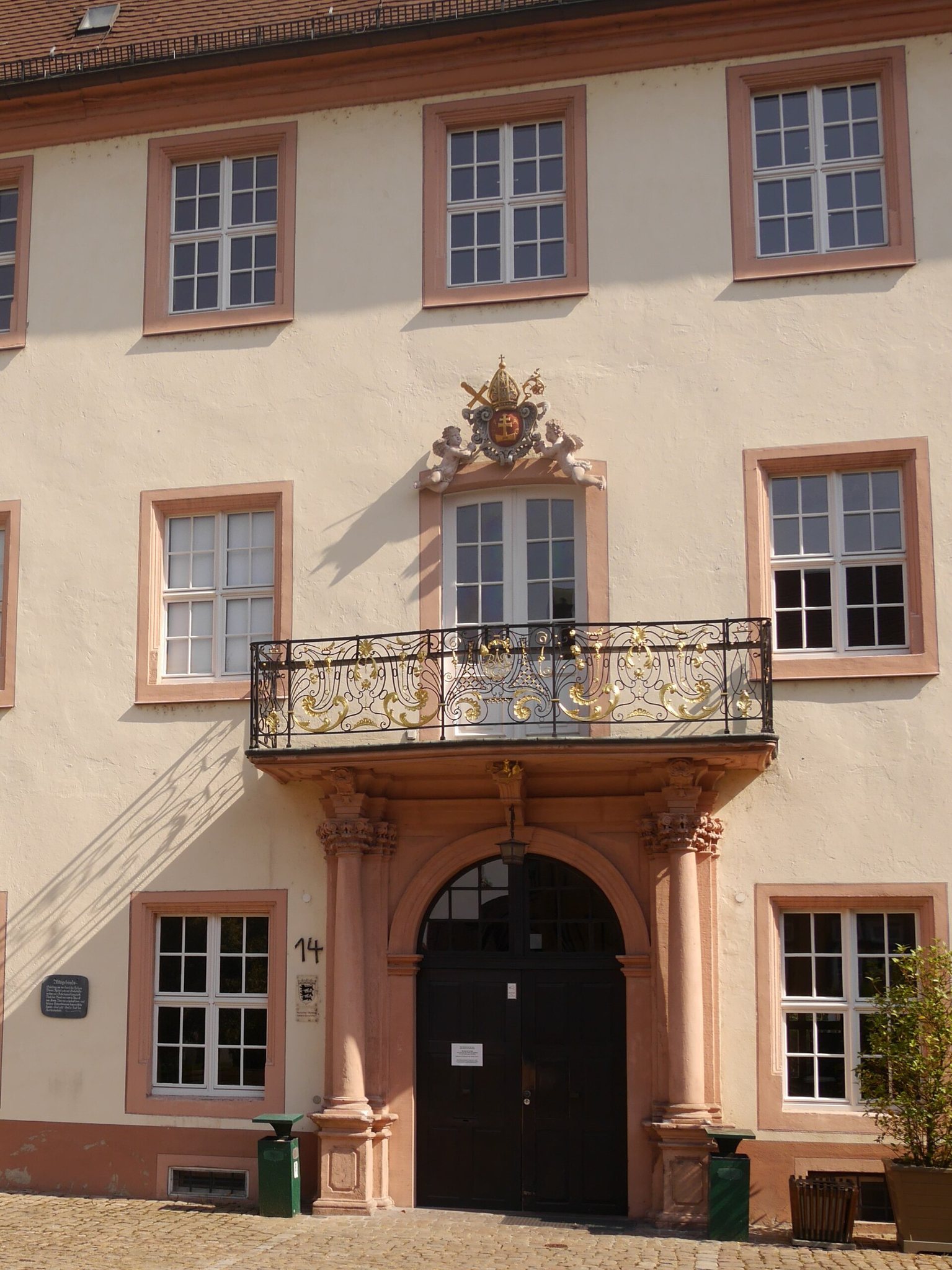
In 1803, secularization incorporated the town and the abbey’s territories into Baden. The monastery continued until 1807 as a Sammelkloster, a house accommodating members of other monasteries in the Ortenau, and was then dissolved. A normal school occupied the former monastery premises by 1904. Since 1978, the buildings have housed the Faculty of Business Administration and Industrial Engineering of Offenburg University. The former abbey church belongs to the Offenburg-Kinzigtal deanery and the Vorderes Kinzigtal pastoral unit following the deanery reform of 1 January 2008.
Remains
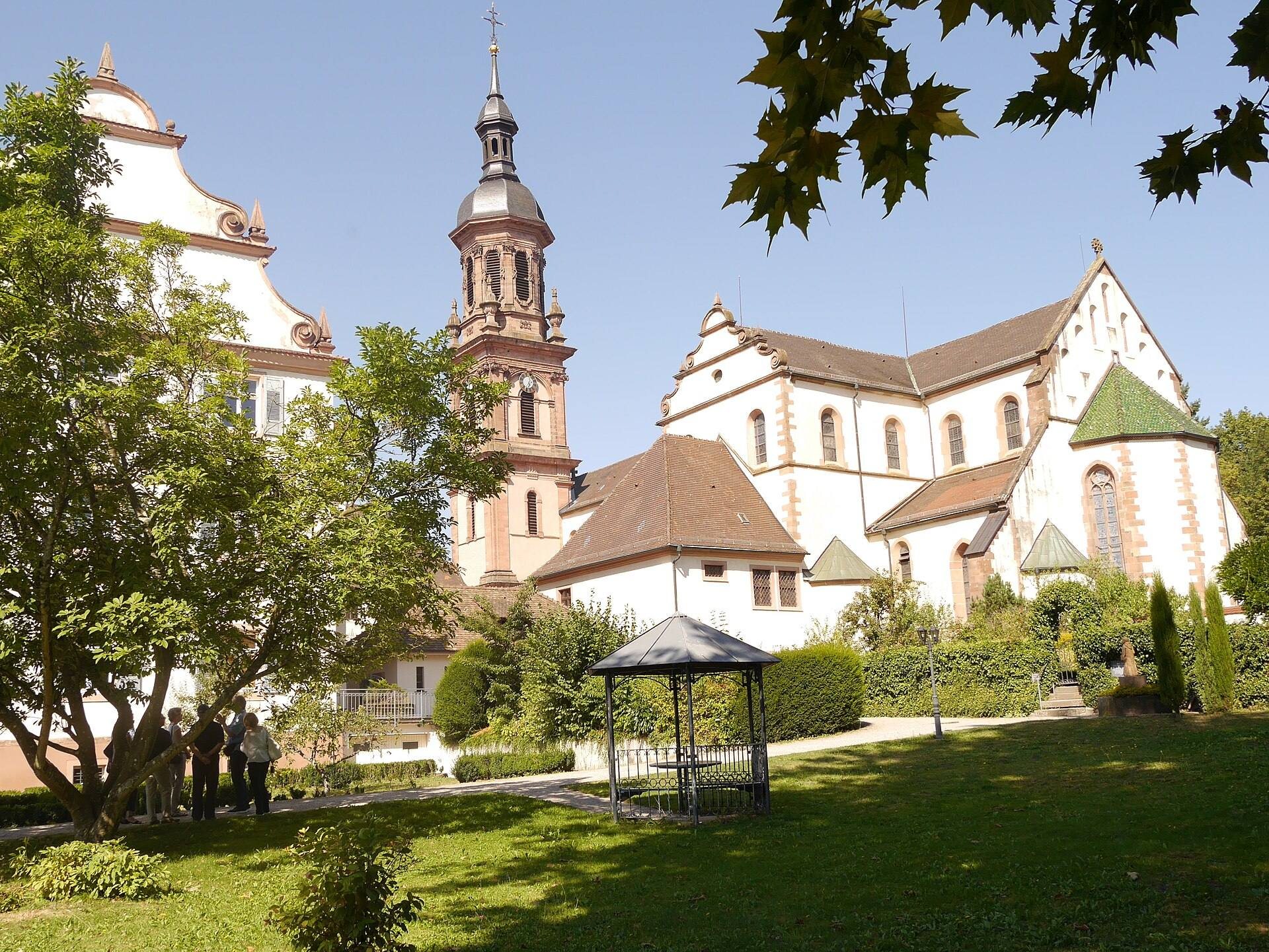
The surviving complex is centered on the former abbey church, whose fabric preserves evidence of medieval rebuilding, Baroque reconstruction, and a later Romanesque Revival remodeling. The church stands within the former monastery buildings, which now serve institutional purposes, while the church functions as the town parish church of Saint Mary.
Abbey church
Medieval basilica
Construction of the present abbey church began in 1120 in the architectural tradition of Hirsau. It was planned as a three-aisled basilica, meaning a longitudinal church with a central nave and lower side aisles. A transept crossed the main axis, and the building had one principal choir, two subsidiary choirs, and apses, semicircular or polygonal ends commonly used to close a choir. The original arrangement had flat roofs, a bound system, and alternating supports. The choir was remodeled in the Gothic style between 1398 and 1415, and a west tower was added during the late Middle Ages.
Baroque and later alterations
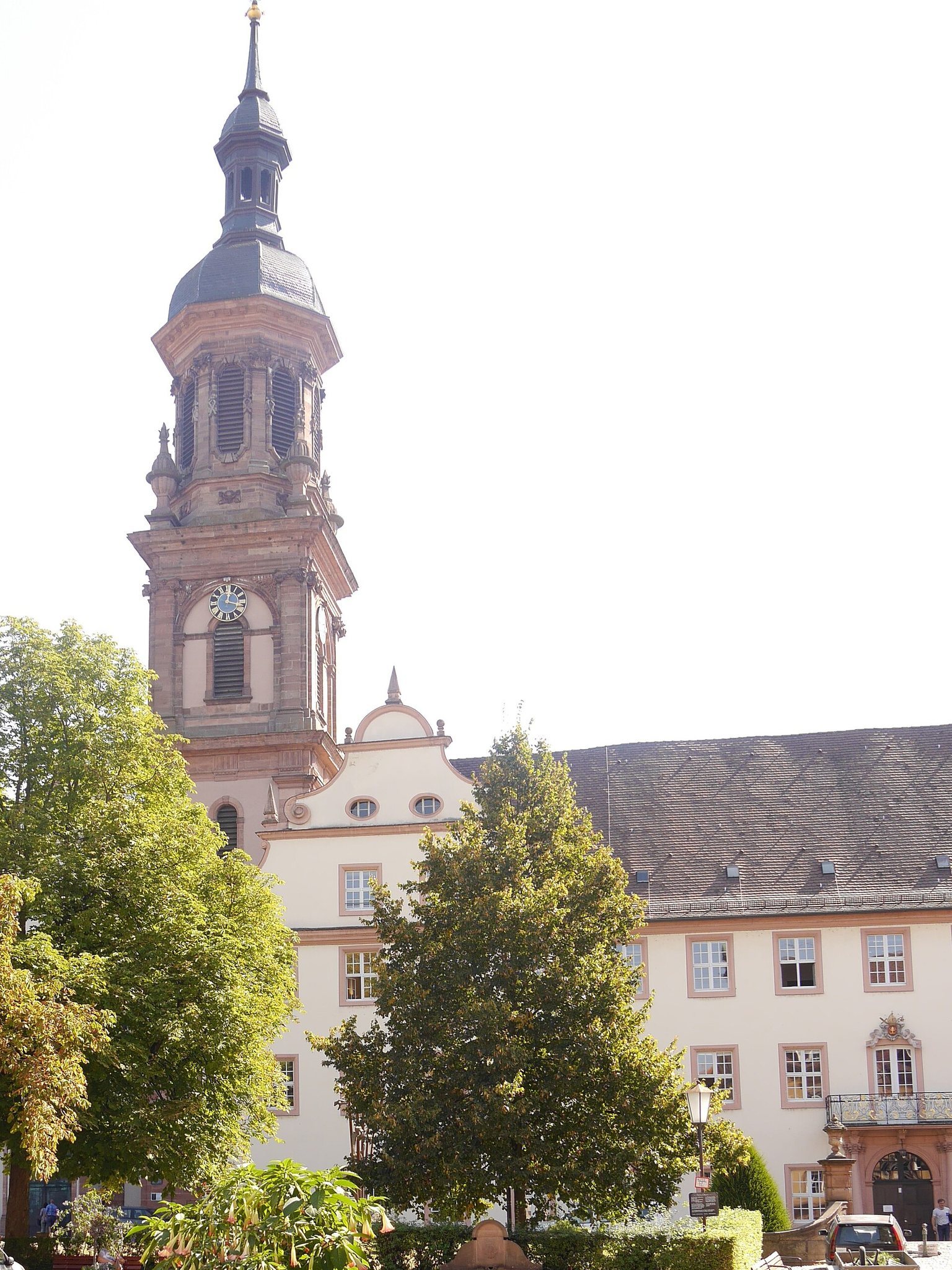
The church was rebuilt and repaired between 1690 and 1722 after the wartime damage of the seventeenth century. Johann Jakob Rischer completed the Baroque church tower in 1716. Between 1892 and 1906, Max Meckel, the Freiburg architect and archiepiscopal building director, remodeled the church in the Romanesque Revival style. After the abbey’s dissolution, the building became the parish church of Saint Mary.
Organ and bells
Romantic organ
The organ on the rear gallery was built between 1896 and 1899 by Wilhelm Schwarz and Son of Überlingen. It has 38 stops, three manuals, and a pedal. Max Meckel designed its case and the main altar. The case was made at Schwarz in collaboration with the Freiburg sculptor Joseph Dettlinger and contains 170 silent ornamental pipes. Fischer and Krämer Orgelbau of Endingen am Kaiserstuhl carried out extensive restoration in 1984 and 1985, followed by a major overhaul by Joachim Popp of Altheim in 2006.
Bell tower
The tower beside the entrance gable contains a seven-bell peal. An eighth bell from the earlier peal made by the Grüninger foundry in Villingen can be rung only by hand. Bells 1 through 5 were made by the Grüninger foundry in Strass near Neu-Ulm, while bells 6 and 7 came from the Karlsruhe Bell and Art Foundry. The bells hang in two superimposed chambers within wooden frames. Bells 2 and 8 occupy the lower chamber, while the remaining bells are arranged in an upper, two-level frame.
Books and learning
During the High and Late Middle Ages, the abbey maintained a scriptorium, a room for copying manuscripts, and a bookbindery. The Gengenbach Gospel Book was produced in the first half of the twelfth century, although it probably came from the Augustinian canons’ foundation at Marbach in Alsace or the associated Augustinian canonesses’ foundation at Schwarzenthann rather than from Gengenbach itself. A Latin school existed at the abbey during the early modern period, and several abbots were known for their learning.
An eighteenth-century organ case from the former abbey church is now preserved in the Augustinermuseum in Freiburg im Breisgau. Together with the surviving church, organ, bell installation, and former monastery buildings, it reflects the abbey’s long sequence of medieval, Baroque, and modern transformations.