Hohengeroldseck: Medieval Ancestral Castle of the Lords of Geroldseck


Site at a Glance
- Rating
- 4.7
- Popularity
- Medium
- Country
- Germany
- Primary era
- Medieval
- External website
- Open
- Eras represented
- Medieval
- Civilizations
- Holy Roman Empire
- Site type
- Military
- Remains
- Castle
On this page12 sections
History
Hohengeroldseck is a medieval hilltop castle ruin in Germany, built by Walter I of Geroldseck between 1240 and 1250 as the ancestral seat of the Lords of Geroldseck. From the division of the family’s lands in 1277 until the end of its rule in 1634, the castle was the centre of the Upper Lordship of Hohengeroldseck.
The Geroldseck lordship
After the division of 1277, Walter’s descendants controlled territories in the Upper Ortenau, including the lordships of Lahr, Mahlberg, and Schiltach. Their possessions also included holdings belonging to the abbeys of Schuttern, Ettenheimmünster, and Wittichen. The Lords of Geroldseck additionally held the territorial governorship on both banks of the Rhine between Basel and Seltz.
The family’s territorial position changed during the 15th century. In 1442, Margrave Jacob I of Baden bought half of the lordships of Lahr and Mahlberg from Walter’s descendants for 30,000 guilders. Strasbourg forces besieged Hohengeroldseck in 1473, but abandoned the attack. In 1486, Elector Palatine Philip captured the castle after a six-week bombardment led by the Palatinate artillery master Martin Merz. The Electoral Palatinate retained control until 1534.
Residence and succession dispute
In 1599, the Geroldseck family moved its residence to nearby Dautenstein Castle, which had been converted into a Renaissance palace. Hohengeroldseck nevertheless remained tied to the family’s territorial claims. When Jakob of Hohengeroldseck died in 1634, his daughter Anna Maria became the sole heir of the family. Her marriage to Margrave Frederick V of Baden-Durlach in 1644 led to a succession dispute. The Habsburgs regarded Hohengeroldseck as a reverted fief, meaning a lordship expected to return to its superior, and rejected Anna Maria’s claims to the family’s allodial property, which was hereditary land held outside the feudal grant.
Emperor Ferdinand II had already promised the lordship to the imperial count Adam Philipp XI of Cronberg, first in 1620 and again in 1630 as a formal expectation of succession. Adam Philipp died during a campaign in 1634. Two years later, his underage son Kraft Adolf Otto of Cronberg received the castle and lordship as a fief, while his mother, Margarethe Sidonia of Daun, Countess of Falkenstein, acted for him.
Kraft Adolf Otto took personal control after reaching legal majority in 1650. He married Maria Franziska of Oettingen-Baldern in 1653, but she left the marriage in 1662. He delayed judicial decisions that could have transferred the allodial property to the Margraves of Baden-Durlach and also disputed territorial sovereignty over a sawmill between Kuhbach and Lahr.
Destruction and the change of ownership
French troops destroyed Hohengeroldseck in January 1689 during the War of the Palatine Succession, a European conflict fought from 1688 to 1697 that particularly affected the German territories along the Rhine. The second and last Count of Cronberg died in 1692 after all four of his legitimate children had predeceased him, leaving no legitimate heir.
After the count’s death, Margrave Frederick Magnus revived the Baden-Durlach claim inherited from his grandfather, Frederick V, and took possession of the lordship six months later. In 1695, Karl Kasper Franz von der Leyen also claimed the succession because the Habsburgs had promised it to him. On 16 April 1697, Karl II of Neveu, the Austrian territorial governor of the Ortenau, arrived with 300 soldiers. The force removed the Baden coats of arms, occupied Dautenstein Castle, and expelled Baden officials. The population was required to pay homage to Karl Kasper von der Leyen. Since this takeover, the castle ruins have belonged to the von der Leyen family.
Hohengeroldseck formed part of the County of Hohengeroldseck from 1711 to 1806 and of the Principality of von der Leyen from 1806 to 1813. An illustration by the German writer Grimmelshausen dated 1645 was long regarded as the oldest known representation of the castle. A hypothesis published in 2001 identified a depiction in Philipp Münch’s 1496 war book as Hohengeroldseck during Philip’s 1486 siege, although that identification remains a hypothesis.
Preservation of the ruins
Initial maintenance work took place in 1883. The Hohengeroldseck Ruin Preservation Association has cared for the remains since 1958, while ownership rests with the legal successors of the Lords of Geroldseck, the Princes of von der Leyen. A spiral staircase was installed in the tower of the rear palas, the principal residential and representative building of a medieval castle, in the early 1950s. Extensive restoration followed in 2011 and 2013. The ruins were designated a cultural heritage site of the state by the Landesverein Badische Heimat in 2005 and named Baden-Württemberg’s Monument of the Month for June 2010.
Remains
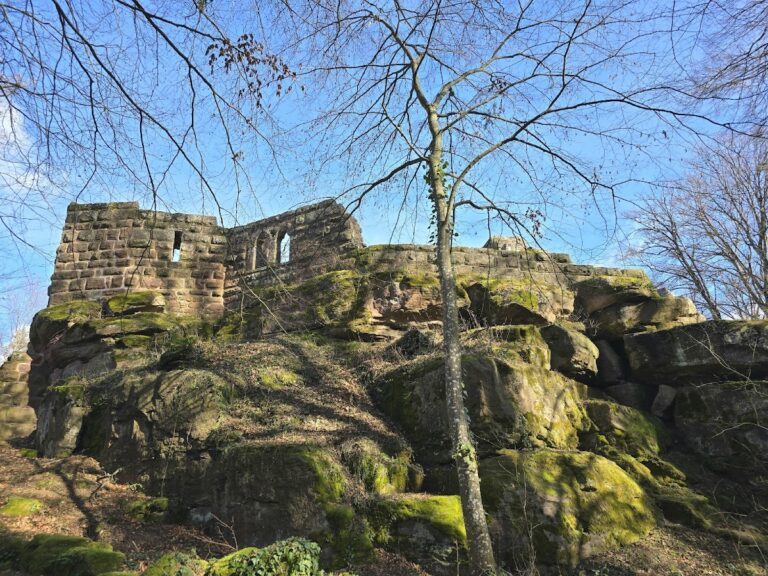
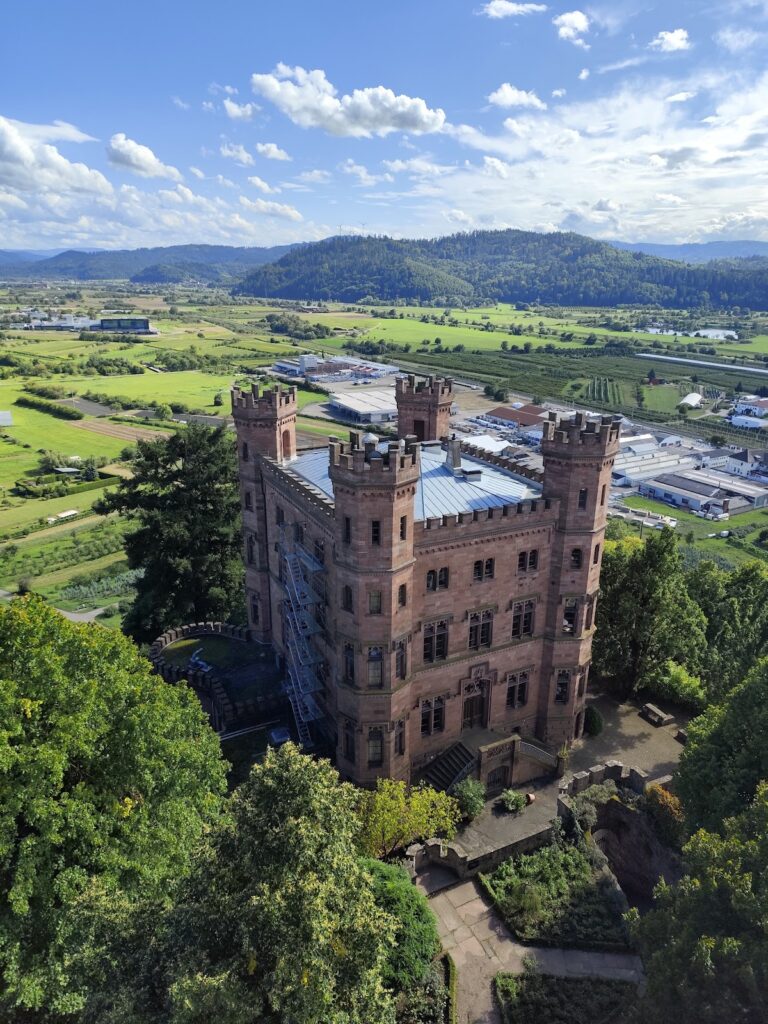
Hohengeroldseck stands at 523.9 metres above sea level on Schönberg, a hill between the Kinzig and Schutter valleys in the Black Forest. The castle is a tower-house castle without a separate tower. Excluding the outer works, its plan covered approximately 95 by 50 metres. The surviving lower castle and the principal building of the upper castle retain outer walls about 10 metres high, while the wider site remains set within a predominantly wooded, hilly landscape.
Defensive enclosure and castle plan
Enclosing wall
The castle’s 2.10-metre-thick enceinte, or main enclosing defensive wall, surrounded the complex and incorporated a wall walk, the passage along the top of a defensive wall. Loopholes, which were narrow openings used for defense, opened from this passage. The enclosure defined the castle’s approximately 95-by-50-metre area apart from the outer works.
Upper and lower castle buildings
Two principal buildings stood on porphyry rock, each approximately 50 metres long and up to 20 metres wide. A courtyard separated them. Their surviving masonry forms the main physical division of the upper and lower castle, with portions of the outer walls still rising to approximately 10 metres.
Residential building
Knights’ house
The facade of the four-storey knights’ house, a palas, is largely preserved. Its knights’ hall occupied the second storey and measured 80 square metres. The building forms part of the principal upper-castle remains and preserves the scale of the castle’s residential and representative architecture.
Hilltop setting
The ruins occupy Schönberg within a wooded and hilly section of the Black Forest. Rauhkasten, the highest nearby point, reaches 639 metres above sea level and lies 2.3 kilometres north of Hohengeroldseck. The ruins stand between the Kinzig and Schutter valleys, and their hilltop position makes them a prominent landmark when viewed from the Kinzig Valley. The ruins of Alt-Geroldseck lie on a ridge 1,700 metres to the north.