Zedtlitz Castle: A Baroque Manor Estate in Germany
Site at a Glance
- Popularity
- Medium
- Country
- Germany
- Primary era
- Early Modern
- Eras represented
- Medieval, Early Modern
- Civilizations
- Electorate of Saxony, Holy Roman Empire
- Site type
- Domestic
- Remains
- Castle
On this page7 sections
History
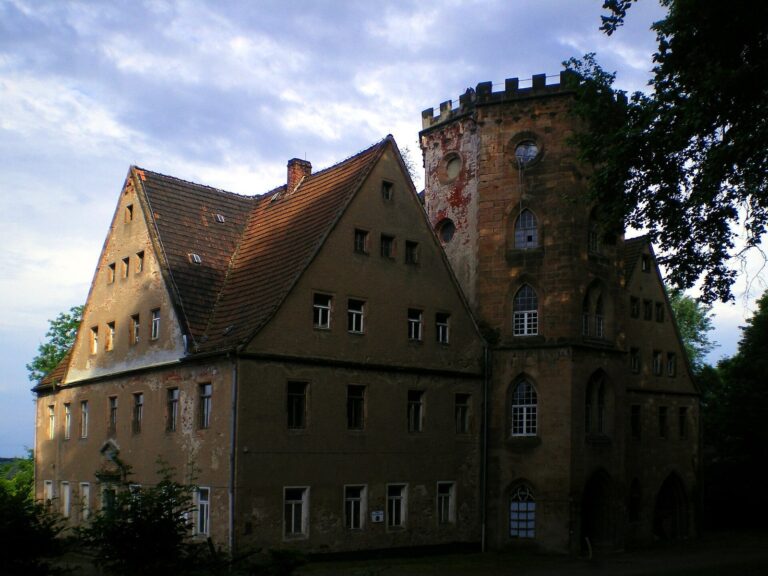
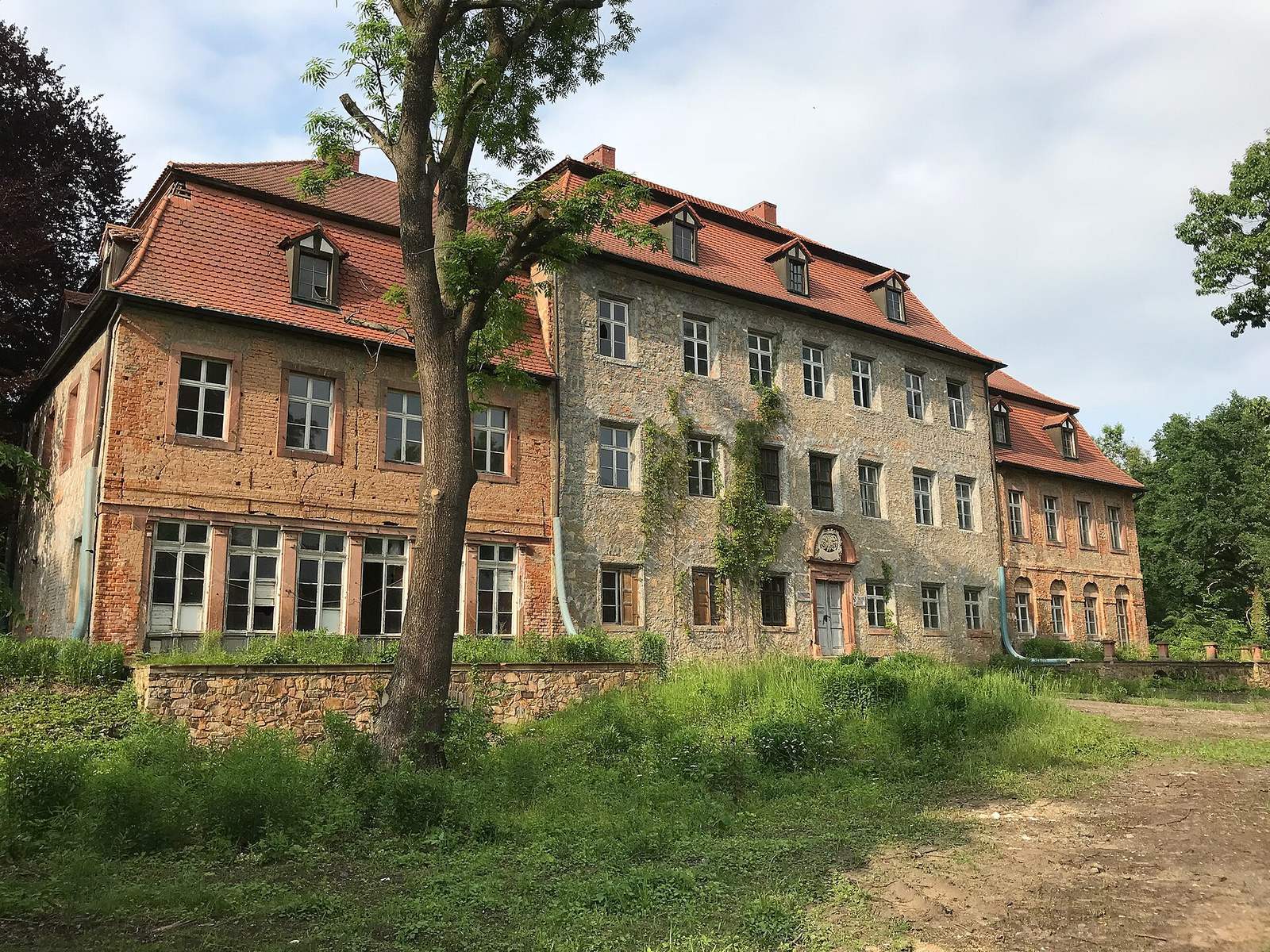
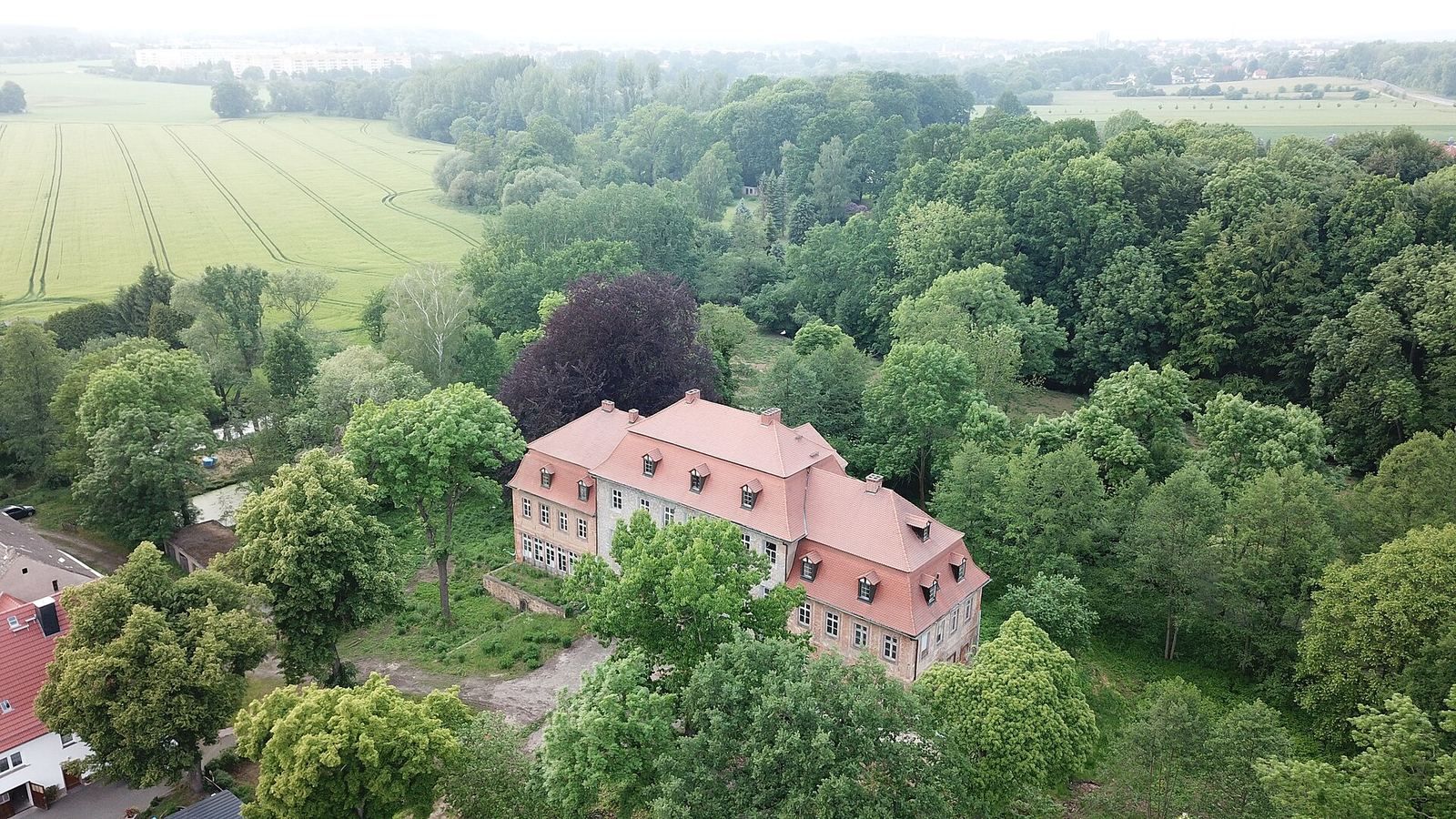
Zedtlitz Castle in Germany was first recorded in 1190 as a moated stronghold and was rebuilt in 1706 in the Baroque style, a European tradition of formal design and elaborate ornament. Over the centuries, it passed among noble families and later served changing residential and institutional uses.
Early records and noble ownership
An early reference names the place as Cedelice, an earlier name for Zedtlitz. A 1191 donation charter from Naumburg identifies Heinrich and Otto von Zedlitz as owners, and their family retained the castle at least into the early thirteenth century. A castle at Zedtlitz was recorded again in 1303.
The von Wolkaw family held the property from the mid-fifteenth century. The von Neustadt family acquired it in 1498, before the von Wolkaws returned in 1590. The von Draschwitz family then held it from 1611 to 1685. The castle burned during the Thirty Years’ War, the major European conflict fought from 1618 to 1648.
Rebuilding and nineteenth-century ownership
The von Gladebeck family acquired the ruined castle in 1692. Christiane Elisabeth von Gladebeck, born von Münchhausen, commissioned its Baroque reconstruction. After her death, her daughter Christine Lucie’s marriage brought the property into the Aus dem Winckel family.
In 1782, the castle was sold to Jacob Heinrich Reinhold, a court councillor in Dresden. In 1826, the manor was described as including the villages of Raupenhayn and Plateka. Reinhold’s great-niece Julie, who was married to a member of the von Metzradt family, transferred the property to her son Jacob Friedrich Rudolph von Metzradt in 1836. During a visit in 1840, composer Albert Lortzing is said to have found inspiration for his opera Der Wildschütz.
The Rex estate and twentieth-century changes
Before 1898, the property passed to the counts of Rex through the marriage of Margarete Gräfin Rex and Karl Graf Rex. At sessions of the Saxon Landtag, Saxony’s parliament, in Dresden, the owner styled himself Chamberlain Count von Rex-Zedtlitz. Their eldest son, Rudolf Karl Caspar von Rex (1858–1916), inherited the estate. He was a royal Saxon chamberlain, a senior court official, and a privy councillor, a member of an advisory council. Karl-Max Oswald Graf von Rex (1888–1942) was named as the next heir before 1920.
In the 1920s, the Zedtlitz manor estate covered 412 hectares, including land at Neukirchen, and some of its property was leased. Forest accounted for 153 hectares, the estate’s largest component, and it also operated a distillery. Forester Holm Weber managed the estate. In 1925, forester Bernhardt Rost worked in the woodland, while Willy Schlenzig leased the remaining land.
By about 1929 to 1930, Karl-Max Oswald Graf von Rex no longer owned the castle and estate. In 1933, Karl Schulze of Bockwitz purchased the castle, vineyard, fields, meadows, and woods; his brother later acquired the manor itself. Extensive renovation work preceded the castle’s use as a kindergarten during the 1930s. From 1939 to 1945, girls in the League of German Girls, the Nazi Party organization for girls and young women, lived there as part of its rural Land Service program and worked for the Borna and Surrounding Area Market Gardeners’ Association.
From 1945, Schulze made the castle available to about nine refugee families displaced from Germany’s eastern territories. His family initially retained de facto ownership, and he reserved four rooms in the central, stately wing for them. Schulze had managed the nearby Bockwitz estate as a tenant under either the town of Borna or the Saxon Works company. During the 1945 to 1946 land reform and subsequent forced collectivization, that estate was dissolved and Schulze was expelled. He and his family moved into the Zedtlitz manor house at Christmas 1945.
In 1969, Schulze’s children sold the castle and park to the municipality because they could no longer maintain them. The municipality used part of the castle as a kindergarten. Around German reunification, work included renewing the roof and renovating the kindergarten in 1990; farm buildings were later put to use. The municipality subsequently sold the castle to investors. Further ownership changes followed without a lasting new use being established.
Remains
Historic estate layout
The estate lay deep within the Wyhra floodplain, on its left side, and a moat enclosed the complex. August Schumann’s 1826 description presents a large courtyard with medium-sized farm buildings forming three of its sides. The spacious main residence stood three storeys high and was seven window bays wide. A smaller residential wing stood to its right, while a large greenhouse was attached on the left. In front of the castle lay an ornamental garden of formal beds; behind it was another garden with an orangery, a building for sheltering citrus and other tender plants. A larger ornamental and kitchen garden extended toward the village. A sheepfold stood farther south, a brickworks lay to the southwest, and avenues approached the manor from several directions. Embankments were also present in the floodplain.
Surviving entrance and park
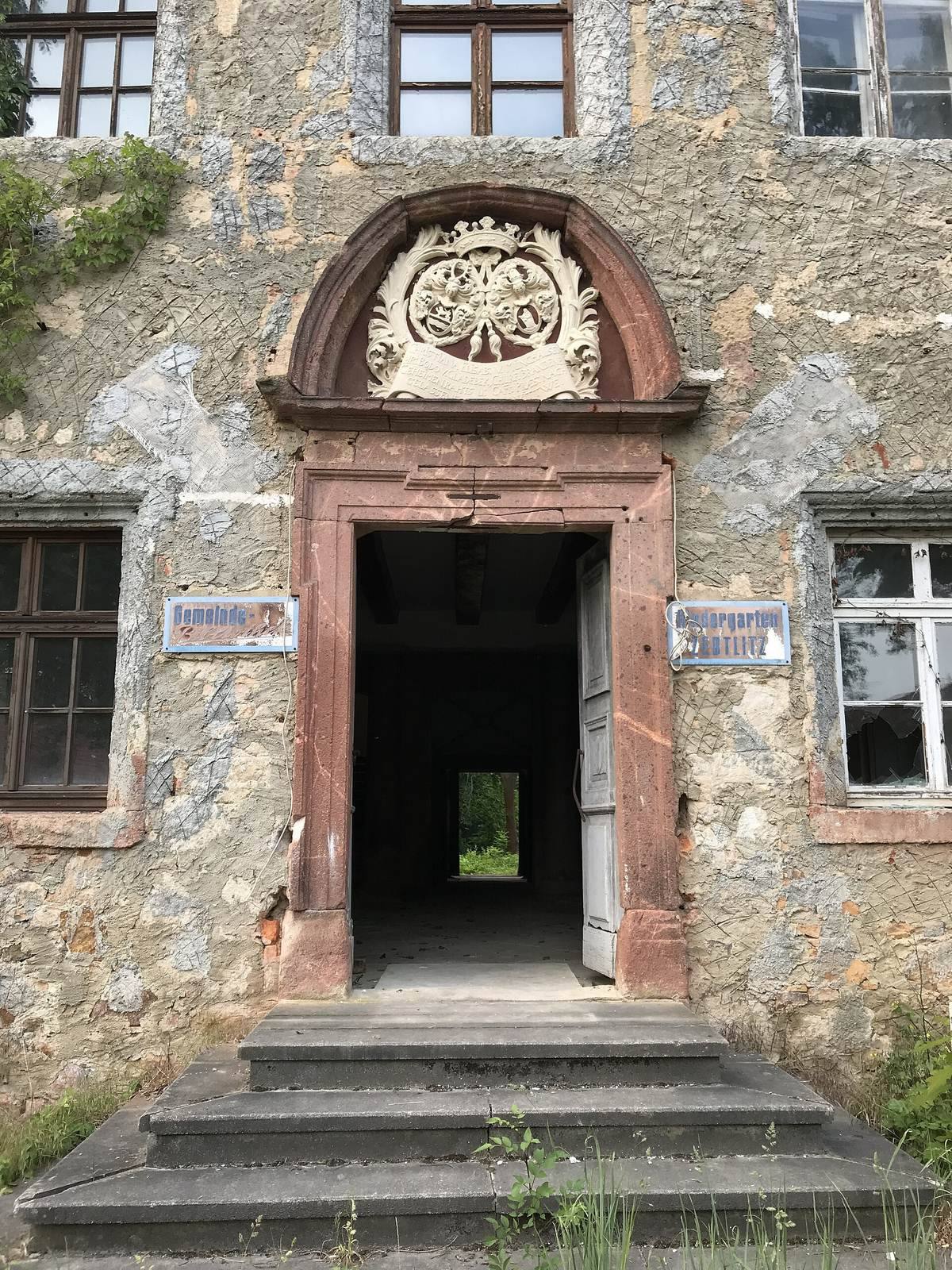
The castle entrance is marked by a formal central Baroque portal with a molded frame and projecting sections, reached by an exterior staircase. A relief bears the coats of arms of the von Gladebeck and von Münchhausen families. An inscription on a ribbon identifies Christiane Elisabeth von Münchhausen as the second wife and widow of Bodo von Gladebeck, and gives his titles as privy councillor and president of an administrative chamber in the service of the Elector of Brandenburg, a prince entitled to vote in the election of the Holy Roman Emperor. Remnants of the park survive.