Schloss Wrodow: A Historicist Manor House and Cultural Venue in Germany


Site at a Glance
- Rating
- 4.3
- Popularity
- Very Low
- Country
- Germany
- Primary era
- Modern
- External website
- Open
- Eras represented
- Modern
- Civilizations
- German
- Site type
- Domestic
- Remains
- Castle
On this page7 sections
History
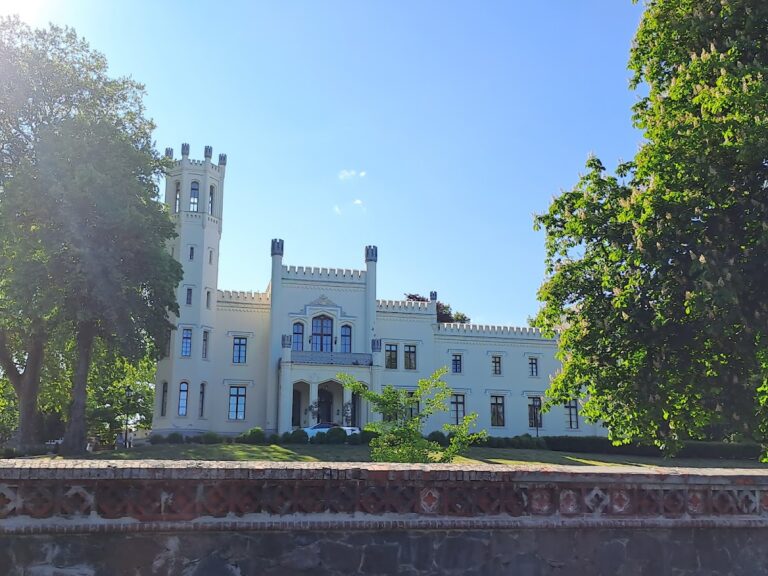
Schloss Wrodow is a historic manor house and cultural venue in Mölln, Germany, whose present form was created through an enlargement in 1860 in the historicist style, incorporating Tudor-inspired Romantic Neo-Gothic elements. The estate developed from the Wrodow holding, which is documented from the sixteenth century and for a long period functioned as a subsidiary estate rather than an independent manor seat.
The Estate Before 1860
At the beginning of the sixteenth century, Wrodow belonged to the Maltzahn family. Christian von Kamptz acquired Gut Wrodow in the summer of 1707. He represented the landed knighthood of the Güstrow district and had also served for several years as provisional administrator of Malchow Abbey. The ennobled von Engel family is likewise associated with the estate during this period.
The Neumann family owned Wrodow from 1817. In 1860, Ludwig Neumann junior received the estate from his father and enlarged the manor house in castle-like form. Neumann-Wrodow also became part of the Mecklenburg knighthood, the territorial estate of the region’s landed nobility, which participated in representative assemblies.
Estate and Wartime Use
Before 1900, the estate covered 325 hectares. By the late 1920s, the manor derived from older feudal holdings extended over 406 hectares, including about 10 hectares of woodland, and the family had it managed by an appointed administrator.
The widow of the last heir lived in the castle until the end of the Second World War. In 1943, after an air raid destroyed its school building in Rostock, a Rostock grammar school moved into Schloss Wrodow with 80 girls and their teachers. The school stayed for nearly two years, until the region came under Soviet Army occupation.
Abandonment and Cultural Renewal
After the war, the castle was abandoned. Between 1945 and 1990, local residents’ efforts helped prevent the building from deteriorating completely.
In 1993, youth judge Frank Bauer, religious-education teacher Brigitte Gross, and artist Sylvester Antony bought Schloss Wrodow. They restored it over almost ten years. The Kunstverein Schloss Wrodow, the arts association responsible for the cultural programme, then helped establish the building as a venue for changing exhibitions, theatre productions, opera balls, performances, workshops, and seminars.
German filmmaker Rosa von Praunheim made two films at Schloss Wrodow. His 1999 documentary Wunderbares Wrodow, which portrayed cultural life in and around the castle, contributed particularly to its wider recognition and received the Robert Geisendörfer Prize, a German award for notable achievements in media, especially broadcasting and journalism.
Remains
Main Residential Block
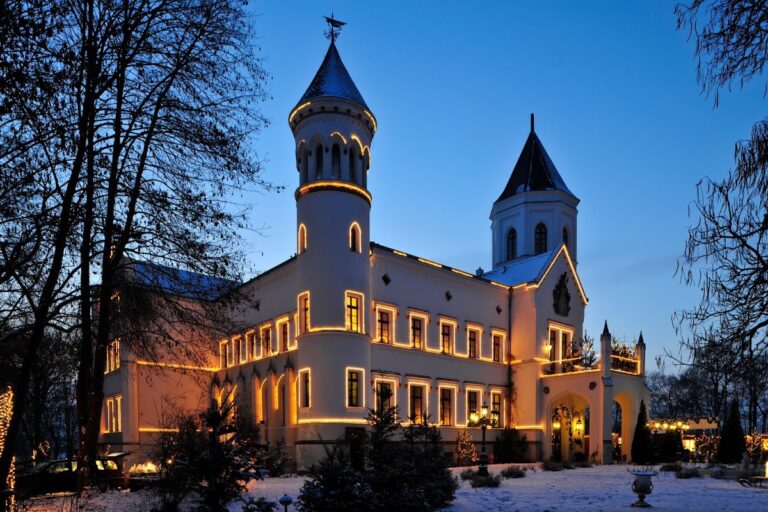
The castle stands in Wrodow, a hamlet within the municipality of Mölln in Mecklenburg-Western Pomerania, about 15 kilometres west of Neubrandenburg. Its two-storey residential block is arranged around a ceremonial entrance portico, a roofed entrance supported by columns. The portico uses Doric columns, a comparatively plain classical column type, and carries a terrace beneath a stepped gable, whose sloping edges rise in successive steps. The design combines northern German architectural features with the medieval forms reinterpreted by nineteenth-century Neo-Gothic, or Gothic Revival, architecture.
Wings and Towers
Two continuous wings extend from the main block. The right wing is accompanied by a small Neo-Gothic tower. On the left, a three-sided projecting section rises to a terrace and marks the boundary of the principal block before continuing into another part of the building crowned by a gable.
A tall Neo-Gothic tower rises at the rear of the main block, adding a strong vertical element to the castle-like composition. The building now accommodates changing art exhibitions and cultural events, including seminars.
Nearby sites