Schloss Waldenburg: A Hohenlohe Castle and Renaissance Palace in Germany


Site at a Glance
- Rating
- 4.5
- Popularity
- Low
- Country
- Germany
- Primary era
- Early Modern
- External website
- Open
- Eras represented
- Medieval, Early Modern, Modern
- Civilizations
- Holy Roman Empire
- Site type
- Domestic
- Remains
- Palace
On this page9 sections
History
Medieval Origins and Hohenlohe Rule
The Schloss Waldenburg complex in Waldenburg, Germany, was built by the Hohenlohe noble dynasty, whose regional fief began to take shape around 1250. A castle at Waldenburg is first mentioned in 1253, and the settlement received town rights in 1330. The House of Hohenlohe was a German noble family that held territories and residences in the region now associated with northern Baden-Württemberg.
Transformation into a Palace
In 1553, the castle became the principal seat of one Hohenlohe line. During the sixteenth century, it was partly converted from a medieval stronghold into a Renaissance palace, while some of these changes were reversed in the eighteenth century. Count Eberhard of Hohenlohe-Waldenburg commissioned Schloss Pfedelbach between 1568 and 1572 as a winter residence. Pfedelbach offered a milder climate than Waldenburg, and the new residence was built over the walls of an older ministerial castle, a fortified home associated with an official serving a noble lord.
Additional structural work took place in the early seventeenth century, with Heinrich Schickhardt acting as an adviser. Schickhardt was an influential architect and civil engineer active in southwestern Germany during the late sixteenth and early seventeenth centuries. After the Hohenlohe-Waldenburg line died out, the castle stood vacant from 1679. A new Hohenlohe-Waldenburg line emerged after an inheritance division, prompting extensive renovation during the nineteenth century.
The Waldenburg Carnival Fire
On 7 February 1570, Count Eberhard of Hohenlohe-Waldenburg and his wife, Countess Agathe of Tübingen, held a masquerade at the castle for aristocratic relatives and friends. Women appeared as angels and men as devils, although a territorial ordinance issued three years earlier had prohibited carnival celebrations. When a costume caught fire, the blaze killed several people and seriously injured many others. Count Eberhard and Count Georg of Tübingen-Lichteneck were among those who died, and both were buried in the collegiate church at Öhringen. Valentin of Berlichingen, Simon of Neudeck, and Count Albrecht of Hohenlohe-Neuenstein attended the event, but reports claiming that they also died in the fire are erroneous.
Destruction and Reconstruction
In 1945, artillery fire set the castle ablaze during the destruction that also affected almost 80 percent of Waldenburg. Reconstruction continued from 1948 to 1963. The exterior was rebuilt as far as possible to reflect its historical appearance, while the interiors were simplified rather than recreated exactly. Schloss Waldenburg remains associated with the Hohenlohe-Waldenburg-Schillingsfürst family.
The castle also acquired cultural and educational uses in the modern period. Hans Gottfried von Stockhausen, a German stained-glass artist, painter, and draughtsman who lived from 1920 to 2010, maintained an atelier there and occasionally presented exhibitions of his work to the public. In 1972, a seal museum opened on the ground floor. Its collection originated in the nineteenth century and was founded by Prince Karl of Hohenlohe-Waldenburg, regarded as one of the founders of sphragistics, the scholarly study of seals and their historical uses.
Remains
Castle Complex
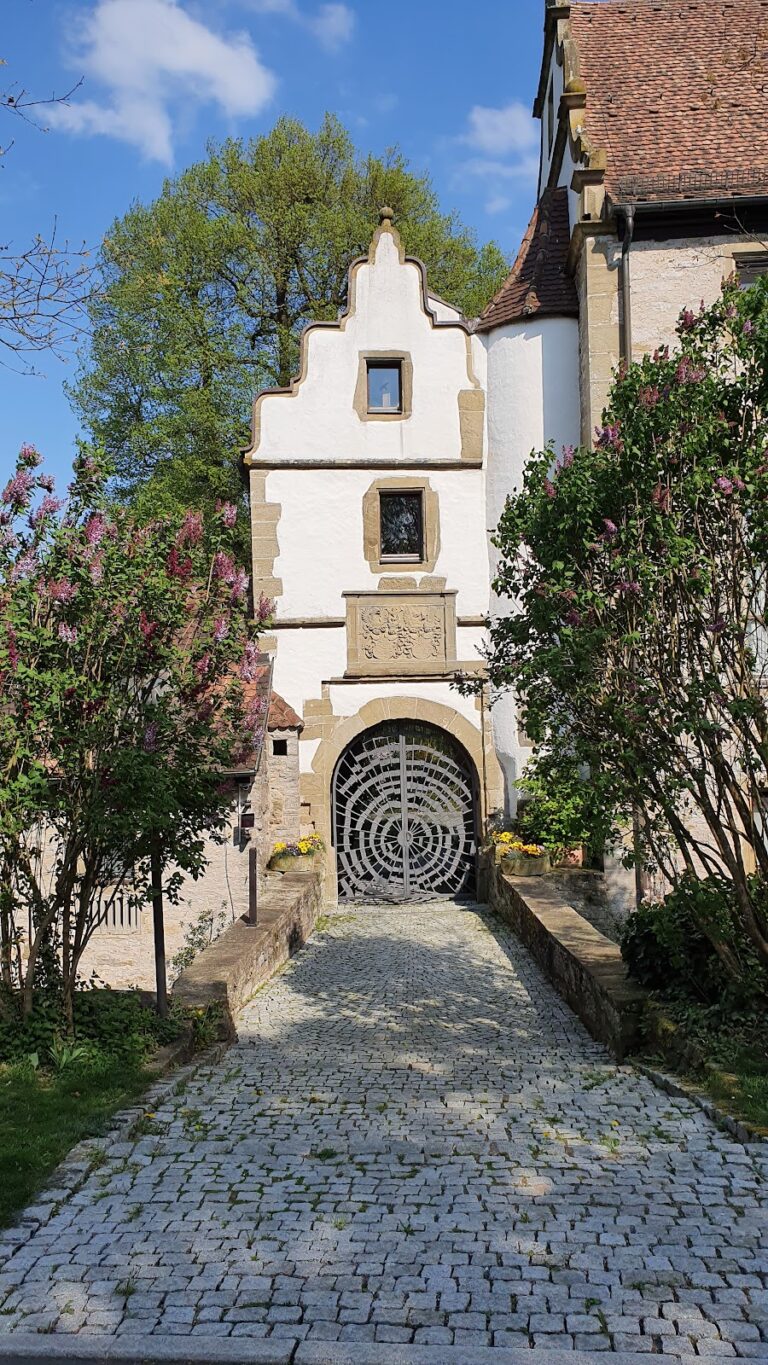
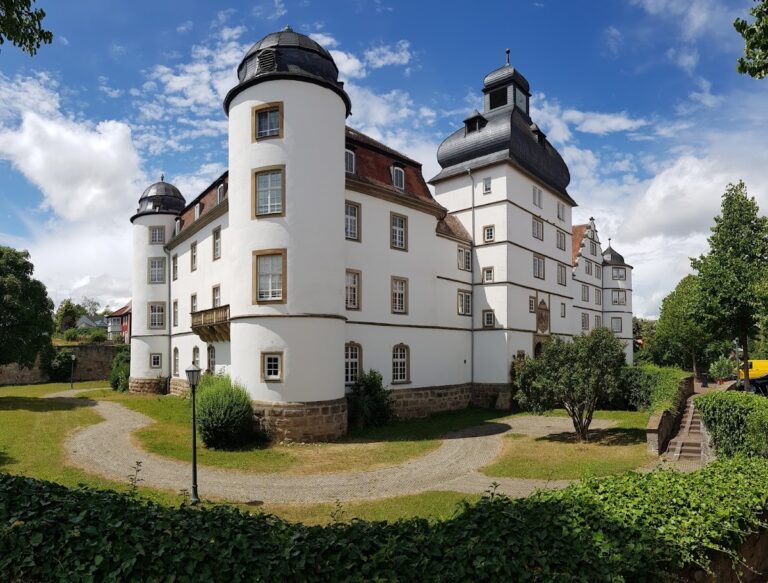
Schloss Waldenburg stands on a mountain spur above the Hohenlohe Plain at the edge of Waldenburg. The complex began as a thirteenth-century castle and was later partly transformed into a Renaissance palace. Its surviving arrangement includes a palace gate, a coat of arms, and an interior courtyard. The exterior seen today reflects the post-1945 reconstruction, which sought to reproduce the historic appearance of the complex.
Keep and Chapel
The castle keep, also known as the Männlesturm, acquired its present form in 1576. The palace chapel of St. Michael was built in 1781–1782 by the master stucco worker Christian Dornacher and incorporates Classical elements. The reconstructed interiors throughout the palace are simplified versions of the earlier rooms and do not reproduce them exactly.
Seal Museum
The seal museum occupies the castle’s ground floor. Its collection reaches back to the nineteenth century and presents seals as reproductions, including examples that are themselves old. The displays relate to sphragistics, the study of seals, their inscriptions, forms, uses, and historical meaning.
Nearby sites