Cadmea of Thebes: The Citadel of Ancient Thebes


Site at a Glance
- Rating
- 4.2
- Popularity
- Low
- Country
- Greece
- Primary era
- Bronze Age
- External website
- Open
- Eras represented
- Bronze Age, Classical
- Civilizations
- Ancient Greek, Kingdom of Macedon, Mycenaean
- Site type
- Military
- Remains
- Citadel
On this page8 sections
History
Cadmea of Thebes is the ancient citadel of Thebes in Greece, established by the Mycenaean civilization during the Late Bronze Age, with settlement securely dating to around 1400 BC. Named after Cadmus, the legendary founder of Thebes, it occupied the city’s fortified upper center and later served as a political, religious, and military stronghold.
Mycenaean beginnings
The area may have been settled from the early Bronze Age, while the earliest archaeological remains indicate Mycenaean habitation around the sixteenth century BC. A Mycenaean palace and defensive walls formed the early center of the settlement. Later tradition held that these structures were destroyed shortly before the Trojan War by the Epigoni, the sons of the heroes known as the Seven Against Thebes. Historical and archaeological interpretations also connect a possible abandonment of the Cadmea with the Boeotian invasion. Thucydides placed the arrival of the Boeotians sixty years after the end of the Trojan War, and the Cadmea may not yet have been repopulated when the Catalogue of Ships, the section of the Iliad listing Greek contingents and settlements, was composed.
Classical and Hellenistic Thebes
During the Classical and early Hellenistic periods, the Cadmea performed a role comparable to the Acropolis of Athens, the city’s fortified upper citadel and major civic-religious center. It contained public buildings, and the assemblies of Thebes and the Boeotian Confederacy, a political league of cities in Boeotia led by Thebes, are thought to have met there.
The citadel became a focus of foreign control during the fourth century BC. From 382 to 379/2 BC, a Spartan garrison occupied Thebes. In 382 BC, the Spartan general Phoebidas seized the Cadmea without authorization, violating the Peace of Antalcidas, a treaty regulating relations among the Greek states and the Persian Empire. With help from Leontiades, a polemarch, or military commander, he established an oligarchy, a government controlled by a small group. Pelopidas and Gorgidas overthrew the oligarchy three years later.
After the Cadmea was recaptured in 379 BC, the Sacred Band of Thebes was stationed there as a permanent force. This elite unit, composed of paired soldiers, probably guarded the citadel against further attempts by foreign troops to seize it. Following the Greek defeat at Chaeronea, a major battle between Macedonian and Greek forces, Thebes accepted a Macedonian garrison.
Destruction and rebuilding
In 335 BC, Thebes and Athens rebelled against Macedonian rule after receiving a false report that Alexander the Great had died. Alexander ordered the destruction of Thebes as a warning to other Greek cities. The Cadmea was destroyed during this action, and the inhabitants of Thebes were sold into slavery.
The Macedonian general Cassander I rebuilt Thebes and the Cadmea in 316 BC. The city’s later decline could not be reversed. In the second century AD, the Greek travel writer Pausanias described Thebes and its surrounding territory as largely deserted, with only a small number of people living in the Cadmea.
Rediscovery
The Greek archaeologist Antonios Keramopoulos rediscovered the Cadmea. Modern investigation has traced the line of the Mycenaean enclosure along the eastern side of Thebes, from the Electrae Gates to the Proetides Gates.
Remains
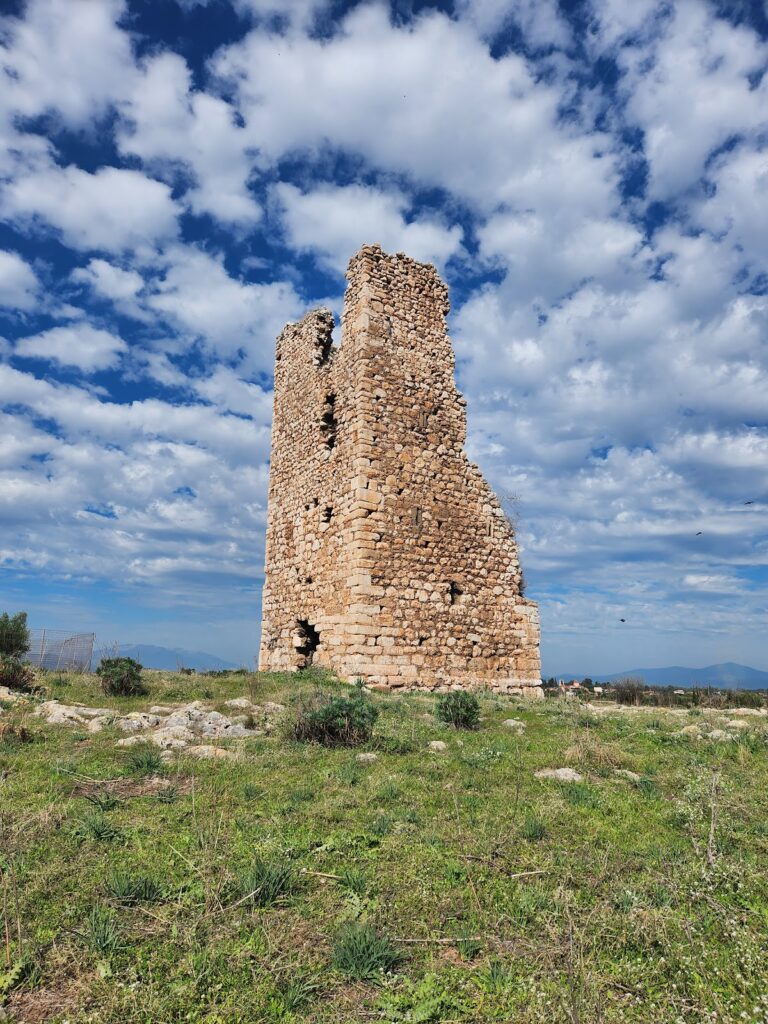
The Cadmea occupied a naturally rocky citadel built on seven hills. Large stone blocks set directly on the natural rock formed its fortifications. One wall enclosed the citadel, while a second surrounded the lower city. Only a few sections of the fortification circuit survive, and the ancient citadel now lies beneath the modern city of Thebes.
Fortifications and gates
The Cadmean circuit had seven gates: the Electrae, Homoloides, Proetides, Ogygian or Northern, Neistae, Hypistae, and Oncae Gates. The Electrae Gates have been identified, while part of the Mycenaean wall has been found at the level occupied by the Proetides Gates in the Classical period.
The Electrae Gates were the principal entrance to ancient Thebes. The road from Athens, passing through Plataea, entered the city through them. Their name was associated with Electra, who appears in different mythological traditions as Cadmus’s mother-in-law and as the mother of Harmonia, Cadmus’s wife. The surviving gate remains date from the Hellenistic period, and tradition places the epic combat between Eteocles and Polynices, rival brothers in the Theban myths, outside the gates.
Palace and religious buildings
Major monuments within the Cadmea included a Mycenaean palace and the temple of Ismenian Apollo. Ismenian Apollo was worshipped under a cult title associated with the Ismenus area of Thebes. These monuments formed part of the citadel’s civic and religious importance alongside its fortifications and gates.
Nearby sites