Schloss Vitzenburg: A Castle and Renaissance Palace in Germany
Site at a Glance
- Rating
- 4.7
- Popularity
- Very Low
- Country
- Germany
- Primary era
- Early Modern
- Eras represented
- Medieval, Early Modern, Modern
- Civilizations
- Electorate of Saxony, German, Holy Roman Empire, Kingdom of Prussia
- Site type
- Domestic
- Remains
- Castle
On this page13 sections
History
Castle and convent, ninth to twelfth centuries
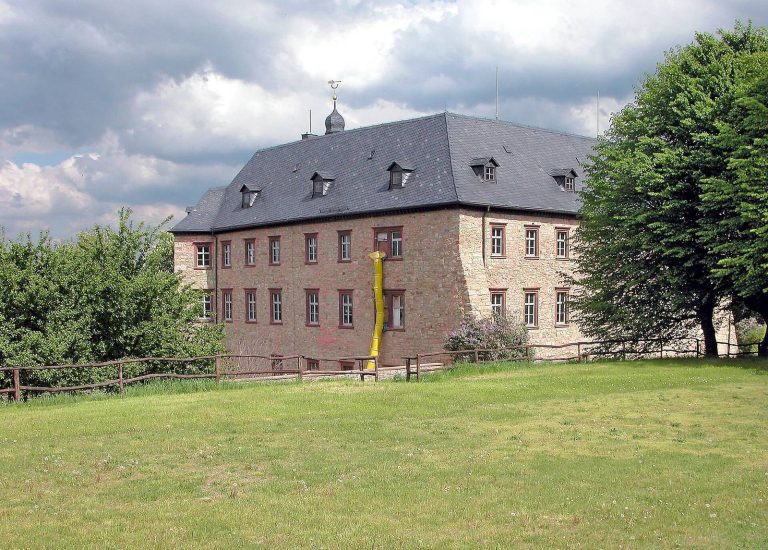
Schloss Vitzenburg is a castle and later palace on a westward-projecting spur above the Unstrut near Querfurt, Germany. It probably began as a castle in the ninth century. The site is named in a tithe register compiled for Hersfeld Abbey between 881 and 899, and Emperor Otto II referred to it in a 979 charter transferring regional tithes to Memleben Monastery.
Before 991, the nobleman Brun and his wife Adilint established a convent for women within the castle, dedicated to St Mary and St Dionysius. Their family connections are uncertain. Brun has been associated with both the Billing and Querfurt families, while Adilint has been proposed as a member of the Schweinfurt family. On 19 January 991, the ten-year-old King Otto III confirmed the convent at his mother Theophanu’s request. He placed it under royal protection, granted it immunity, and provided for the appointment of an abbess and a lay protector, a representative in legal and secular matters. These privileges made the convent an imperial abbey, an institution directly under the emperor. The castle continued to exist alongside it.
A later claim that the convent had been founded in 626, during the reign of Merovingian king Dagobert I, originated with the chronicler Cyriakus Spangenberg in 1590. It was a sixteenth-century invention, and a Merovingian foundation in this region can be ruled out.
The Pegau annals relate that Vizo de Vizemburch transferred his lands, including Vitzenburg Castle and its convent, to his relative Wiprecht of Groitzsch shortly before his death. Wiprecht’s widowed mother, Sigena of Leinungen, retired to the convent and was buried there after her death on 24 February 1110. The annals also describe a decline in convent discipline. Wiprecht expelled the nuns and, following the advice of Bishop Otto of Bamberg, established a monastery at nearby Reinsdorf, transferring Vitzenburg’s property to it. The convent was probably converted into a monks’ monastery by 1112.
Wiprecht’s political fortunes affected the site’s religious community. After opposing Emperor Henry V in a failed alliance, he was imprisoned at Trifels in 1113 and compelled to surrender his estates. He regained the confiscated property after his release in 1118. On 25 March 1121, Henry assigned Vitzenburg Abbey to the bishopric of Bamberg. Bishop Otto and Wiprecht soon established a Benedictine monastery at Reinsdorf, whose monks followed the Rule of St Benedict, and dissolved the Vitzenburg monastery in its favour. In 1123, Pope Calixtus II placed Reinsdorf under papal protection and confirmed its possessions, including property transferred from Vitzenburg.
Medieval lords and changing fiefs
After Wiprecht’s death, the castle passed to the Wettins, a German ruling dynasty. From the 1160s, free nobles and ministeriales, members of a service nobility who served lords as administrators or soldiers, appear in records under the name Vitzenburg. Iggoldus and later Odeschalcus of Vitzenburg were among those associated with its administration. A 1235 charter names Albert Knut and the noble Meinher of Querfurt at the castle. The Treaty of Weißenfels in 1249 required the destruction of specified castles in the Landgraviate of Thuringia, a territory ruled by a landgrave; Vitzenburg was included, although the extent of the work there is unknown.
In 1255, Meinhard, a lord of Vitzenburg from the Querfurt family, went to Prussia with the Teutonic Order, a medieval religious and military order. He returned in 1261, arranged his affairs, transferred Vitzenburg to his brother Gebhard XI, and then went back to Prussia. In 1262, the Schenks of Saaleck and Nebra received the castle as a subfief, land held from another vassal, of the Thuringian landgrave. The Querfurt family also had close ties to the Order: Brother Meinherus of Querfurt served as a regional Land Commander from 1282 and as Land Master in Prussia from 1288 until his death in 1299. By April 1302, Heinrich Schenk, called of Vitzenburg, held the castle as a subfief.
In 1316, the lordship of Nebra passed to the Archbishopric of Magdeburg. That year Gerhard, lord of Querfurt, acquired Vitzenburg from the indebted Rudolf Schenk for his son Bruno III. Bruno used the title lord of Vitzenburg Castle from 1317 to 1338, and in 1323 the Bishop of Merseburg granted him Vitzenburg and the episcopal castle at Lützen as fiefs. Burchard of Querfurt, lord of Nebra, acknowledged in 1331 and again in 1334 that he held Nebra and its dependencies, including Vitzenburg, from the archbishop of Magdeburg. Gebhardt XVI of Querfurt held Vitzenburg from 1341 to 1353; Bruno VI held it from 1372 to 1402 and was followed by his brother Protze.
Protze was killed at the Battle of Aussig on 16 June 1426. On 2 August, Landgrave Frederick the Warlike granted Protze’s sons Hans and Bruno half of Vitzenburg, among other properties. On 15 May 1464, Bruno the Elder sold the fortified castle to Hans von Selmenitz, while the Querfurt lords retained overlordship. In 1467, Hans II von Selmenitz was granted the castle and the district of Allstedt for four years. A fire in 1492 destroyed the parish farmstead and the outer bailey.
Selmenitz and Lichtenhayn, sixteenth century
Financial difficulties led Hans III and Friedemann III von Selmenitz to sell their shares in Vitzenburg in 1521 to their maternal uncle, Joachim von Lichtenhayn, for 3,000 gulden. Bastian, Lorenz, and Balthasar von Selmenitz sold their shares on 11 March that year. The castle and its judicial villages then passed jointly to the Lichtenhayn family.
The convent, already weakened, was badly damaged during the German Peasants’ War, a series of uprisings in 1524–1526. It was finally dissolved in 1540 during the Reformation, the sixteenth-century religious movement that broke with Roman Catholic authority and led to the formation of Protestant churches.
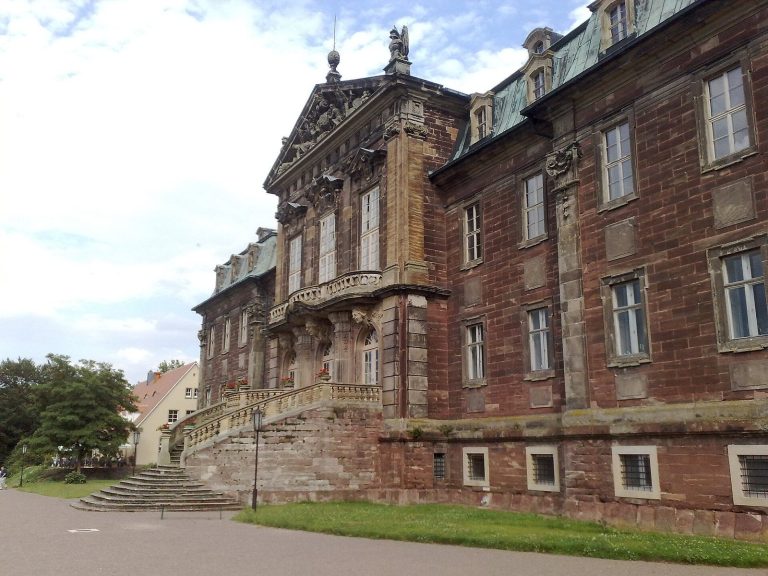
Between 1574 and 1587, Nickel and Valten von Lichtenhayn rebuilt and remodelled the partly burned outer bailey. After Nickel’s death in 1577, his son Valten received Vitzenburg as a fief from Elector Augustus of Saxony. In 1586–1587, Valten oversaw the castle’s transformation into a two-winged Renaissance palace with a stair tower. Nickel’s 1577 estate register also set out the family’s lands and income, as well as peasants’ feudal obligations.
Heßler and Schulenburg ownership
On 18 April 1649, Valentin Dietrich and Friedrich Wilhelm von Lichtenhayn transferred Vitzenburg and its judicial villages to Lieutenant Colonel Hans Heinrich II von Heßler. In exchange, they received the manor at Uhlstedt, an outlying farm at Pleissern, and 42,000 gulden in cash. Hans Heinrich III von Heßler had a manor built in front of the castle in 1665. In 1695, war commissioner Georg Friedrich von Heßler enlarged the north wing in Baroque forms. Around the middle of the eighteenth century, court councillor Friedrich Moritz von Heßler oversaw construction of an estate revenue office in the north wing. From 1764 to 1767, he directed a Baroque remodelling of the castle and former monastery; the vineyard tea pavilion probably dates from this period.
Friedrich Moritz, who died without children on 12 April 1803, had left Vitzenburg in his 1801 will to Heinrich Moritz I von der Schulenburg, the second son of his eldest sister. After 1843, Heinrich Moritz II von der Schulenburg had the castle remodelled in Neo-Renaissance and Neo-Baroque styles while retaining its basic form. At the 1861 coronation of Wilhelm I as King of Prussia, Heinrich Moritz II received the hereditary office of chamberlain in the Landgraviate of Thuringia and added the title to his coat of arms.
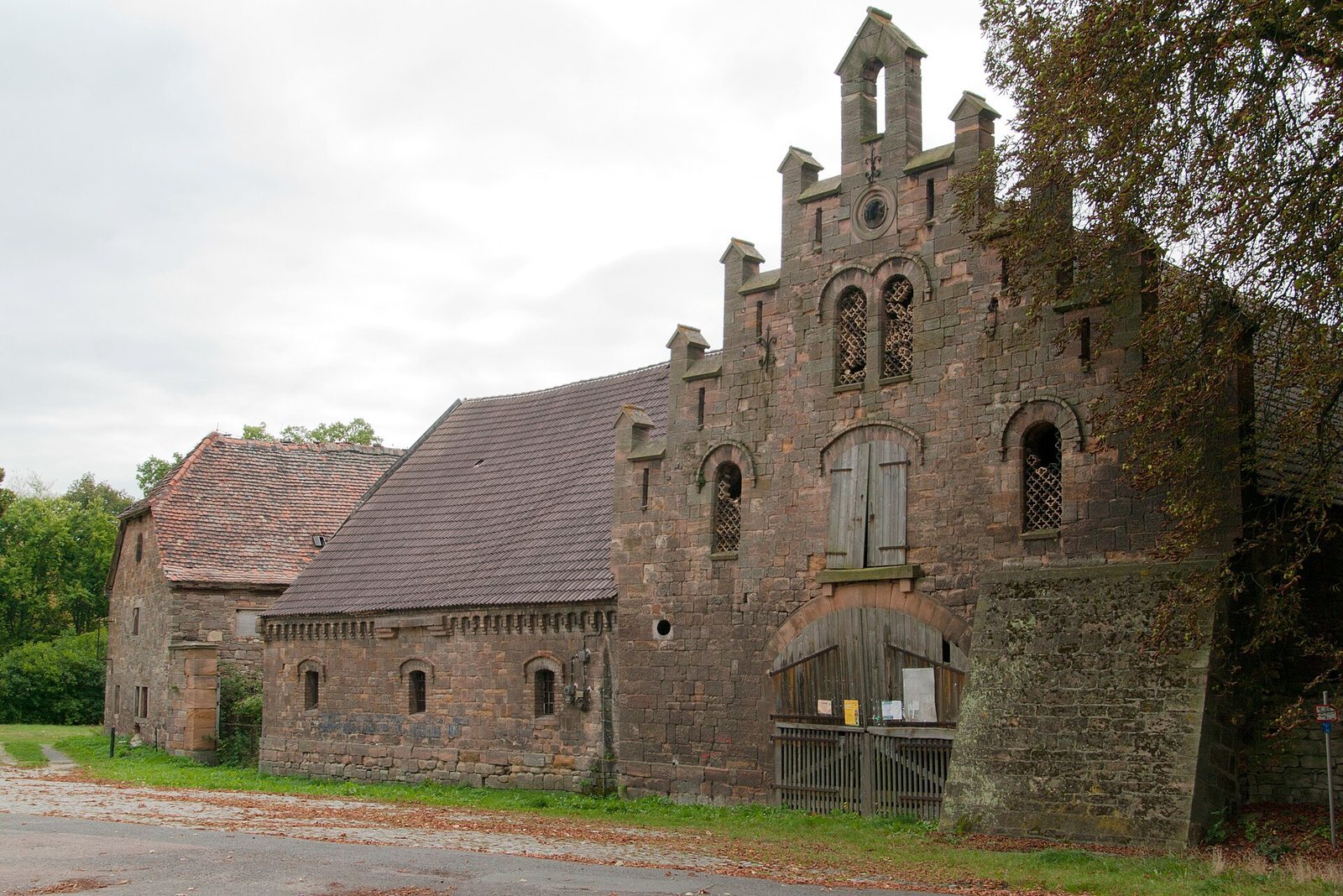
From 1880 to 1884, architect Max Wallenstein made further alterations, rebuilding the entrance gate and adjoining enclosing walls. Werner Christoph Daniel von der Schulenburg-Heßler added farm buildings in 1892. His death on 17 June 1930 ended the male Schulenburg line at Vitzenburg. His 1925 will named his daughter Auguste Marie Anna, Baroness von Münchhausen, as sole heir, and the estate passed out of Schulenburg ownership. In 1934, the manor was rebuilt using older building fabric.
Twentieth-century use and ownership
After the Second World War, Auguste’s husband, Rembert von Münchhausen, remained at the castle after American occupation forces withdrew. Soviet occupation forces arrested him, and he died at Special Camp No. 2, a Soviet internment camp at Buchenwald, on 14 July 1947. His estates at Vitzenburg, Steinburg, and Herrengosserstedt, amounting to 2,719 hectares since 1913, were expropriated and divided among new farmers and agricultural labourers. Auguste left Vitzenburg for West Germany.
The castle was subsequently used as a school estate and youth home, then as a training centre for teachers of agricultural apprentices. In 1948, an agricultural school and its associated provincial school estate were established at Vitzenburg. After the agricultural college moved to Naumburg, the castle was converted into a specialist hospital for child and adolescent psychiatry, formally handed over on 11 December 1969.
The hospital closed or relocated in 1996, and the castle stood empty. An architect bought it from the Treuhandanstalt, the agency responsible for privatizing state-owned property in the former East Germany after reunification, but did not find a new use for the building. The castle received maintenance and preservation work, while the grounds and vineyards were restored and made accessible through employment schemes. The castle was forcibly auctioned in late June 2004 because of insolvency. In 2016, the von Münchhausen family’s Vahlberg branch bought back the vineyard and its pavilion, which was then restored with public and charitable support.
Remains
Layout and surviving fabric
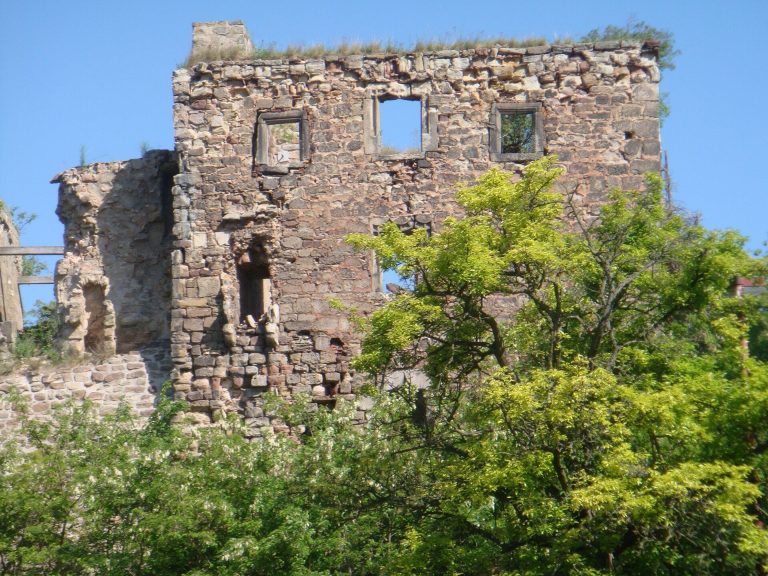
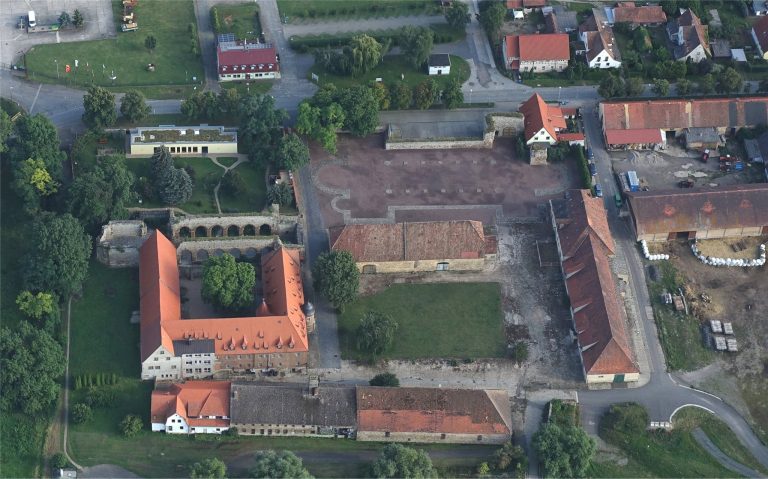
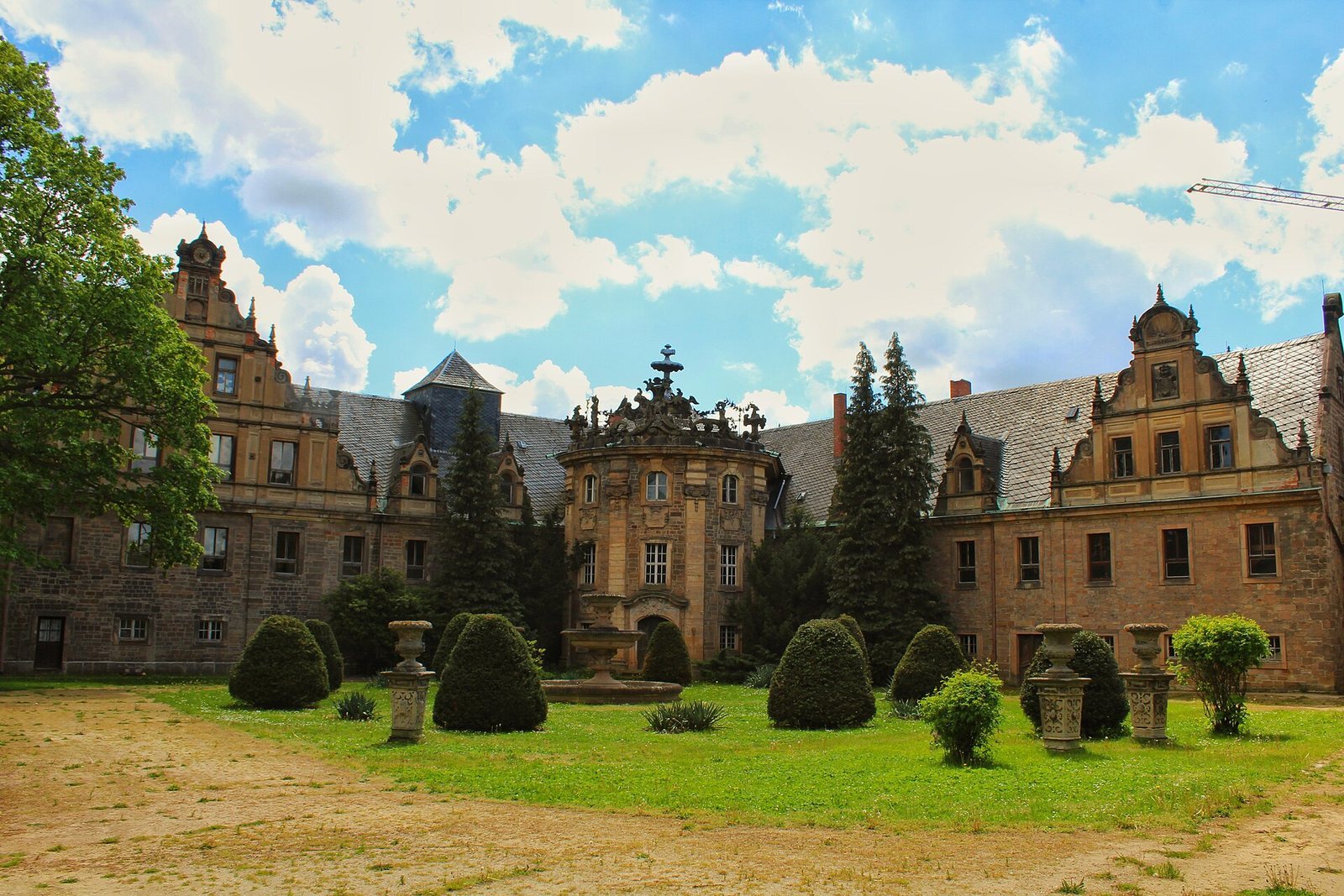
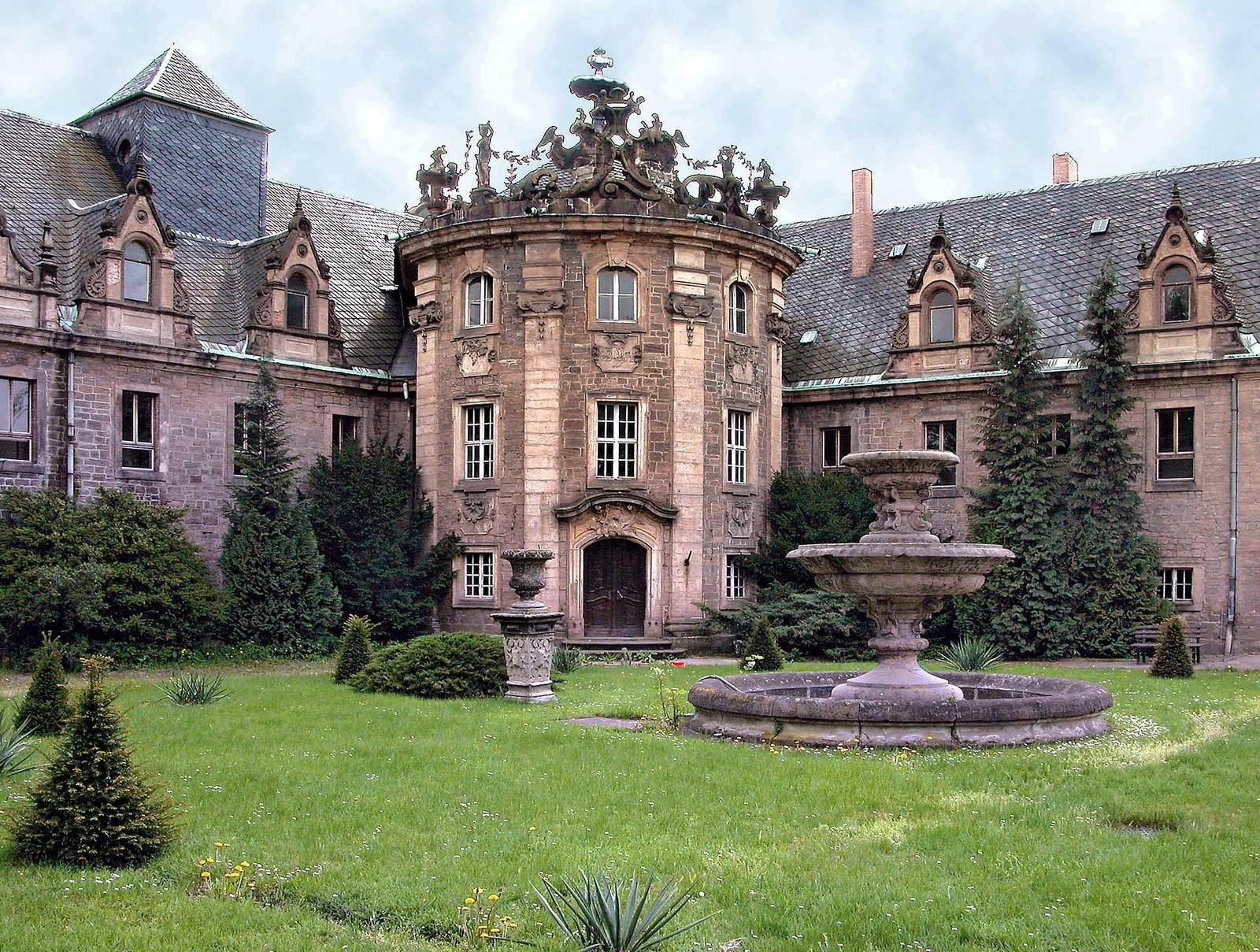
The castle occupies a westward-projecting spur above the Unstrut, southwest of the village. A terrace north of the former main castle and below the present castle may preserve part of an earlier enclosing ditch. The present complex reflects the transformation into a two-winged Renaissance palace, followed by Baroque and Neo-Renaissance alterations. Sections of masonry and probably some cellars belong to the late medieval castle.
Renaissance and later architecture
Renaissance palace
A doorway arch dated 1574 and a columned hall dated 1587 are associated with the Lichtenhayn remodelling. The hall was later built over. Together with the stair tower, these features belong to the palace created from the castle in the late sixteenth century.
North wing and estate revenue office
The estate revenue office occupies the north wing. Above its door and two windows are Rocaille cartouches, decorative panels with asymmetrical shell-like forms. One bears the alliance arms of the von Heßler and von Lindenau families and the date 1755. The other displays the arms of privy councillor Johann Moritz von Heßler, who died in 1741, and Henriette Margaretha von Zaschwitz.
Schulenburg features and farm buildings
On the eastern side of the south wing, Heinrich Moritz II von der Schulenburg’s coat of arms displays his titles and possessions. The entrance gate and adjoining enclosing walls, rebuilt between 1880 and 1884, have arches, battlements, and towers. Farm buildings erected in 1892 carry the Schulenburg arms, Werner Christoph Daniel’s name, and the year of construction.
Vineyard pavilion and grounds
The tea pavilion stands above the vineyards, which cover about 2.5 hectares and are among the oldest in the region. Its ceiling painting depicts an assembly of ancient gods. The castle park and grounds were also restored in the modern period.