Schloss Tiengen: Administrative Castle of the Klettgau in Germany

Site at a Glance
- Rating
- 4.5
- Popularity
- Very Low
- Country
- Germany
- Primary era
- Early Modern
- External website
- Open
- Eras represented
- Medieval, Early Modern
- Civilizations
- Holy Roman Empire
- Site type
- Military
- Remains
- Castle
On this page9 sections
History
Schloss Tiengen is a hilltop castle in Waldshut-Tiengen, Germany, whose oldest surviving foundation belongs to the eleventh century. Built initially by the Barons of Krenkingen as a defensive and residential tower, it later became the administrative seat of the Landgraviate of Klettgau, a territorial lordship ruled by a landgrave. Its successive holders included the Barons of Krenkingen, the Counts of Sulz, and the Princes of Schwarzenberg.
The Krenkingen Tower and the Swiss War
The older castle tower formed the original medieval stronghold. Warfare severely damaged it, but it was probably never entirely destroyed. The former castle church likewise survived in part. The most destructive episode came during the Swiss War, also called the Swabian War, a late-medieval conflict between the Swiss Confederacy and neighboring powers.
In 1499, approximately 5,000 Swiss Confederates besieged Tiengen. After four days, the town surrendered on 21 April. Women and children were permitted to leave, while Austrian soldiers withdrew wearing only their shirts after swearing an oath of peace. The nobles were released after paying ransoms, but the town was then plundered and burned. The damage prompted rebuilding, including the reconstruction of the castle under Johann Ludwig I of Sulz.
The Sulz New Castle
The later expansion created the New Castle, first mentioned in 1575 and attributed to the Sulz brothers Wilhelm and Alwig. A sandstone inscription found in 1983 states that Alwig, Count of Sulz and Landgrave of Klettgau, laid its first stone on 24 April 1571. The inscription also lists his offices, including imperial court judge at Rottweil, councillor to the Roman emperor and the prince of Austria, supreme commander in Upper Alsace, and territorial governor.
Work on the wider complex and its garden continued until 1619. The castle later burned during the Thirty Years’ War, the major European conflict fought from 1618 to 1648. The destruction occurred between 1641 and 1648, after which the castle was completely rebuilt soon afterward.
Schwarzenberg Administration and Baden Ownership
Under the Princes of Schwarzenberg, Schloss Tiengen housed the chancery and government of the territory and also served representational purposes. The princes generally governed the Klettgau from their estates in Bohemia rather than living at Tiengen. On 19 July 1812, the castle and the associated territorial lordship were sold to the House of Baden, a dynastic family.
The transfer also dispersed important collections. Schwarzenberg ancestral portraits went to Schloss Frauenberg at Hluboká, the Sulz archive to Schloss Třeboň at Wittingau, and the Klettgau archive to the Baden State Archives, now the Generallandesarchiv Karlsruhe. Into the nineteenth century, the castle housed a forestry office and official apartments. The historian Joseph Bader and the composer Heinrich Kaminski were born there.
Civic and Cultural Use
The older castle now contains renovated rooms used by the Bürger- und Narrenzunft 1503, the local-history museum of Tiengen, and a permanent exhibition on five centuries of Jewish life in the town. In 2012, the State of Baden-Württemberg sold the castle to entrepreneurs Kai Flender and Uwe Gantert. The courtyard continues to host the annual Schwyzertag celebrations and the carnival Narrengericht, or “Fools’ Court.” The vaulted cellar is used for concerts, exhibitions, exhibition openings, and readings.
Remains
Setting and Overall Layout
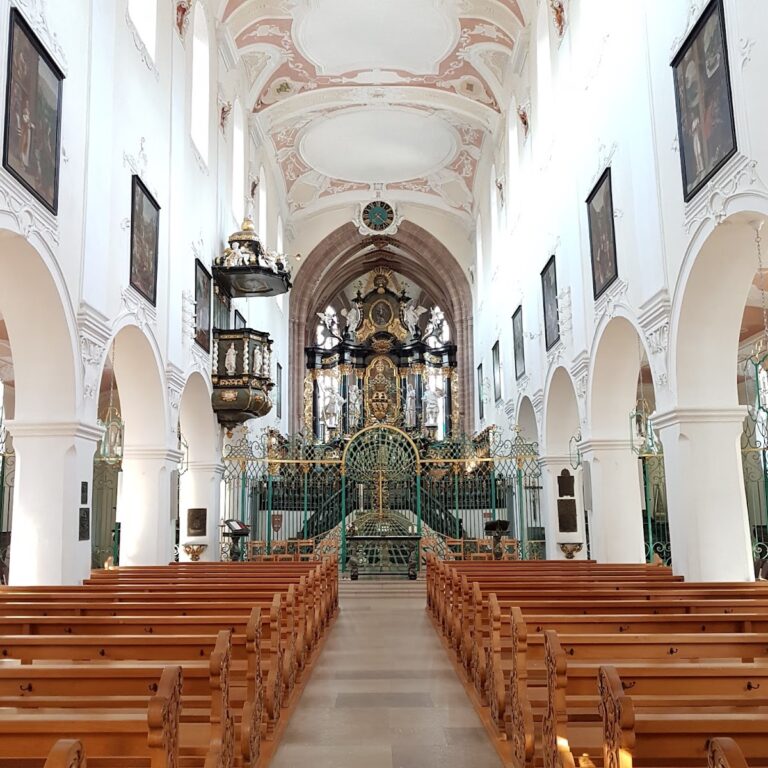
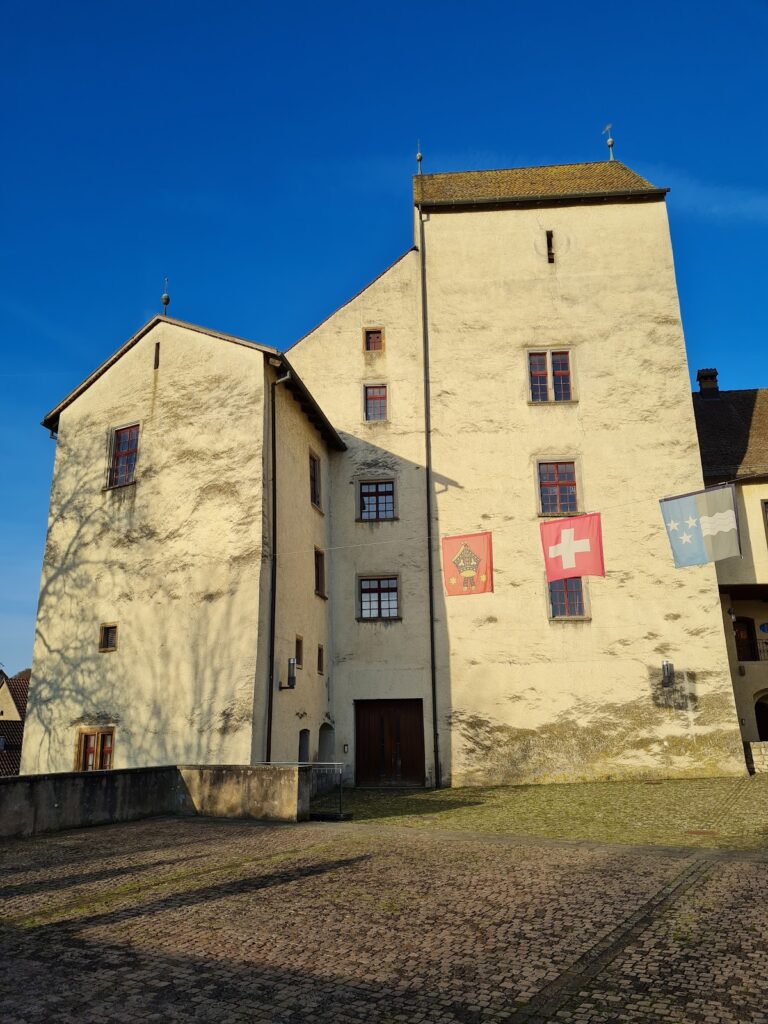
Schloss Tiengen consists of two principal buildings, the older castle, also known as the Small Castle, and the New Castle. The complex stands on a raised Niederterrasse approximately ten metres above the historic old town, where three valleys meet or open out. This position gave the site strategic value. The Baroque parish church of the Assumption of the Virgin Mary stands immediately beside the castle. The main building survives, together with a courtyard, connecting structures, service buildings, and later-adapted interior spaces.
The Older Castle
The older castle is an eleventh-century defensive and residential tower. Although warfare left it badly ruined, the structure probably remained partly intact, as did the former castle church. Its former granary has been converted into an art gallery. Museum rooms in the building include a room devoted to Tiengen’s Jewish community, while other renovated rooms accommodate local civic and historical uses.
The New Castle
The New Castle is organized around a courtyard with two entrances. Its round-arched Renaissance gate carries three heraldic shields belonging to Count Rudolf VII of Sulz and his two wives, who came from the families of Staufen and Limpurg. A passage once ran above the gate and connected the two principal castle buildings. Plans and an inventory prepared by government director Thaddäus von Weinzierl, who held office from 1785 to 1812, preserve evidence of the New Castle’s internal arrangement.
The chaplaincy building was constructed in two phases. Frescoes uncovered in the former knights’ hall in 1971 show elaborate hunting scenes similar to those at Vaduz, which the Sulz family held from 1511 to 1611. The paintings appear to have been made by the same artist. The complex also included a washhouse and a Maierhof, an estate farm serving the manor, with stables and vaulted cellars. The farmyard occupied the site of the present parish house.