Fort Reuenthal: A Swiss Army Border Artillery Fortification


Site at a Glance
- Rating
- 4.7
- Popularity
- Low
- Country
- Switzerland
- Primary era
- Modern
- External website
- Open
- Eras represented
- Modern
- Civilizations
- Swiss
- Site type
- Military
- Remains
- Fort
On this page11 sections
History
Fort Reuenthal is a Swiss Army fortress artillery work in Switzerland, at Full-Reuenthal in Aargau. Built from 1937 to 1939 as part of Switzerland’s 1930s border defenses, it was the first artillery work on the country’s northern front to become operational before the Second World War. The fort and its surrounding defensive works belonged to the operational area of Border Brigade 5, a Swiss Army formation responsible for defending a frontier sector.
Construction and wartime service
The fort was designed to prevent an enemy crossing of the Rhine below the Albbruck-Dogern weir, a hydroelectric river installation whose approaches were central to the defensive plan. Low summer water levels could make the river relatively easy to ford at this point. Of 56 calculated targets, 48 covered the crossing, six covered German approach roads descending from the Hotzenwald, a wooded upland region above the southern German Rhine valley, and two lay on Swiss heights.
The target plan extended across the frontier, with 29 targets in Germany and 27 in Switzerland. Their calculated distances ranged from approximately 1,280 to 9,100 metres. The fort was almost continuously occupied during the Second World War. Its artillerymen were mobilized and sworn in on 29 August 1939. The original design allowed for a garrison of 90 personnel, but this was increased to 150 by June 1944. The average wartime garrison was about 100 soldiers.
General Henri Guisan, the commander-in-chief of the Swiss Army during the Second World War, visited Fort Reuenthal on 30 October 1942. The garrison was successively supplied by Fortress Artillery Detachment 253 under Border Fusilier Battalion 253 from 1939 to 1943, Fortress Artillery Company 95 from 1943 to 1951, Fortress Company 95 under Fortress Battalion 21 from 1952 to 1961, and Fortress Company II/21 from 1962 to 1977.
Decommissioning and preservation
Fort Reuenthal was decommissioned in 1988 after the Leibstadt Nuclear Power Plant entered operation, and the fort’s military secrecy was lifted. The wider Reuenthal-Full defensive position is classified as a military-historical monument of national importance. The fort itself is listed as Swiss cultural property of regional significance and forms part of the cultural-property inventory of Full-Reuenthal.
The Association of the Military and Fortress Museum Full-Reuenthal, founded in 1982, operates the artillery work as a fortress museum. The association also owns the Swiss Military Museum Full and maintains approximately 100 military-historical installations in Aargau, preserving them in original or historically faithful condition. At Fort Reuenthal, the restored armament and equipment are displayed alongside objects from twentieth-century European military history. A changing special exhibition, devoted to a different subject every two years, occupies the former medical section.
Remains
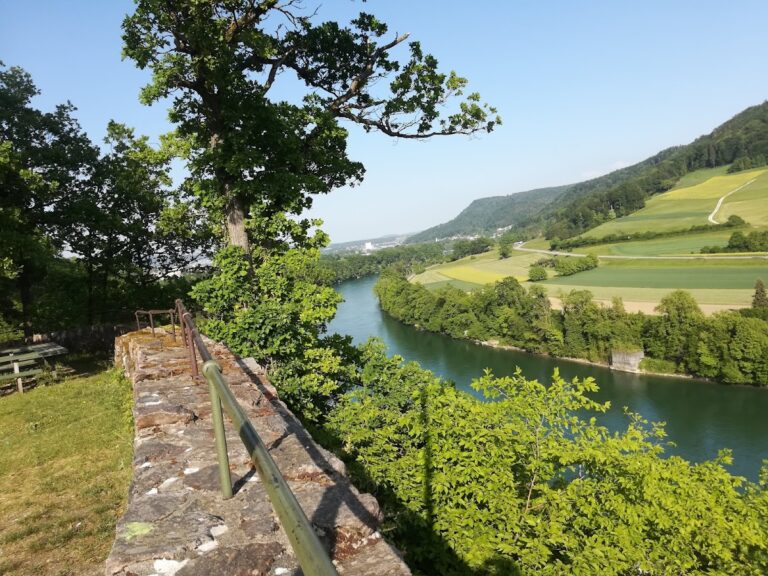
The artillery work lies north of Reuenthal on a rise above the Rhine, opposite the German town of Waldshut. The river curves around Full-Reuenthal within direct view of the fort. An approximately 600-metre tunnel system links the entrance with two gun positions, Bunker 1 and Bunker 2, as well as ammunition and material magazines, command rooms, a telephone exchange, a dining room, a kitchen, troop quarters, and a medical section. The fort also contains an operating room and several above-ground bunkers for external and close defense.
Artillery work
The principal armament consisted of two 7.5 cm 1938 L30 fortress guns, introduced in 1938. Each semi-automatic gun could fire up to 20 rounds per minute. The fort stored 8,000 shells with their associated charges and fuzes. Some positions had camouflage arrangements, while certain gun positions were covered by distinctive domino-shaped superstructures. A roughly 300-metre escape tunnel was later constructed beneath the eastern external-defense bunker and ended at an emergency exit. Three bunkered external observation posts had been added by the end of 1941.
Reuenthal-Full defensive position
The wider Reuenthal-Full position occupied a large bend of the Rhine around Full-Reuenthal, beginning shortly after the Aare confluence. It secured the riverbank, roads, the Albbruck-Dogern hydroelectric facility, and approaches through the surrounding area. Three machine-gun bunkers were built in the Fuller Feld in 1938–1939. The Fullfeld-Ost infantry bunker, A 4243, held two machine guns; the Reuenthal-Schulhaus bunker, A 4244, held three; the Fullfeld-West bunker, A 4245, held three; and the Fullfeld-Rhein bunker, A 4246, held two. The Reuenthal-Schulhaus bunker has since been demolished.
Other works in this position included the Reservoir infantry-gun garage, A 4564, the Bettlerküche infantry bunker, A 4265, built in 1941, shelters F 5153 and F 5197, and the company command post F 5192, an atomic-protection shelter built in 1983. The Stier observation post supported observation. Two terrain anti-tank obstacles, barriers intended to impede or channel armored vehicles, were built at Reuenthal-Nagelfluh in 1939 and Reuenthal-Bettlerküche in 1938.
Felsenau and Leuggern positions
The Felsenau position lay in the Felsenau hamlet east of Reuenthal. Its Steinbruch infantry bunker, A 4261, had a 24 mm anti-tank rifle and three light machine guns, while the Wald bunker, A 4262, had a 24 mm anti-tank rifle and one light machine gun. Shelter F 5150 and railway obstacles T 2236 completed the position.
The Leuggern position comprised the Gippingen Nord and Gippingen Süd bunkers, A 4280 and A 4281, the Leuggern-Ost and Leuggern-West bunkers, A 4282 and A 4283, and the Hettenschwil Süd and Hettenschwil Nord bunkers, A 4284 and A 4285. The Immenholz Irmgard medical shelter, A 4271, was also part of the position.
In 1940, the cemetery at Leuggern was converted into a military strongpoint. Its walls were reinforced and rebuilt, and 12 firing loopholes were inserted. The four entrances were prepared for horizontal T-rail obstacles because the cemetery walls lay directly in the lines of fire of the Leuggern-Ost and Leuggern-West bunkers. A detailed civilian evacuation plan was prepared, and residents of the old-age and nursing home were evacuated to Muri in Aargau on 10 May 1940.
Leibstadt and Bernau positions
The Leibstadt position blocked the road between Leibstadt and Leuggern in the Strick area. It included the Kaltentanne Pak infantry bunker, A 4266, Kaltentanne shelter A 4267, Peterlibuck infantry bunker A 4268, Leibstadt shelter A 4269, Rägehalde Pak infantry bunker A 4270, also known as Kirchtanne, Bossenhus infantry bunker A 4272, shelter F 5159, and company command shelter F 5160.
The Bernau position lay on the Rhine bank at Bernau, in the municipality of Leibstadt, southwest of Reuenthal. It secured the riverbank and the Albbruck-Dogern weir. The Strahler infantry bunker, A 4247, had a light machine gun and an observation post. The Bernau observation post has been demolished. The Stauwehr infantry bunker, A 4248, had a machine gun and was demolished in February 2007. The Station, Grossäcker Ost, and Grossäcker West infantry bunkers were equipped with one, two, and two machine guns respectively.
Schwaderloch and Etzgen positions
The Schwaderloch position protected the Rhine bank through the Rossgarten infantry bunker, A 4300, the Im Sand bunker, A 4301, the Steg bunker, A 4302, of the Schindler type, and the Schwaderloch Warte bunker, A 4303. The Wandfluh artillery observation post, A 4273, supported the Reuenthal artillery work from the rear.
The Etzgen position consisted of the Grossmatt, Zegli, Zoll, Etzgen Nord, Etzgen Süd, and Etzgen Sandrüti infantry bunkers, designated A 4304 through A 4309. An Etzgen mortar observation post occupied the rear position.
Laufenburg position
The Laufenburg position contained the Laufenburg Ost, Laufenburg Münz, Laufenburg West, Laufenburg Säge, and Laufenburg Kraftwerk infantry bunkers, designated A 4311 through A 4315. It also included the Kaisterbach Ost bunker, A 4316, now demolished, the Kaisterbach West bunker, A 4317, the Obert observation post, A 4318, the Obert Ost and Obert West bunkers, A 4319 and A 4320, and the Chaisterkopfweg bunker.
Museum collections
The museum preserves the fort’s restored artillery armament and equipment, allowing the tunnel system and its military functions to be understood together. Its military-historical objects include a French percussion pistol, a combat knife of the Royal Welch Fusiliers, Swiss submachine guns, German Wehrmacht invasion maps, and a Swiss Nazi leaflet. These objects are displayed with exhibits from twentieth-century European military history.