Schloss Süßenstein: A Gothic Castle and Mining Court in Austria


Site at a Glance
- Rating
- 4.9
- Popularity
- Very Low
- Country
- Austria
- Primary era
- Medieval
- External website
- Open
- Eras represented
- Medieval, Early Modern
- Civilizations
- Habsburg, Holy Roman Empire
- Site type
- Military
- Remains
- Castle
On this page7 sections
History
Schloss Süßenstein is a Gothic castle in Hüttenberg, Austria, whose documented history reaches at least the fifteenth century. Its medieval architectural character reflects a tradition associated with pointed arches, substantial masonry, and vertically emphasized forms. The castle’s history is difficult to reconstruct because records sometimes confuse it with another Süßenstein castle near Hüttenberg, now ruined, and with the ruined castle of Althaus. Claims that the latter site had Roman-period origins or was first mentioned in 1247 do not securely identify the present Schloss Süßenstein.
Medieval Conflict
Hungarian forces attacked the castle in 1488 during the Austro-Hungarian War. The assault was repelled and caused no major damage, allowing the castle to continue its historical role in the Hüttenberg area.
The Mining Court
Hüttenberg was an important medieval Carinthian center of iron extraction. From 1610 until the nineteenth century, Schloss Süßenstein served as the official residence of the Hüttenberg mining judge and as the seat of the Hüttenberg mining court. A mining judge administered and adjudicated matters concerning mining operations, miners, and mining rights. During this period, miners repeatedly surrounded or pressured the castle in protest against decisions they considered unfavorable.
Fire, Reconstruction, and Later Use
After a fire, the castle was renovated and enlarged in the seventeenth century. A further fire in the nineteenth century led to additional reconstruction and renovation. Restoration and modernization in the 1970s enlarged the building according to modern principles, after which it was used as a hotel and as a venue for seminars and conferences. The castle was sold in 1992 and adapted as a private property. Its new owner renewed the roof coverings and modernized the interior, and Schloss Süßenstein remains privately owned. It is protected as an Austrian monument under protection number 104528.
Remains
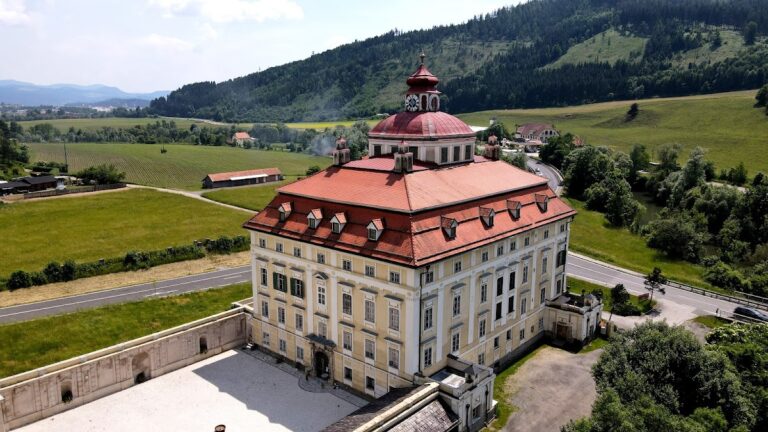
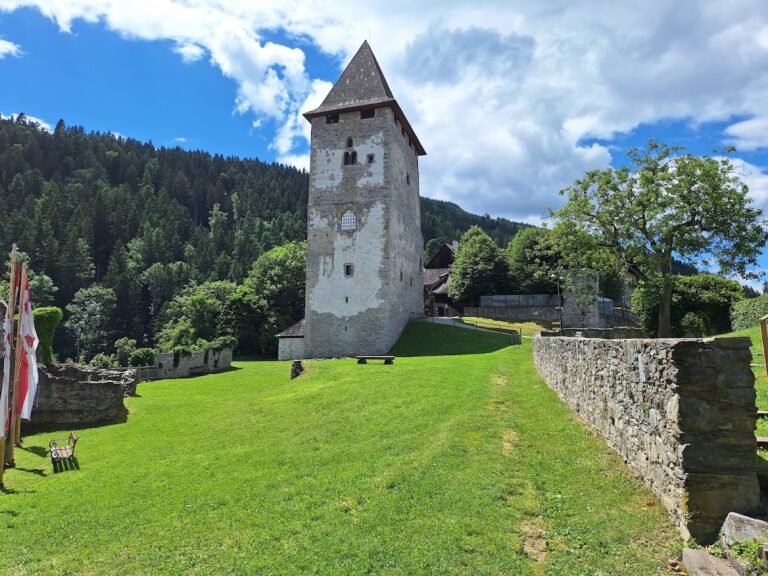
Schloss Süßenstein stands on elevated ground south of the center of Hüttenberg, within the built-up settlement and above the valley floor. It lies near the confluence of the Mosinz and Steirerbach streams, after which the watercourse is called the Görtschitz, and access is provided by a bridge. A Gothic core forms the center of the castle, around which a four-storey structure developed.
Exterior and Tower
The building has a prominent, high tower set at an angle to the main structure. Its tent-shaped roof extends over an entire storey. The exterior is notably austere, with undecorated facades and modern window frames replacing the historic fittings. Almost none of the former sgraffito decoration survives. Sgraffito is a decorative method in which an upper layer of plaster is incised to reveal a contrasting layer beneath and create designs.
Gothic Portal and Interior
The interior has been extensively altered, but it retains a Gothic portal supported by stone corbels. The portal includes a stone-carved coat of arms dated 1544. Schloss Süßenstein stands next to the Heinrich Harrer Museum, named for the Austrian mountaineer, explorer, and author.