Schloss Stainz: A Former Monastery and Baroque Castle in Austria


Site at a Glance
- Rating
- 4.7
- Popularity
- Very Low
- Country
- Austria
- Primary era
- Early Modern
- External website
- Open
- Eras represented
- Medieval, Early Modern, Modern
- Civilizations
- Duchy of Styria, Habsburg, Holy Roman Empire
- Site type
- Domestic
- Remains
- Castle
On this page13 sections
History
Medieval foundation
Schloss Stainz is a former Augustinian Canons’ monastery in Stainz, Austria, founded in 1229 on the Schlossberg by Leuthold I von Wildon, lord of Stainz. The medieval foundation included a small church and was settled by canons regular from Seckau, members of a communal clerical order following the Rule of Saint Augustine.
The monastery church became Stainz’s parish church around 1600, after St. James’ Church in the market was demolished. This change gave the monastery church a wider pastoral role within the town.
Seventeenth-century transformation
The priory flourished under Provost Jakob Rosolenz, who led it from 1596 to 1629. As head of the religious community, he reorganized the monastery and began enlarging the previously neglected church. Work on the church took place between 1605 and 1629, followed by the creation of a Baroque interior.
The monastic complex was altered and expanded further during the terms of Provost Georg Siegfried von Jöchlingen, from 1667 to 1683, and Provost Johann Bernhard von Paumgarten, from 1683 to 1704. Domenico Orsolino was among the builders, while Matthias Echer and Carlo Formentini are identified with the design work. The Baroque construction phase is associated with 1695, and the complex is stated to have been completed in 1730.
Dissolution and the Counts of Meran
Emperor Joseph II dissolved the monastery in 1785 as part of late-eighteenth-century reforms that suppressed religious houses regarded as nonessential to pastoral or social purposes. The church continued in use after the dissolution.
Archduke Johann, the son of Emperor Leopold II, acquired the estate in 1840 for 40,000 guilders and used it as a hunting lodge. Following his death in 1859, the property remained with his descendants, the Counts of Meran. The castle and its ancillary buildings are protected as historic monuments, and the complex remains in the family’s ownership.
Museums and continuing use
The complex now houses the Hunting Museum and the Museum of Agriculture and Forestry, both part of the Universal Museum Joanneum, a Styrian museum institution devoted to art, culture, history, and natural history. The Hunting Museum opened in 2006, while the agricultural museum opened in 2009. In May 2024, the Archduke Johann Museum opened with approximately 650 square metres devoted to his life.
The museums interpret hunting through its historical and cultural meanings, as well as through sociological, anthropological, philosophical, ethical, and ecological perspectives. The agricultural museum presents rural Styrian culture, agricultural implements, household objects, agriculture, and animal husbandry, with material ranging from the Stone Age to the present. Restoration of the church’s Marian statue took place in 2010 and 2011.
Remains
Monastery complex
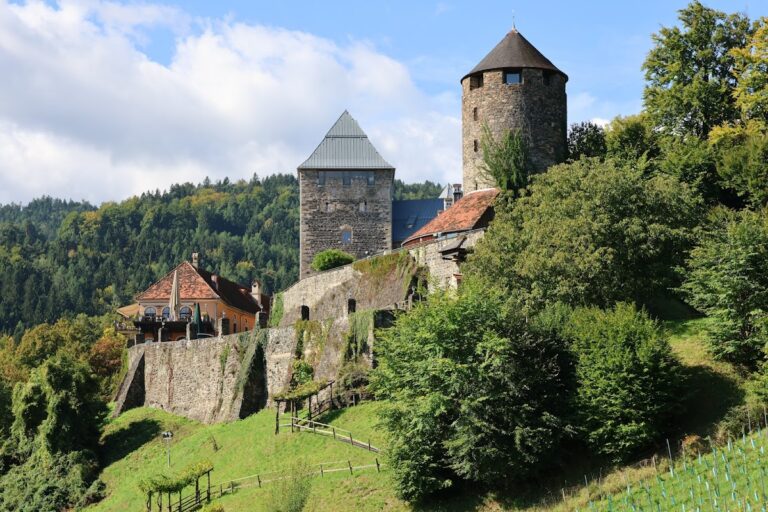
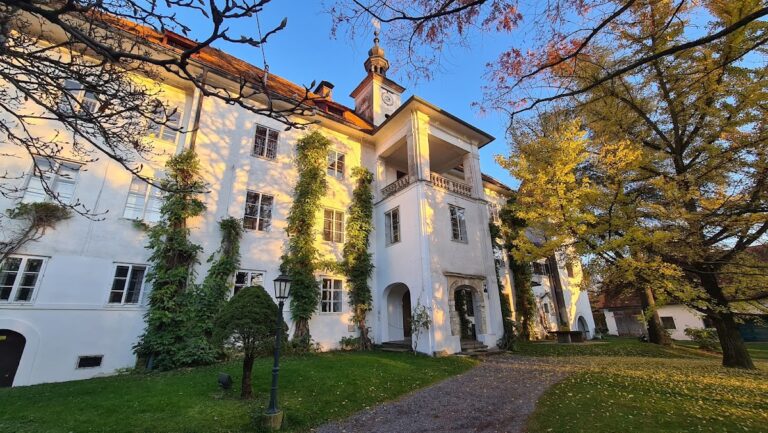
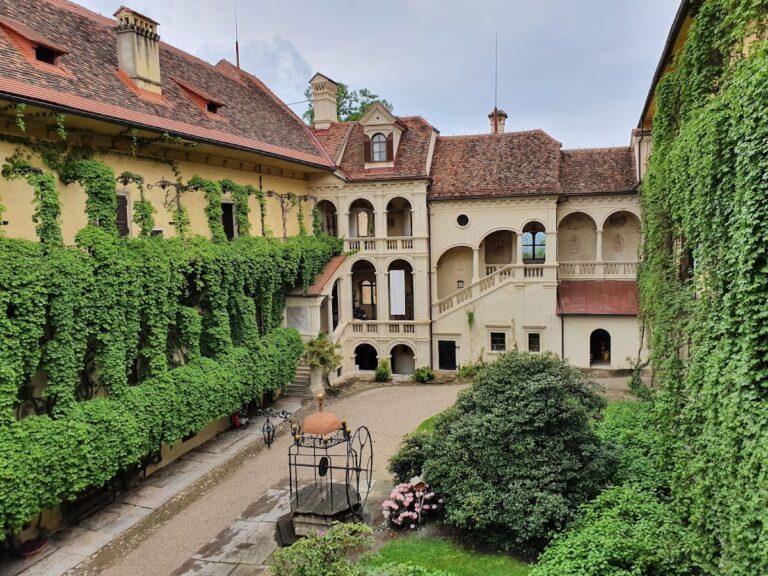
Schloss Stainz is a three-storey Gothic and Baroque complex with an area of approximately 3,000 square metres. Its surviving arrangement includes a courtyard, cellar, arcades, terrace, gardens, residential rooms, and service buildings. Medieval fabric remains in the west wing of the former monastery building, linking the later Baroque complex with its medieval origins.
Former monastery church
Exterior and medieval fabric
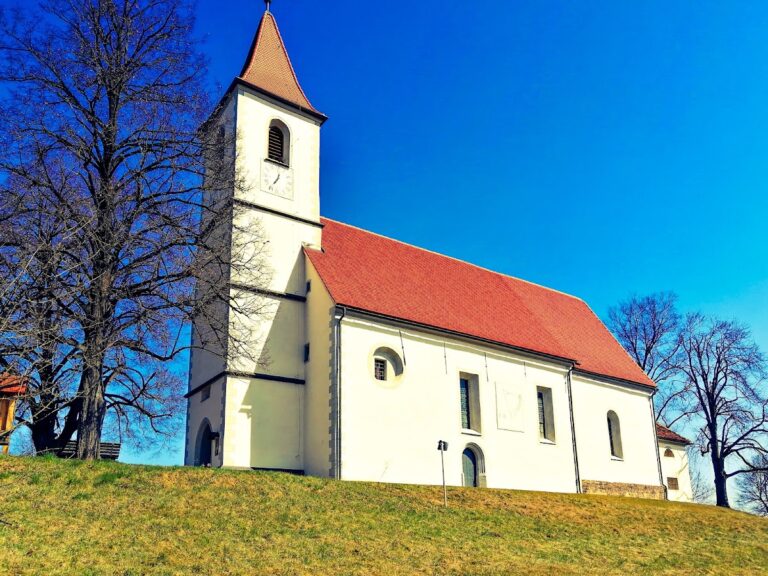
The former monastery church has two towers and was enlarged between 1605 and 1629. Its principal entrance originally lay on the west side between the towers, but it was later moved to the east, where it opens onto the former monastery courtyard. The space between the towers now contains a plain, windowless apse, the semi-circular sanctuary end of the church.
A heraldic tombstone in the church commemorates Leuthold von Wildon, who died in 1249. The stone dates from approximately 1448, around the two-hundredth anniversary of the monastery. It preserves a material connection with the founder of the medieval institution.
Interior and furnishings
The church’s later Baroque interior contains rich stucco, molded plaster ornament, and extensive frescoes painted on fresh plaster. This decorative work dates from after 1680. The two-storey high altar was consecrated in 1695.
The organ case dates from 1880, while the instrument itself was replaced in 1980 by a new organ in the Neo-Baroque style, a later revival of Baroque forms. It is described as among the largest and most melodious organs in Styria.
A Marian statue stands beside the church’s secondary entrance on the north side. The women of Stainz donated it in 1905. It preceded the Marian statue placed on Stainz’s main square, was temporarily kept in the service courtyard after the new arrangement there was created, and was later installed beside the church.
Museum interiors and agricultural collections
Hunting Museum
The Hunting Museum occupies part of the historic complex and contains historical equipment, weapons, and specimens. Its presentation places hunting within historical, sociological, anthropological, philosophical, and ethical contexts, while also addressing wildlife ecology.
Museum of Agriculture and Forestry
The Museum of Agriculture and Forestry contains rural Styrian implements and household objects. Its collections relate to different branches of agriculture and animal husbandry and extend from the Stone Age to the present, placing local rural life within a long chronological sequence.
Nearby sites