Schloss Senden: A Water Castle and Renaissance Manor House in Germany


Site at a Glance
- Rating
- 4.1
- Popularity
- Low
- Country
- Germany
- Primary era
- Early Modern
- External website
- Open
- Eras represented
- Medieval, Early Modern
- Civilizations
- Holy Roman Empire
- Site type
- Military
- Remains
- Castle
On this page11 sections
History
Schloss Senden is a medieval water castle in Senden, Germany, whose fortified house developed into a Renaissance manor complex beside the River Stever. A water castle is an aristocratic residence protected by surrounding water, usually a moat or flooded ditch. The site grew from the medieval Rittergut Senden, then known as Benekamp, and became associated with the Senden branch of the Droste family.
Medieval origins and the Droste family
During the medieval period, Benekamp belonged to the family of Senden, also called the von Senden family of Benekamp. The family heiress Kunigunde married Alexander, known as Sander, Droste zu Kakesbeck. This marriage created the Senden branch of the Droste family, a Westphalian noble lineage whose name was also historically connected with an administrative and judicial office.
Kunigunde and Alexander’s son Ludeke Droste established Schloss Senden as a fortified house in the form of a water castle. His son, Sander II Droste zu Senden, created the manor house in the form that shaped the later complex. The building’s stepped gable belongs to a type associated with late medieval and Renaissance architecture in northern Europe and helped make the castle an important example of Westphalian Renaissance building.
Administration and war
Sander III Droste zu Senden later held an important regional office. In 1510, the mayor and council of Münster entrusted him with the Gogericht of Senden, a territorial court with higher local judicial authority. In 1519, the territorial estates, representative bodies in which the clergy, nobility, and towns participated in administering a territory, elected him to execute the territorial union.
Schloss Senden was also affected by the Eighty Years’ War, the conflict from 1568 to 1648 in which the Dutch provinces revolted against Spanish Habsburg rule. In 1587, Spanish forces subjected the village and the house of Senden to extortion and plunder.
Expansion of the estate
The family’s landed property expanded through inheritance and purchase. Gut Patzlar became part of the estate in 1680, followed by Gut Isingholt in 1713. Gut Venhaus was acquired by purchase in 1729. These additions enlarged the economic base associated with Schloss Senden while the castle remained the central residence of the estate-owning family.
War damage and changing uses
In 1944, during the Second World War, an aircraft making a forced landing struck the castle and knocked the top from the south tower. British soldiers occupied the building afterward, partially devastated its interiors, and looted it.
The Droste zu Senden family sold the castle in 1957 but retained the associated estate holdings and the Senden estate in Münster. The nearby Wulfshoek forester’s house became the family’s new residence. After the sale, Schloss Senden passed through several uses. It housed a commercial-school boarding institution, then a residential home for older people, and from 1976 student accommodation. A hotel operated there from the 1980s until the late 1990s, when a fire in the roof structure forced its closure. The increasingly vacant building later accommodated sculpture courses run by the Senden art school, while its condition deteriorated.
Conservation and new ownership
The Initiative Schloss Senden began work in 2007 to find a new use for the complex and prevent further decline. A municipal assessment placed the market value at about 500,000 euros. The municipality repeatedly declined financial involvement, and in 2014 the owner threatened to demolish the listed monument.
The nonprofit Schloss Senden association was founded in 2015 and acquired the property. Its first measures secured the building fabric through roofing and glazing work. From 2016, volunteers from the NRW-Westphalia youth heritage-building program cleared the site, documented its condition, removed vegetation and graffiti, carried out surveys, prepared room plans, installed protective carpentry, and repaired doors and windows.
Overall conservation has continued with support from the Federal Government Commissioner for Culture and the Media, the Münster district government, the German Foundation for Monument Protection, and the municipality of Senden. The foundation of the leaning Mannenhaus was stabilized in 2018. In July of that year, the LWL Office for Monument Preservation, Landscape and Building Culture in Westphalia recognized Schloss Senden as a “Monument of the Month” in Westphalia-Lippe.
Remains
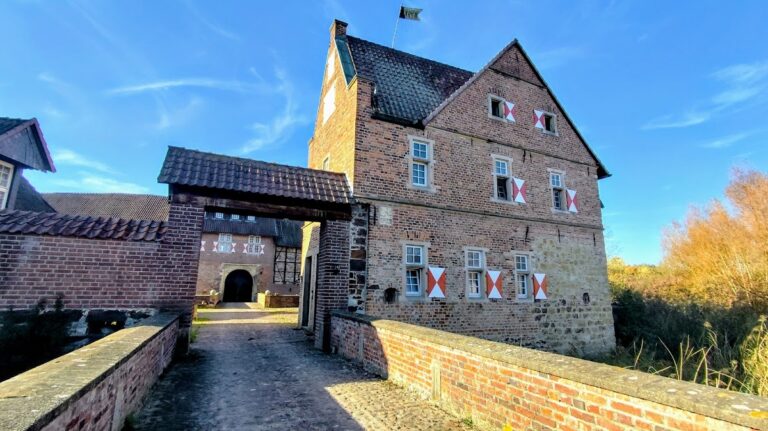
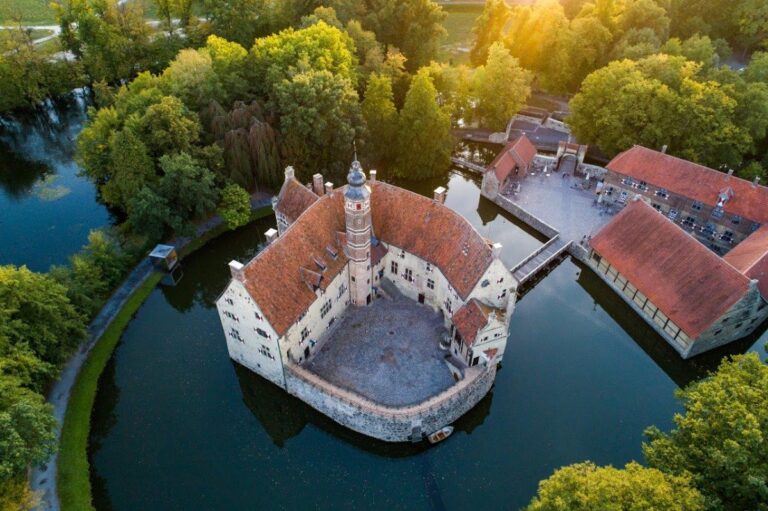
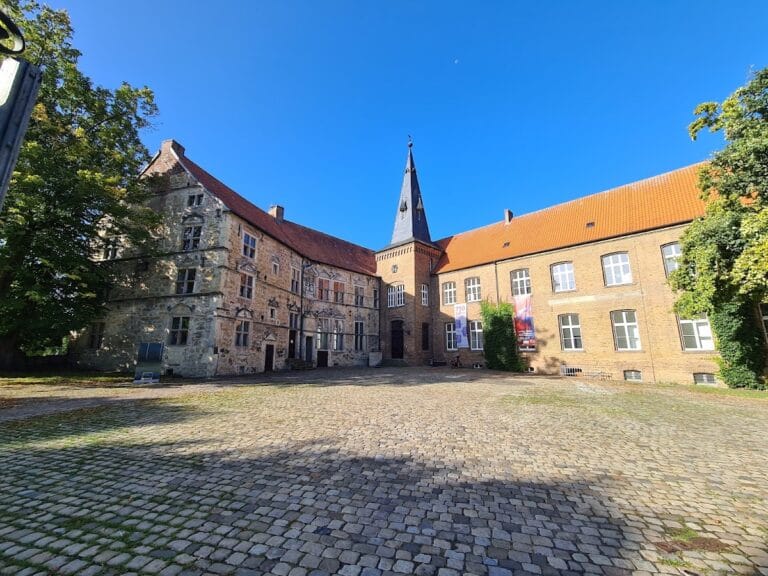
Schloss Senden occupies a water-surrounded complex in the Münsterland beside the River Stever, whose water supplies the moat. The Dortmund–Ems Canal lies about 250 metres south of the castle. The surviving layout combines the original fortified house with later additions, including the manor house, the connecting wing, the Romberg wing, the Mannenhaus, the moat, and the surrounding park.
The manor house
The manor house is the principal residence of the former estate-owning family. Its three-stepped gable rises in horizontal stages rather than along a continuous slope. The form is regarded as probably the oldest surviving monument of its type and served as a model for buildings of the Westphalian Renaissance.
The southern facade of the connecting wing, which faces the moat, probably belongs to the same period as the manor house. It contains a series of stone cross windows and loopholes, showing how the residential and defensive aspects of the complex were combined. Exterior renovation of the approximately 500-year-old manor house was completed in 2025. The work renewed its roof and removed plaster applied to the facade in the 1960s.
The Romberg wing
The Romberg wing forms one of the later building elements within the castle complex. Its renovation was carried out in the middle of 2019. The entire roof was renewed, the brick facade was repaired, and the missing top of the south tower was reconstructed as a modern steel structure in a historically styled form. This work addressed both the surviving masonry and the tower damage caused by the 1944 aircraft impact.
The Mannenhaus
The Mannenhaus is another individual building within the complex. Its leaning foundation was stabilized in 2018, and renovation of the facade and roof began in 2021. A terrazzo floor made from reused bricks was installed afterward, adding a new interior surface while retaining material connected with the building’s earlier fabric.
Moat and park
The moat and surrounding park remain part of the castle complex. The moat’s connection to the River Stever preserves the defining physical setting of Schloss Senden as a water castle, while the park forms the wider landscape around its buildings.
Nearby sites