Schloss Röhrsdorf: A Historic Castle Estate in Germany


Site at a Glance
- Rating
- 4.6
- Popularity
- Low
- Country
- Germany
- Primary era
- Early Modern
- External website
- Open
- Eras represented
- Early Modern, Modern
- Civilizations
- Electorate of Saxony, German, Holy Roman Empire
- Site type
- Domestic
- Remains
- Castle
On this page12 sections
History
Schloss Röhrsdorf is a historic castle complex in Germany, in the Röhrsdorf district of Dohna, whose origins lie in a sixteenth-century Rittergut, a landed manorial estate associated with noble ownership and estate jurisdiction. Its first documentary mention is dated either 1436 or 1583, and it remains uncertain whether the settlement came first or developed to serve the estate.
Noble ownership and estate development
Rudolf von Neitschütz of Borthen, Röhrsdorf, and Tronitz owned the estate from 1649 to 1682. He served as an Electoral Privy and War Councillor and was married to Magdalena von Osterhausen. Their family included 13 children. This Rudolf von Neitschütz was a different person from the Rudolf von Neitschütz who died in 1703 after serving as lieutenant general in the Saxon elector’s bodyguard.
Christoph Vitzthum von Eckstädt succeeded him as owner. In January 1668, Christoph married Johanna Helene von Neitschütz, Rudolf’s second daughter. They had 17 children, linking the two noble families through both ownership and marriage.
In 1741 the estate passed to Carl Adolph von Carlowitz, a member of a Saxon noble family and the patron of the local church. A church patron, or Patronatsherr, held rights and responsibilities connected with a church and its clergy. Carl Adolph had the dilapidated church demolished in 1748 and commissioned a replacement at a cost of 1,429 thalers, 12 groschen, and 1 pfennig. The new church was dedicated in 1749, and its patron’s box carries the von Carlowitz family arms.
The eighteenth-century castle and park
During the eighteenth century, the estate was enlarged with the manor house that became Schloss Röhrsdorf. In 1771, Georg Heinrich I von Carlowitz commissioned a walled landscape park in the Röhrsdorfer Grund. An orangery, a garden building for protecting citrus and other frost-sensitive plants, was added in 1787. Christoph Nathe is associated with a 1780 depiction of the expanded castle, titled Prospect des Schloßes zu Röhrsdorf bey Dohna.
The estate’s agricultural role continued into the early twentieth century. Its plant-breeding garden cultivated several crops, including Pirna rye. The von Carlowitz family retained ownership until the end of the Second World War in 1945. The last owner was Frieda von Carlowitz, née von Schönberg. Her adopted daughter Melitta, née von Carlowitz, married her first husband, Kraft Baron von Palombini, at the castle in 1922. The estate covered approximately 290 hectares.
Fire, public use, and new ownership
A fire completely devastated the castle in 1890. It was rebuilt with some alterations and gained an additional four-storey stair tower. After the Second World War, the Soviet Army took over the castle, and it became public property in 1948. During the German Democratic Republic period, the building served as an agricultural school for trainees in agricultural work until 1989.
In 1990 an investor acquired the building and converted it into a country hotel. The hotel became insolvent five years later, and in 1999 the castle passed to its principal creditor, the savings bank. It closed in 2002 and later reopened under another operator. David Krysko, a Canadian businessman and co-founder of Club Penguin, acquired the castle in 2008. It now serves as the residence of an artists’ community and hosts exhibitions and events. Seven themed rooms are rented as band-hotel accommodation, and a recording studio is also available for use.
The castle and estate stand on a high plateau about 238 metres above sea level between Lockwitz and the Müglitz valley. Röhrsdorf lies immediately south of the castle. The stream Briese passes through the settlement, becomes the Rietzschke, and ultimately drains through the Müglitz into the Elbe. The estate is about 15 kilometres southeast of Dresden’s old town, 10 kilometres west of Pirna, and 4 kilometres west of central Dohna.
Remains
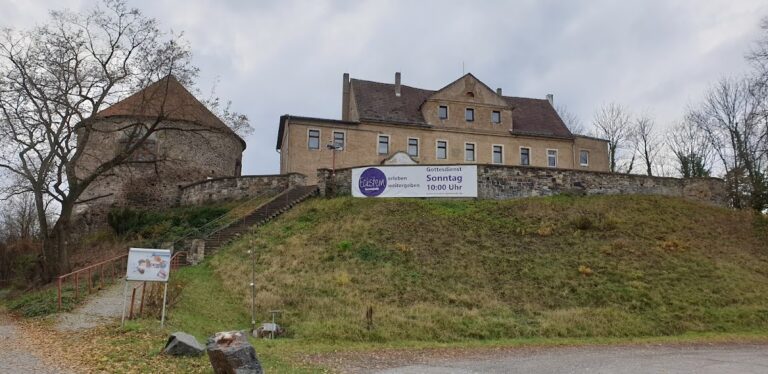
The surviving estate combines a restored castle, remnants of an earlier defensive enclosure, a Baroque entrance building, and the landscaped grounds of the Röhrsdorfer Grund. The main complex is formed by two adjoining rectangular blocks, while the park preserves ornamental features associated with the eighteenth-century expansion.
Castle and estate buildings
Main house and bell tower
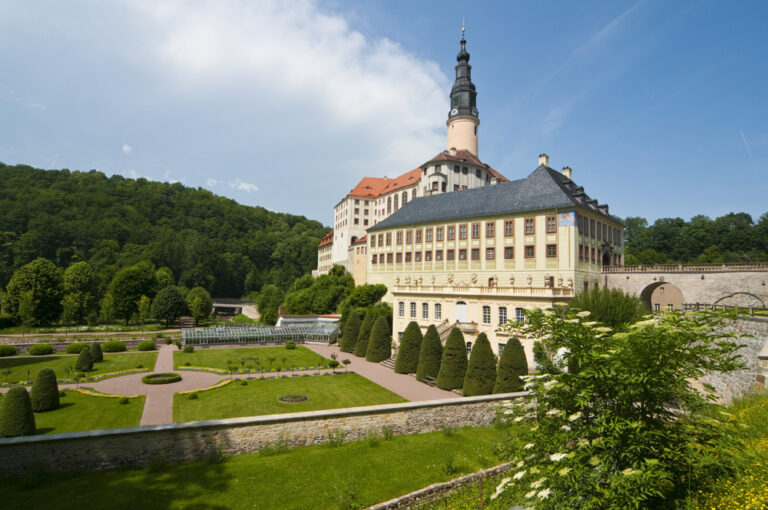
The original castle was a simple rectangular building of three storeys, seven by eleven bays, and a hipped roof. Large rusticated corner blocks extended across its full height, and a small Baroque bell tower rose above the structure. After the fire of 1890, the building was reconstructed in an altered form.
The present main house is oriented from north to south. It has three storeys, seven by four bays, and a hipped roof. A centrally placed four-storey Baroque bell tower stands on its west side and is topped by a belfry, the upper structure that houses bells. The restored interior contains numerous paintings of former owners and scenes from Saxon history.
Cross wing and courtyard entrance
A northwestern cross wing extends from the main house along an east-west axis. It is now two storeys high, has seven bays, and is covered by a hipped roof. Most of the buildings around the estate and former stables are modern, but a single-storey building adjoining the west side of the courtyard entrance retains Baroque forms. Its divided hipped roof and windows with sandstone surrounds preserve elements of the earlier architectural character.
The courtyard entrance and the entrance to the adjoining building carry a slightly modified von Carlowitz coat of arms. Its triple cloverleaf is horizontally mirrored and surmounted by a capital C. The colours on the courtyard entrance are heraldically incorrect.
Enclosure wall and gateway
Parts of the old enclosure wall survive around the estate. Some sections retain vertical loopholes, narrow openings through which weapons could be used while defenders remained protected. At the southern end of the wall, an arched gateway bears the date 1599.
Röhrsdorfer Grund park
Orangery and sculptures
The landscape park originally included an orangery decorated with sculptures of Bacchus, the Roman god of wine, and Flora, the Roman goddess of flowers and spring. Both works were made by the Dresden sculptor Johann Gottfried Knöffler. The orangery was demolished in the 1970s. After restoration by the conservator Michael Eilenberger of Holzhau, the sculptures were moved in October 2012 to the park of Gut Gamig.
Temple of Friendship and event grounds
The Röhrsdorfer Grund retains the structure known as the Temple of Friendship, an ornamental park building rather than a functioning religious temple. Several small monuments and sandstone formations also survive in the grounds. A covered open-air stage has been built in the castle park for events, while the annual blossom festival and the Saxon-Bohemian farmers’ market reflect the estate’s continuing cultural use.
Nearby sites