Dohna Castle: Medieval Hill Castle and Seat of the Burgraves of Dohna


Site at a Glance
- Rating
- 3.9
- Popularity
- Low
- Country
- Germany
- Primary era
- Medieval
- External website
- Open
- Eras represented
- Medieval, Modern
- Civilizations
- Duchy of Bohemia, Holy Roman Empire
- Site type
- Military
- Remains
- Castle
On this page10 sections
History
Dohna Castle is a medieval hill and spur castle in Germany, probably founded around 950 by Emperor Otto I on the site of an earlier Sorbian hillfort. It stood on the medieval trade route between Saxony and Bohemia and took its name from the associated settlement of Donin. Sorbs, a West Slavic people of eastern Germany, had settled in the surrounding region during the early Middle Ages.
Foundation and Bohemian connections
The castle was first mentioned in 1040, during the conflict between King Henry III and Duke Bretislaus of Bohemia. It appears to have been held as an imperial fief by the Margraviate of Meissen under Eckard II before authority passed to burgraves connected with the Duchy of Bohemia.
In 1076, Vratislaus II of Bohemia received the Gau of Nisani from Henry IV and transferred the territory, including Dohna Castle, to his son-in-law Wiprecht of Groitzsch as a dowry. Wiprecht surrendered Nisani and Dohna to Henry V in 1112, but recovered them in 1117, restoring Bohemian overlordship. The castle was probably destroyed around 1113 and rebuilt by Duke Vladislaus I of Bohemia around 1121.
The castle also served at times as a state prison. In 1126, the Bohemian ruler Soběslav I had several Bohemian nobles confined in its dungeon. An imperial official named Erkembert, recorded in 1113 as Erkembertus prefektus de castro Donin, is the earliest specifically named burgrave associated with the site. His possible connection with the uncertain Tegkwitz family remains unclear. The Erkenbertinger family came from Franconia, established itself near Naumburg, and later had a Starkenberg branch involved in the colonization of the Ore Mountains.
The Dohna burgraviate
From 1156, Dohna became the centre of an imperially immediate lordship and burgraviate. An imperially immediate territory was subject directly to the Holy Roman Emperor rather than to an intermediate territorial lord. The burgraves combined military, judicial, and administrative responsibilities. At Dohna, these included guarding the Saxony-Bohemia trade route, controlling the subjugated Sorbian population in hereditary serfdom, and promoting its Christianization through emissaries of the Catholic Church.
Burgrave Henry I of Dohna is regarded as the progenitor of the Donin family, the noble lineage associated with the castle and its burgraviate for roughly two and a half centuries. He appears in records from 1143 and 1144 and was expressly identified as Burgrave of Dohna no later than 1156, although the document of his enfeoffment has not survived.
Dohna Castle became the political centre of the burgraviate and the seat of the Dohnaer Schöppenstuhl, a lay court whose judges issued decisions in matters such as feudal and inheritance disputes. This court is documented from 1390 and exercised legal influence beyond the borders of Saxony until 1572.
The Dohna Feud and decline
The Dohna Feud, fought from 1385 to 1402 between Burgrave Jeschke of Dohna and the Saxon nobleman Hans of Körbitz, ended the burgraves’ control of their lordship and estates. These possessions passed to the House of Wettin, a German ruling dynasty. Dohna Castle was besieged from autumn 1401 and captured by assault on 19 June 1402 in the presence of Margrave William I the One-Eyed.
The castle was not completely demolished. Its residential buildings remained and served as residences for officials administering the Dohna district. After the administrative seat moved to Pirna around 1457, the castle began to decay. Later inhabitants of Dohna removed stone from the ruins for building materials. In 1406, the neighbouring castle of Pirna, its dependent villages, and Königstein Fortress, where Jeschke had taken refuge, also passed to the Wettins, helping establish the later Saxony-Bohemia border.
Romantic reconstruction and modern use
In 1803, Heinrich Ludwig von Dohna-Lauck bought the Schlossberg and attempted to rebuild the castle in the spirit of Romanticism. The hill was cleared of rubble and construction began on a round tower, but the Napoleonic Wars prevented the larger reconstruction plan. The tower was completed in its present form in 1830.
The Privileged Shooting Association of Dohna bought the Schlossberg in 1826 for 700 thalers. In 1828, it levelled the front section of the hill and used stone from the medieval walls to build a shooting house, shooting wall, and retaining wall beside the access track. A local-history museum founded in 1906 occupied the upper floor of the former castle inn from 1958. It later moved to a former pharmacy on the market square, where its castle-related exhibits include medieval finds, Donin bracteates, graphics, and documents. A bracteate is a thin, usually one-sided medieval coin struck from a single piece of metal.
Since 2005, the 1830 round tower and the former castle inn on the Schlossberg have been adapted as a meeting centre by the Christian free-church Eckstein community, with the registered association Horizonte Weltweit Eckstein as its supporting organization. The castle complex is protected as an archaeological monument, as is the separate Sorbian hillfort on the rear of the Robisch spur.
Remains
Dohna Castle originally occupied a rocky spur near the River Müglitz at approximately 155 metres above sea level. The complex was a substantial double castle, with a rear castle, a front castle, and a spacious outer court. Excavations carried out between 1904 and 1906 confirmed the division between the two castle sections through the discovery of a transverse wall.
Medieval castle remains
The old castle survives mainly as a small remnant of wall. Historical images from 1690 and 1793 nevertheless show extensive walls and towers, while a description from 1735 refers to surviving walls, towers, and vaults made of exceptionally strong limestone and rock. These remains represent the medieval defensive and residential complex that once occupied the Schlossberg.
Later buildings on the Schlossberg
The round tower completed in 1830 was built in the style of the old castle and forms part of the modern buildings on the former castle hill. It was later used as a museum area. The former shooting house, constructed in 1828 from stone taken from the castle walls, also survives. It later became the Burgschänke, or castle inn, and was formerly used as an HO restaurant and dance hall. HO was the state-run retail and restaurant organization of East Germany. The associated shooting wall and retaining wall remain part of the Schlossberg complex.
Market-square tower image
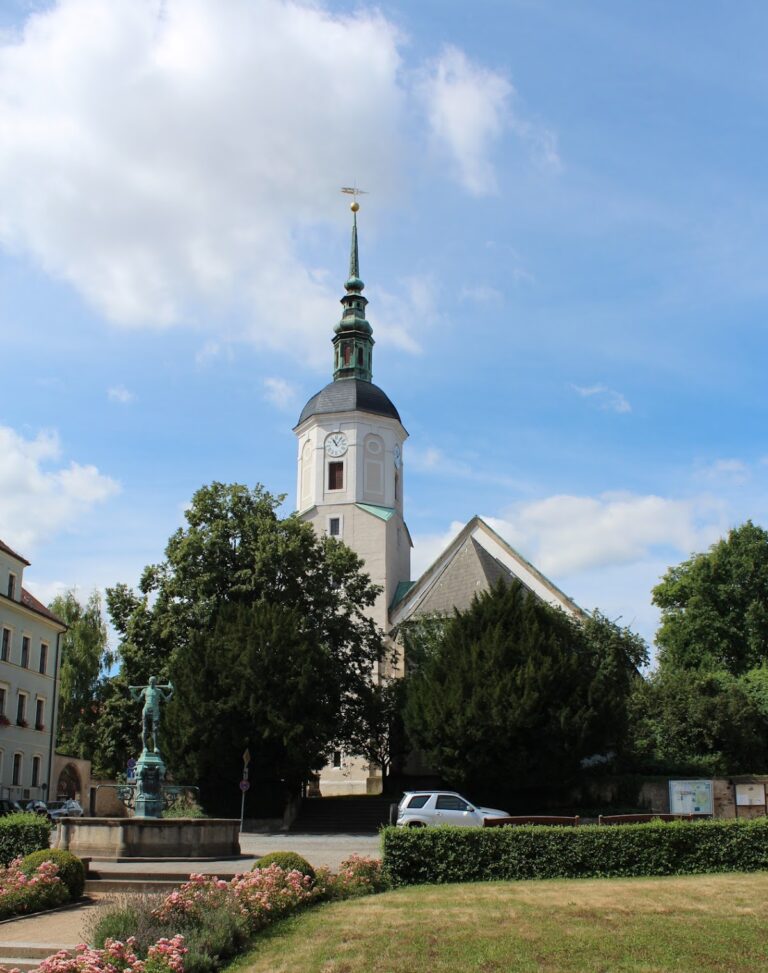
A round castle tower appears in an oval depiction on the Fleischerbrunnen in Dohna’s market square. Dresden sculptor Alexander Höfer created the fountain in 1912, following the tower shown on Dohna’s oldest town coat of arms, dated 1525.
Robisch hillfort
The Robisch hillfort, also called Robsch or Robscher, occupies a rocky spur at the rear of the Schlossberg. It remains visible above the railway-station grounds and is a separate Sorbian defensive installation associated with the area before settlement of the castle hill.