Schloss Petershagen: A Weser Renaissance Palace in Germany

Site at a Glance
- Rating
- 4.4
- Popularity
- Low
- Country
- Germany
- Primary era
- Early Modern
- External website
- Open
- Eras represented
- Medieval, Early Modern, Modern
- Civilizations
- Holy Roman Empire
- Site type
- Civic
- Remains
- Palace
On this page8 sections
History
Foundation and Renaissance transformation
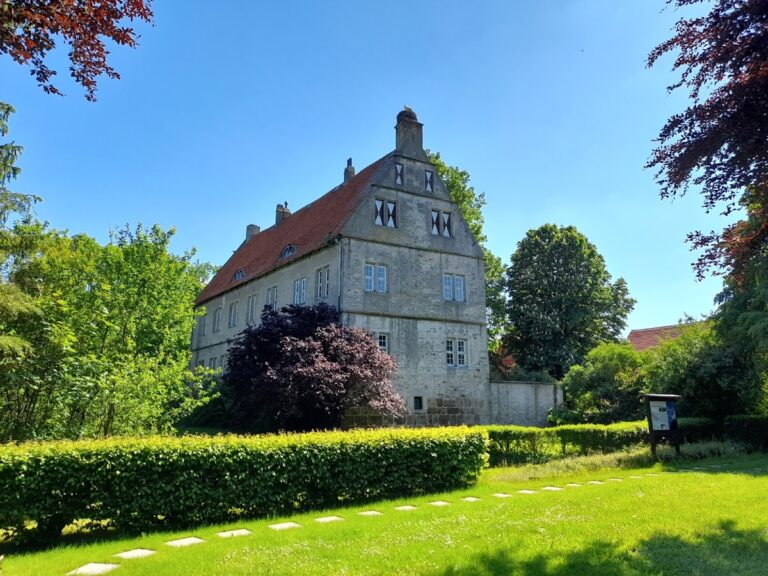
Schloss Petershagen is a palace complex in Petershagen, Germany, transformed between 1544 and 1547 into an early example of Weser Renaissance architecture, a regional Renaissance style that developed along the Weser during the sixteenth and early seventeenth centuries. It began around 1306 as a water castle, a fortified residence protected partly or wholly by water, built by Gottfried von Waldeck, Bishop of Minden. The Bishops of Minden were ecclesiastical princes who combined religious authority with territorial rule. The castle was intended to defend their lands to the north and served as their residence. It was placed under the protection of Saint Gorgonius, a Christian martyr regarded as its patron saint.
At the request of Bishop Franz von Waldeck, the Swabian master builder Jörg Unkair converted the castle into a palace. The project used dark Porta sandstone and light Obernkirchen sandstone, and included the architectural features associated with the later complex. Work ended earlier than planned because of the Schmalkaldic War, the conflict of 1546–1547 between the Holy Roman Emperor and the Protestant Schmalkaldic League. Christian of Brunswick-Lüneburg, a member of the Brunswick-Lüneburg ruling house, commissioned additional alterations between 1608 and 1611.
War, territorial change, and government
During the Thirty Years’ War, the major European conflict of 1618–1648 involving religious and dynastic struggles across the Holy Roman Empire, Swedish forces occupied Schloss Petershagen together with the rest of the Prince-Bishopric of Minden. The Peace of Westphalia, the group of treaties concluded in 1648 that ended the war and redistributed political control in parts of the Holy Roman Empire, awarded the territory to the Hohenzollerns. Their Brandenburg-Prussian branch held the titles of elector of Brandenburg and duke, later king, of Prussia, and the territory became the Hereditary Principality of Minden.
Brandenburg representatives took over the palace after the Swedish handover on 25 October 1649. On 22 and 23 February 1650, the Great Elector received homage there as the new territorial lord. Schloss Petershagen housed the government of the Principality of Minden until 1669 and was the seat of Minden’s governor from 1649 to 1659. After 1669, the complex increasingly declined. Some buildings collapsed or were demolished, and a fire in 1780 destroyed the main roof of the stairwell.
Ownership, war damage, and changing uses
Heinrich Hestermann, a farmer and member of the Reichstag, the parliament of the German Empire, purchased the palace in 1901 and began making it habitable the following year. During the Second World War, the British Army of the Rhine occupied the complex. The owners’ family left the main house for a separate house in front of it and returned only after the occupying authority released the building. Refugee families were also accommodated in the palace, while shortages of building materials and money damaged its fabric.
War damage was repaired between 1964 and 1967. After renovation, the complex began operating as a hotel in 1967. Its later uses included rented rooms, the discotheque “Studio im Schloss,” and a furniture shop. The Homage Hall was added in 1969, a heated garden swimming pool opened in 1975, the “Orangerie” restaurant opened in 1985, and the “St.-Gorgonius-Keller,” named after the palace’s patron saint, opened on the lowest floor in 1988.
The hotel began as an upmarket establishment with eight rooms and later expanded to 15 rooms, comprising three single rooms, two suites, five junior suites, and five double rooms. Some rooms also housed a museum devoted to the history of Schloss Petershagen. The Minden-Lübbecke district organized chamber concerts there with the association “Manor Houses and Parks in the Mühlenkreis.” The complex also supported cultural and recreational activities connected with the nearby Westphalian Mill Route and Weser Cycle Route.
The Hestermann family owned Schloss Petershagen until 2022 and operated the hotel until financial reasons led to its closure on 31 August 2018. The town sought a subsequent use that would preserve the complex as a whole. Peter Kenzelmann purchased it in January 2022 with the intention of reopening it for celebrations and conferences. Since September 2024, the business has been managed by Michael Brühl and his wife, Manuela Brühl.
Remains
Plan and setting
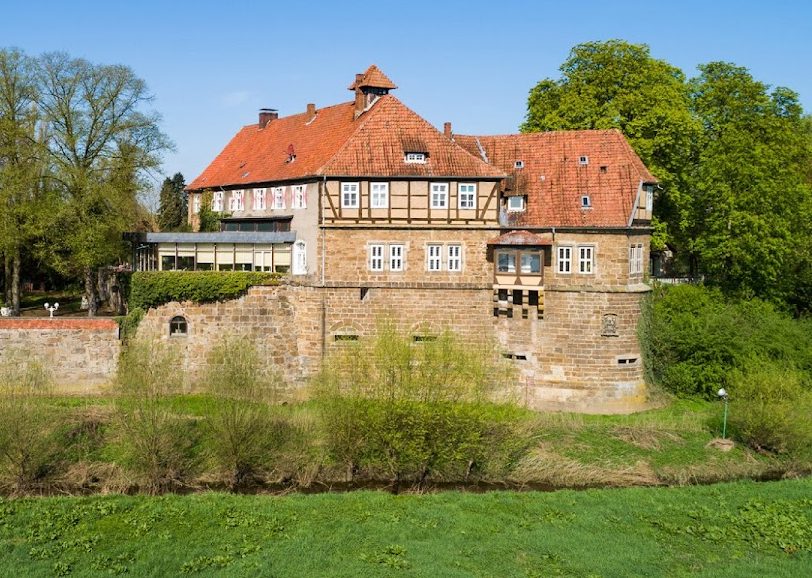
Schloss Petershagen is formed from several buildings that have grown together in the central town, at the mouth of the Ösper River where it enters the Weser. The complex has an irregular two-wing plan organized around a courtyard. A polygonal stair tower rises within the courtyard, while a bastion, a projecting fortification designed to strengthen defensive fire along a wall or approach, stands on the Weser side.
Stonework and heraldic features
The palace’s 1544–1547 conversion combined dark Porta sandstone with light Obernkirchen sandstone. Heraldic stones bearing the coats of arms of Hermann von Holstein-Schauenburg and Franz von Waldeck survive on the stair tower. The mason’s mark of Jörg Unkair also remains there. Christian of Brunswick-Lüneburg’s coat of arms is mounted on the south wall above the upper terrace.
Terraces and later additions
An expanded terrace overlooks the floodplains of the Weser and is partly protected from the weather by a winter garden. The complex’s later physical additions and associated uses included the garden swimming pool, the “Orangerie” restaurant, the Homage Hall, and the lowest-floor “St.-Gorgonius-Keller.” These features form part of the palace’s later architectural and functional development alongside its medieval and Renaissance fabric.
Nearby sites