Burg Schlüsselburg: An Ecclesiastical Castle and Territorial Administrative Seat in Germany


Site at a Glance
- Rating
- 4.1
- Popularity
- Very Low
- Country
- Germany
- Primary era
- Early Modern
- Eras represented
- Early Modern
- Civilizations
- Holy Roman Empire
- Site type
- Military
- Remains
- Castle
On this page6 sections
History
Burg Schlüsselburg is an ecclesiastical castle in Germany, in Schlüsselburg, now part of Petershagen, built by Bishop Ludwig of Minden in 1335. Its name refers to the key emblem on the coat of arms of the Diocese of Minden. Located near the Weser, it served as an outpost of Petershagen Castle and helped guard the territory against attacks from the north, particularly those associated with the Counts of Hoya and Stolzenau Castle.
Castle and territorial administration
The castle formed part of the Prince-Bishopric of Minden, a territory where the bishop exercised both religious authority and secular political power. The prince-bishopric was divided into five territorial offices, or administrative districts. Their centers were the castles of Schlüsselburg, Petershagen, Schalksburg, Rahden, and Reineberg. Petershagen had contained the episcopal chancery and the bishop’s residence since the beginning of the fourteenth century.
Financial difficulties led the territorial rulers to pledge the castle to local noble families. Its holders included the von Münchhausen and von Klencke families. During the fifteenth century, its military importance steadily declined. The surviving two-winged complex was constructed between 1581 and 1585, replacing the earlier buildings.
From military outpost to civic use
After the Thirty Years’ War, the major European conflict fought mainly between 1618 and 1648, Burg Schlüsselburg became the administrative building of the Schlüsselburg territorial office. Johann Georg von Möller bought the state domain in 1822. A state domain was property owned by a territorial or national government. His descendants established the Schlüsselburg manor, a large landed estate, on the right bank of the Weser.
The town of Schlüsselburg acquired the castle in 1846. It housed the local office administration until 1934 and then served as a school until 1961. The Swoboda family purchased it in 1971 and restored the building. Burg Schlüsselburg remains privately owned and is protected as an architectural heritage monument in North Rhine-Westphalia.
Remains
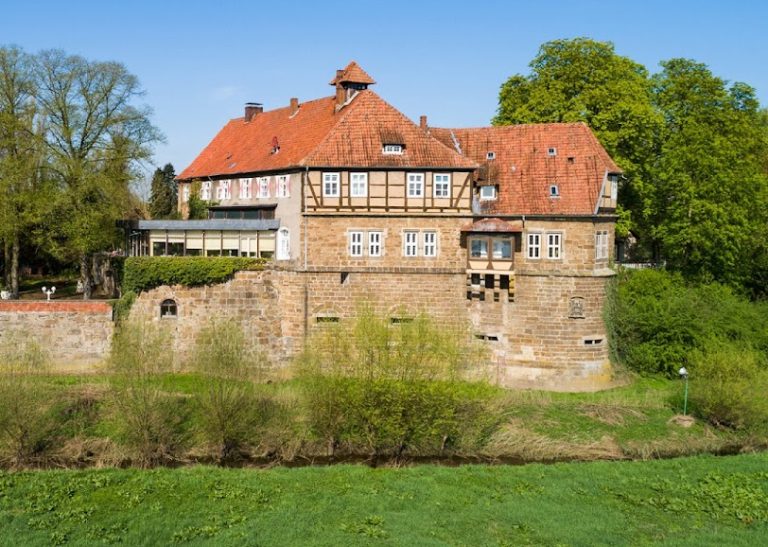
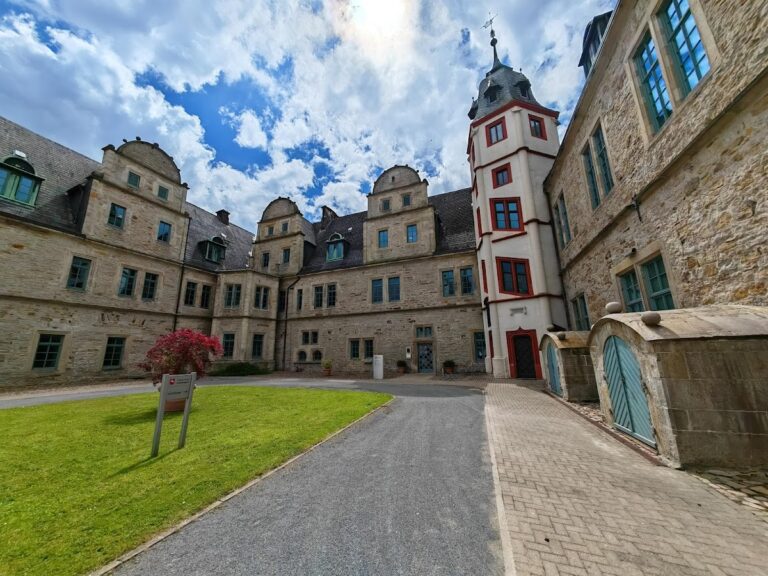
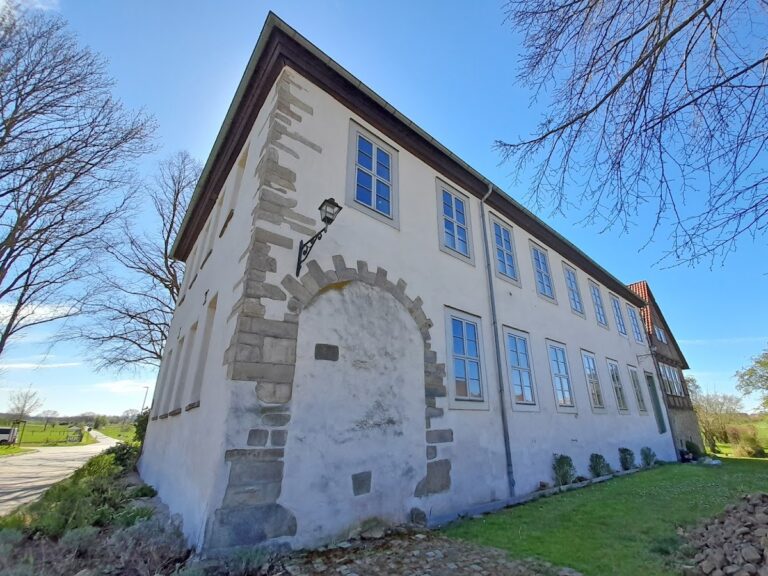
The surviving structure is part of a two-winged castle complex erected between 1581 and 1585. The complex replaced the earlier castle buildings, while the north wing was demolished during the nineteenth century. The present building therefore preserves only a remnant of the later arrangement.
Surviving castle building
The remaining building represents the surviving portion of the late sixteenth-century complex. Its construction belongs to the rebuilding carried out between 1581 and 1585, and its present form also reflects the nineteenth-century demolition of the north wing and the restoration undertaken after the Swoboda family acquired the castle in 1971.
North gable and stork nest
A stork nest stands on the chimney of the north gable. Storks have occupied the nest continuously since at least 1935, making it a longstanding feature of the surviving castle fabric.
Nearby sites