Kreuzkirche, Dresden: The City’s Principal Evangelical-Lutheran Church
Site at a Glance
- Popularity
- Very High
- Country
- Germany
- Primary era
- Early Modern
- Eras represented
- Early Modern, Modern
- Civilizations
- Electorate of Saxony, German, Holy Roman Empire, Kingdom of Saxony
- Site type
- Religious
- Remains
- Church
On this page20 sections
History
The Kreuzkirche is Dresden’s principal Evangelical-Lutheran church, located at the Altmarkt in Germany. A Romanesque church, probably designed as a basilica, was begun in the mid-12th century as the city’s merchant settlement grew, perhaps before Dresden was formally founded. Today the church is also a preaching church of the bishop of the Evangelical-Lutheran Church of Saxony, alongside Meissen Cathedral, and the home of the Dresden Kreuzchor, a boys’ choir with a history extending back more than 700 years.
Origins and the Holy Cross
The church initially came under the parish authority of the Frauenkirche. In the 14th century it was called St Nicholas’s Church, a name associated with the saint’s connection to merchants and traders. In 1234, Constance of Babenberg gave the church a relic believed to come from the cross on which Jesus was crucified. A chapel was added to house it, drawing pilgrims to the church. The chapel’s dedication gradually became the name of the whole building: the church was called the Church of the Holy Cross in 1319, and the name was applied to the entire structure after its main altar was consecrated in 1388.
To finance the church’s upkeep, the assets of the Cross Chapel were combined with those belonging to the Elbe Bridge and the earlier church. The Dresden Bridge Office managed these funds until the 19th century. Revenue also came from lordship rights over lands in Bannewitz, Prohlis, Lockwitz and Gittersee, interests in other villages, and vineyards in Kötzschenbroda.
Gothic rebuilding and the Reformation
Between 1447 and 1449, Hans Kumoller and his son Matthes remodelled the Romanesque church as a three-aisled Gothic hall church, in which the side aisles were close in height to the central nave. A city fire on 15 June 1491 destroyed the vaults and nave pillars, while the sacristy survived. The choir, which had suffered less damage, was repaired in 1492–93. Matthes Kumoller then led the rebuilding, with Hans Reinhart managing construction. The western nave had new vaults by 1497, and Conrad Pflüger took charge from 1499. The rebuilt church formed a new type of preaching church, although completing its furnishings took decades. Its design influenced St Wolfgang’s Church in Schneeberg and reflected the medieval building tradition associated with the Parler family of Prague.
Dresden’s first Lutheran service took place in the church in 1539, after which it became the city’s principal Evangelical church. The relic was moved to the sacristy attic, known as the idol room, and eventually forgotten there. It was destroyed when the church was bombarded in 1760. The pre-destruction church was depicted by Anton Weck in 1680 and by Dresden court painter Bernardo Bellotto, also known as Canaletto, in views made around 1750 and in 1765.
Destruction and rebuilding, 1760–1800
During the Seven Years’ War, a major European conflict fought from 1756 to 1763, Prussian forces besieged and bombarded Dresden in 1760. The church’s Gothic nave and choir were destroyed, although its western tower front initially remained. The rebuilding prompted a prolonged dispute between Baroque and Neoclassical designs. Dresden master builder Johann George Schmidt prepared Baroque plans that the city council submitted for review in 1763. Officials influenced by Neoclassicism preferred a different approach, and court architect Friedrich August Krubsacius opposed Schmidt’s proposals.
Construction began under Schmidt in 1764, after Prince Xaver laid the foundation stone. The remaining tower front collapsed in 1765, weakening the council’s support for Schmidt. Xaver sought advice from the newly established Dresden Academy of Fine Arts, and Krubsacius became an adviser to Schmidt. The council also requested other assessments, including one from Samuel Locke, who directed the excise-building administration. Christian Friedrich Exner won a competition for the new tower in 1766. Work resumed in 1769, and Exner then returned direction of the project to Schmidt. Following Schmidt’s death, Christian Heinrich Eigenwillig took over. Gaetano Chiaveri helped Schmidt with the interior plan during a visit to Dresden in 1766.
The final design retained Schmidt’s Baroque scheme for the interior while adopting Exner’s Neoclassical designs for the exterior. The exterior was completed in 1778 and the tower in 1788. The church was consecrated in 1792, and construction was finished in 1800.
Fires, reconstruction and civic life
A fire on 16 February 1897 gutted the church. During the three-year rebuilding, Dresden architects Schilling and Graebner redesigned its interior with Neo-Baroque and Art Nouveau elements. The church’s prewar interior was destroyed again after the bombing of Dresden on 13 February 1945. The building burned out, its organ was lost, and its altar painting survived with soot damage.
From 1946 to 1955, Fritz Steudtner led the reconstruction. The exterior was rebuilt, while the interior received a deliberately restrained modern design. Roughcast was intended as a temporary finish, and many surviving fittings were removed as the altar was substantially reduced. The decision to preserve signs of wartime damage and retain the austere interior later prompted extended debate. From 2000 to 2004, Peter Albert led an interior restoration that conserved the postwar scheme after its heritage value had been recognised. The church has been destroyed five times in its history, most recently during the Second World War.
The Kreuzkirche became an important centre of East Germany’s civil-rights movement in the 1980s. A Peace Forum has been held there each 13 February since 1982, the anniversary of the bombing of Dresden. In 1989, the church sheltered demonstrators and activists from government persecution. Since 1986 it has also kept a Coventry Cross of Nails, a Christian symbol of reconciliation associated with the heavily damaged Coventry Cathedral. Friday prayers for peace and reconciliation use the Coventry Litany, a prayer associated with the cathedral. The practice links the church with Laurenskerk in Rotterdam, whose congregation is its partner.
Remains
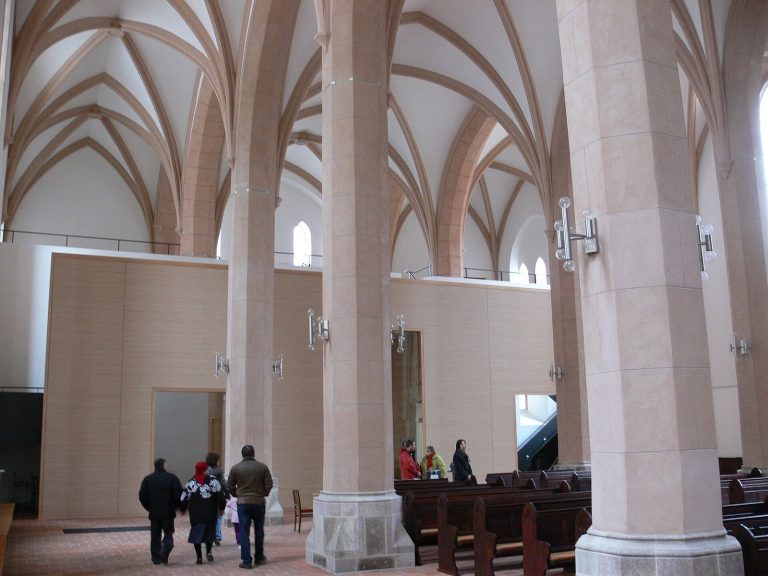
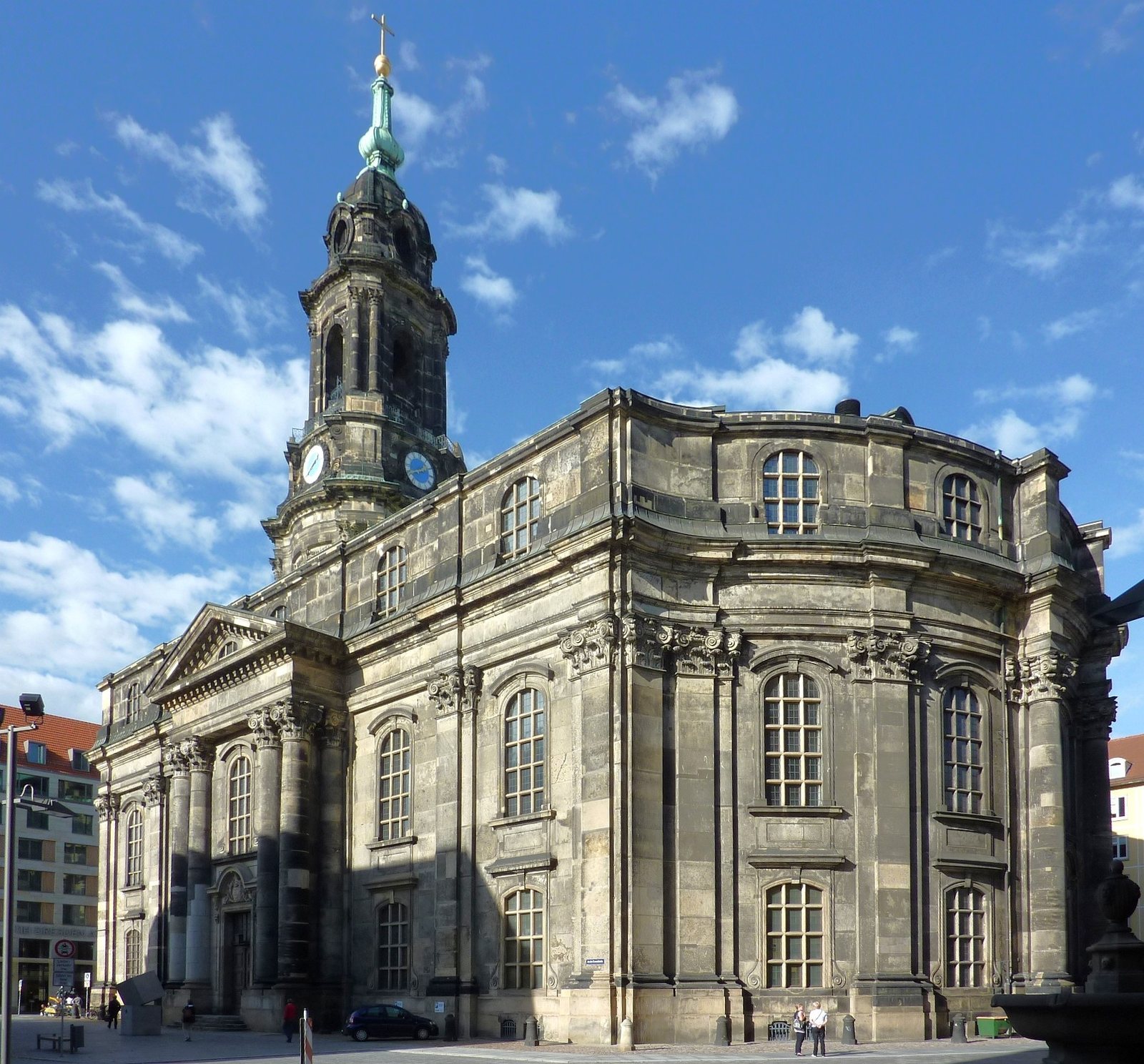
The present church combines a Neoclassical exterior with a Baroque interior arranged around a central space. It stands at Dresden’s Altmarkt. Its long sides have central projections and entrances, while a high attic conceals the lower part of the roof. Inside, the square outer walls enclose an oval arrangement of nave and aisles, ending in a semicircular choir.
Exterior and tower
Exterior
The exterior rises in two main storeys, articulated by large, flat wall columns. The long façades are organized around central projecting sections and portals. Columns set partly into the walls frame the portals, with triangular pediments above. The substantial attic masks the lower roofline.
Tower
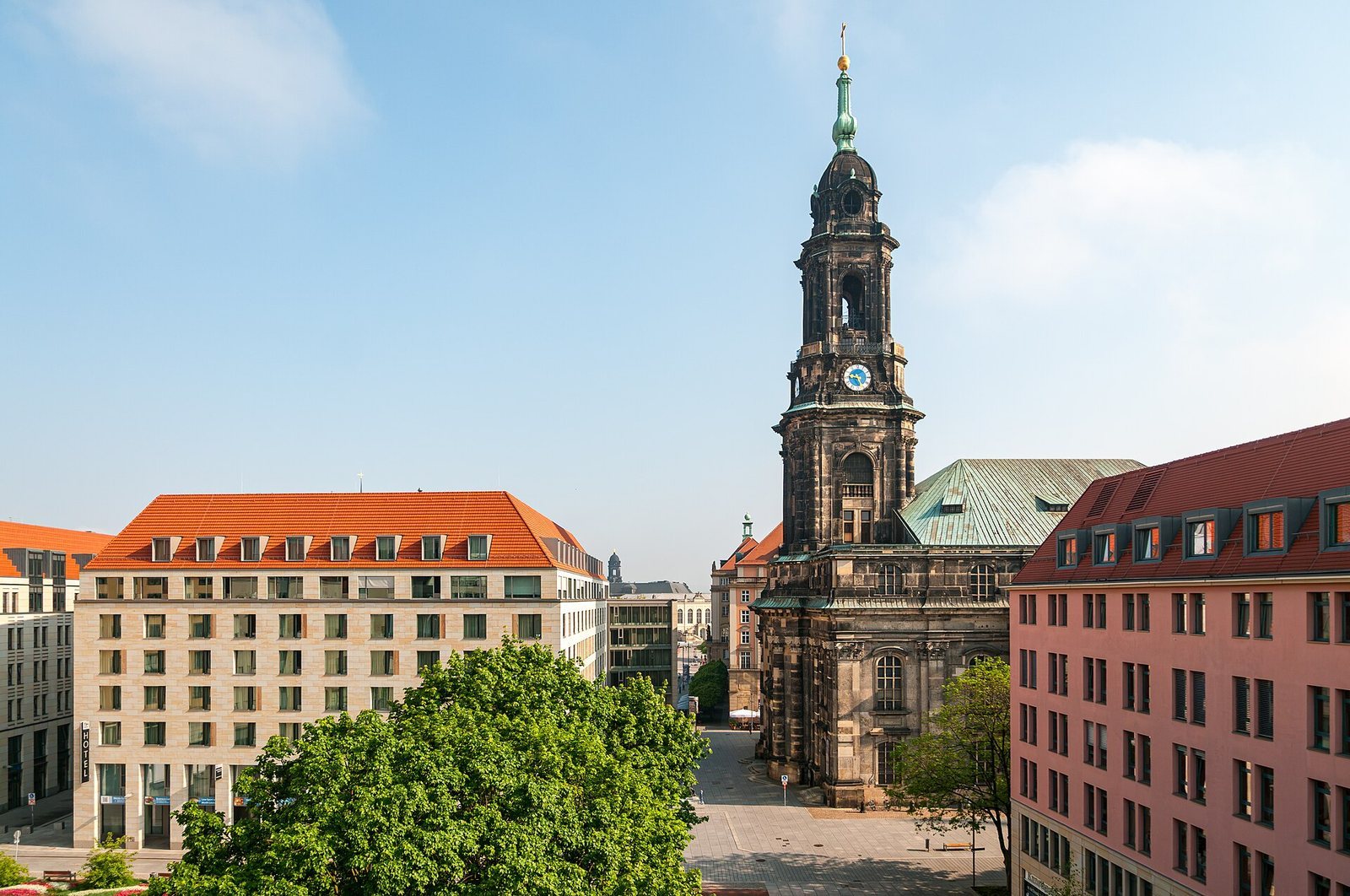
The tower reaches about 92 metres. Its design adapts the Baroque form of the tower at Dresden’s Catholic Hofkirche to simpler Neoclassical lines. A chamber in the tower housed its keeper until 1950. The clock, installed in 1930, has a dial three metres across.
Interior and memorial art
The interior follows a square plan and ends in a semicircular choir. Three pillars along each long side and two along each short side create an oval inner space, dividing it into the nave and two aisles. The aisles have galleries on two levels. The organ and altar face one another across the central space. Schmidt’s plan also resembles the layout of Dresden’s Annenkirche.
Altars and altar art
The present altar painting, The Crucifixion of Christ, was made by Anton Dietrich in 1900 and bears soot and fire damage from 1945. Above the altar table, a bronze relief made by Heinrich Epler in 1900 depicts the first Lutheran service held in the church in 1539.
The earlier sandstone altar, made by Hans Walther in 1579, is now in St John’s Church in Bad Schandau. Two storeys high, it was arranged with Corinthian and Ionic columns. Its reliefs showed the Last Supper and the Passover meal. The upper section included the crucified Christ, angels bearing the scourging column and cross, and God the Father blessing the congregation. Roman numerals referred to the Ten Commandments, and seated figures of the Evangelists flanked God the Father. John the Baptist and the apostle Paul appeared at the sides. Master Hans’s paintings of the Ten Commandments, made for the church in 1520, are now in Dresden City Museum.
Chapel and funerary sculpture
The Heinrich Schütz Chapel contains a bronze crucifix from a funerary monument made by Wolf Ernst Brohn in 1652 for Duchess Sophie Hedwig. The work came from the Sophienkirche. The church also holds an alabaster relief from the funerary monument of Marcus Gerstenberger. Made by Christoph Walther IV in 1613, it depicts the Entombment of Christ.
Other funerary works include a tombstone for Elisabeth von Haugwitz, who died in 1631, made by Sebastian Walther, and several 17th-century bronze grave slabs from the Sophienkirche, placed in the stairways leading to the galleries. A plaque commemorates the 1818 marriage of painter Caspar David Friedrich and Caroline Bommer in the church.
Civil-rights memorial
A conceptual memorial near the entrance recalls the church’s role in East Germany’s civil-rights movement. Its two cube-shaped figures balance one upon the other, expressing how situations that seem immovable can suddenly shift.
Bells
Present bells
The five-bell peal was cast in 1899 by Franz Schilling and Sons of Apolda. The bells hang in a three-storey steel frame. The large Cross Bell occupies the top level; two bells on each of the lower levels swing in opposite directions. Weighing 11.5 tonnes, the Cross Bell was modelled in profile on the Gloriosa at Erfurt Cathedral. The peal is Germany’s fifth-heaviest. Its Art Nouveau decoration was designed by Schilling and Graebner. Two clock bells cast in 1787 for quarter-hour and hour strikes hang higher in the tower.
The Cross Bell was added to the order for replacement bells after the foundry offered it separately. The peal was blessed at Dresden’s Altmarkt on 6 March 1900 and tested later that month. It survived both world wars. In 1918, a First World War classification that could have led to confiscation was changed; during the Second World War, its removal was prohibited in 1940 after protests that included one by Kreuzkantor Rudolf Mauersberger, the choir’s director. Cracks in the tower and fatigue in the steel frame kept the bells silent from 2009 to 2011. The frame was strengthened rather than replaced, and the bells rang again after the work.
Earlier bells
Earlier bell groups were repeatedly affected by fires and destruction. Six bronze bells dated from 1491 and were badly damaged in a city fire in 1669, after which the council ordered them recast. A 1673 peal of seven bronze bells, accompanied by two clock bells, had a combined weight of 13,858 kilograms and was destroyed with the church in 1760. A four-bell bronze peal cast in 1791, with two clock bells and a total weight of 9,600 kilograms, was badly damaged in the 1897 fire. Its largest bell fell from its support and broke; heat damaged the other three.
Organs and other instruments
Earlier organs
Organs are recorded at the church from 1389. The first large and small instruments burned in 1491. Caspar Coler of Pirna built a replacement in 1494, and his brother Georg renewed it in 1504. From 1512 to 1514, Blasius Lehmann built a two-keyboard organ that remained until the church’s destruction in 1760.
The organ for the church consecrated in 1792 was begun by Johann Michael Wagner in 1786 and completed by Johann Caspar Holland between 1788 and 1792. It had three keyboards and 50 stops, controls that select sets of pipes. Gotthelf Friedrich, Johann Gotthold and Carl Gottlieb Jehmlich rebuilt it between 1825 and 1832, increasing its stops to 54; Bruno and Emil Jehmlich raised the number to 67 in 1895. The organ was lost in the 1897 fire. A replacement built by two Jehmlich brothers between 1898 and 1901 had four keyboards and 91 stops, and served until the 1945 bombing.
Main organ
A large Jehmlich organ was dedicated in 1963 with four keyboards and 76 stops. It was Dresden’s largest organ and, until 1969, the largest newly built church organ in East Germany. Initially intended to provide a full, versatile sound, it was later adjusted toward greater clarity, reducing the volume suited to Romantic and symphonic music. An overhaul and further tonal work by its makers began in 2002, taking account of acoustic changes caused by church renovations while preserving the instrument’s overall design. It was rededicated in July 2005, and four stops were added to its swell division in 2008.
The organ has 6,293 pipes, mechanical key action and slider chests, which direct wind to selected pipes. Electric systems operate its stops and couplers. The four keyboards and pedal can be connected at normal, octave and sub-octave intervals. Its controls include a memory system with 4,000 settings, a register crescendo with four combinations, and three cymbal stars. The Bombarde resonators are visible in the organ case.
Other instruments
A movable horizontal altar organ made by the Wegscheider workshop in 2008 has one keyboard, nine stops and a separate pedal cabinet with a 16-foot sub-bass. It can be played at three pitch levels. A small Wegscheider positive organ made in 1997, with a horizontal wooden Gedackt stop, is on the choir gallery. In 2022 the congregation acquired a Rohlf positive organ with one keyboard, six stops and transposition options.
Matthias Kramer made a harpsichord for the church in 2007, copying a Dresden court instrument built by Johann Heinrich Gräbner the Younger in 1739. The original is held by Dresden’s Museum of Decorative Arts. The replica has two keyboards, with 8-foot and 4-foot registers on the first and an 8-foot register and lute stop on the second. It can be transposed to 392, 415 or 440 hertz.