Schloss Burgk: A Renaissance Manor and Mining Museum in Freital, Germany


Site at a Glance
- Rating
- 4.7
- Popularity
- Medium
- Country
- Germany
- Primary era
- Early Modern
- External website
- Open
- Eras represented
- Early Modern, Modern
- Civilizations
- Electorate of Saxony, German, Holy Roman Empire
- Site type
- Domestic
- Remains
- Manor House
On this page11 sections
History
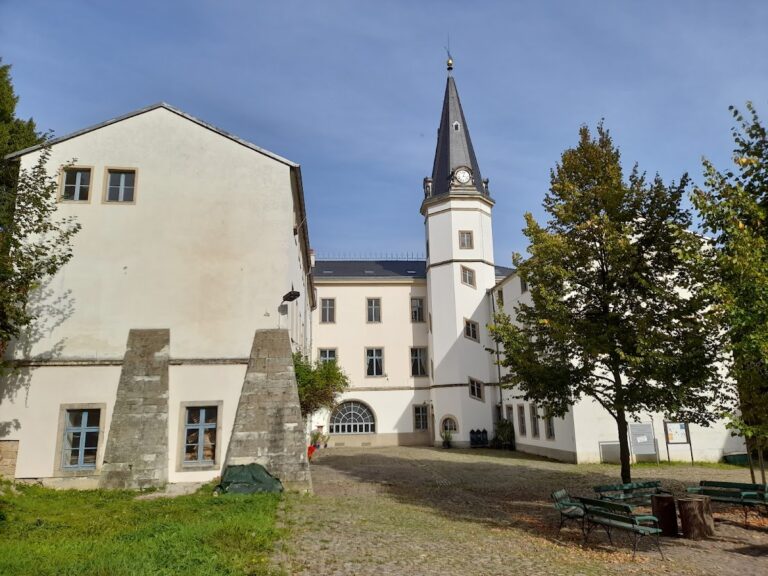
Schloss Burgk is a former aristocratic manor in Freital, Germany, whose surviving Renaissance fabric dates from around 1580. Standing at the edge of the Döhlener Basin beneath the Windberg, it later became closely connected with coal mining and now houses the Freital City Museum, Haus der Heimat, and the Städtische Sammlungen Freital.
The von Zeutsch manor
Parts of the ground floor and the vaulted cellars belong to a Renaissance building phase around 1580. From 1507 to 1742, the noble von Zeutsch family held the lordship of Großburgk together with local judicial authority. In this period, Schloss Burgk functioned as a manor, a landed estate whose owner could exercise administrative and judicial rights.
Fire and rebuilding
The entire manor was destroyed by fire on 26 June 1707. Caspar Heinrich von Zeutsch commissioned its reconstruction in 1708 and 1709, creating the basis for the later complex. The manor house and its surrounding buildings were remodeled around 1800 and underwent another major alteration in 1846.
Coal mining and industrial ownership
Carl Gottfried Dathe acquired the manor and its coalfields in 1768. Coal deposits in the area had been known since at least 1542. In 1819, the Freiherrlich von Burgker Steinkohlen- und Eisenhüttenwerke, a baronial coal-mining and ironworks company, was founded. Under the direction of Dathe’s grandson, Carl Friedrich August Freiherr Dathe von Burgk, the company modernized and expanded coal mining in the Döhlener Basin.
After Carl Gottfried Dathe died, the castle was no longer continuously occupied as a residence. The coal company nevertheless kept its headquarters at Schloss Burgk until it became bankrupt in 1930. In 1846, Carl Friedrich August Freiherr Dathe von Burgk had commissioned a further remodeling of the buildings.
From manor to museum
After Freital became a city in 1921, its municipal parliament decided in 1923 to establish a museum. Following several changes of location, the museum moved to Schloss Burgk in 1946, after the end of the Second World War. The painter Karl Hanusch participated in its development. Elisabeth von Boxberg, born Freiin von Burgk, the last owner, was expropriated during the land reform in the Soviet occupation zone.
The Städtische Sammlungen Freital present the history of the city and life at Schloss Burgk, alongside artistic developments in the Dresden region between 1890 and 1950. Their mining displays address the history of coal mining in the Plauenscher Grund. Hellmuth Heinz served for many years as director of the city museum and art collections and donated his private art collection to Freital before his death. Friedrich Pappermann’s art collection has been at Schloss Burgk since 1993, when he donated it to the museum; he was made an honorary citizen of Freital in 1994. The protected historic monument continues to serve as a museum and as a venue for meetings and events.
Remains
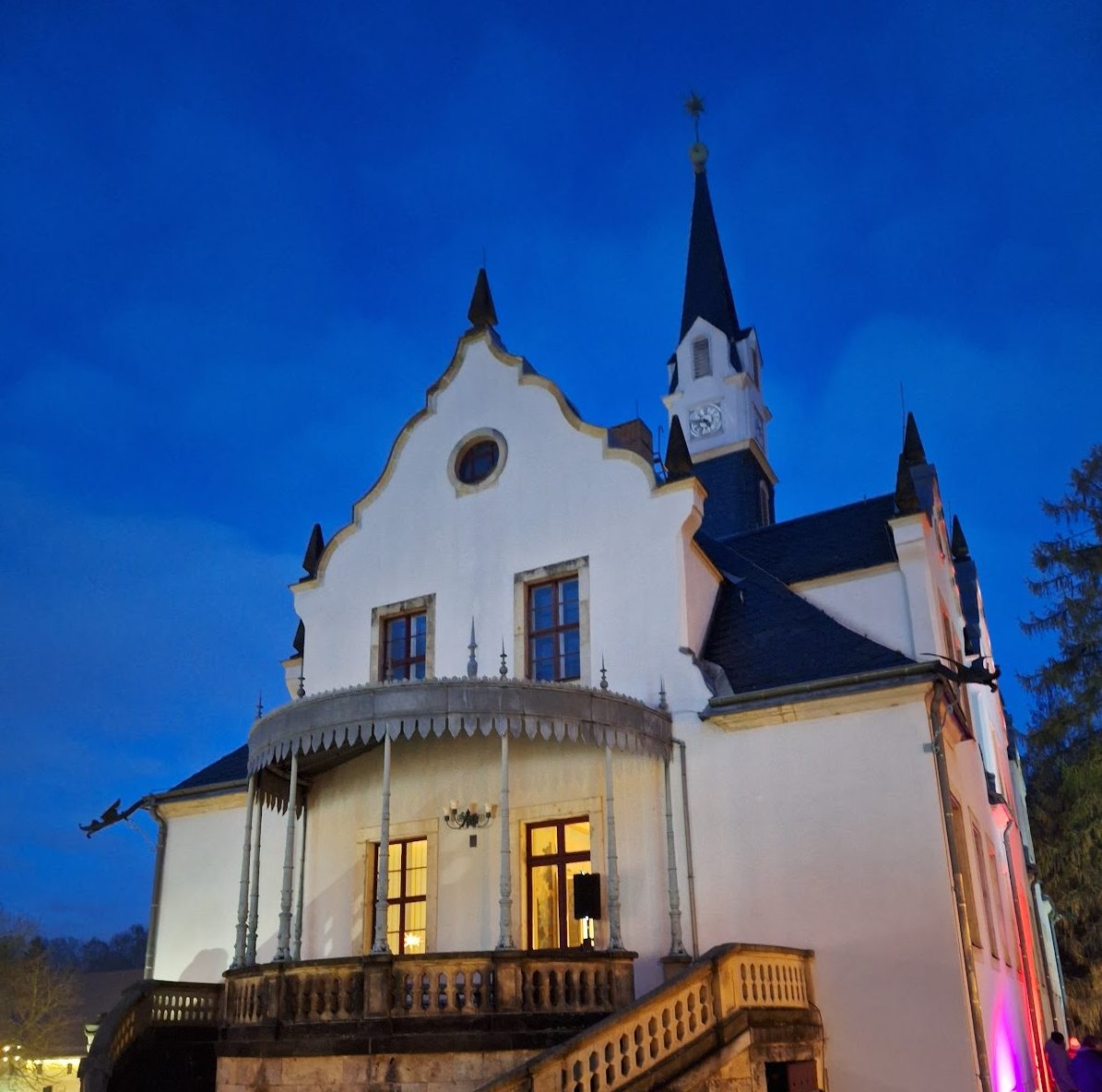
Schloss Burgk occupies the foot of the Windberg at the edge of the Döhlener Basin, within the Großburgk cadastral district of Freital. The complex combines Renaissance masonry, later remodeled manor buildings, formal interior spaces, a park, and surviving mining infrastructure. Its Renaissance character includes scroll gables associated with northern European architecture, while later work added more delicate roof features.
Manor house and interiors
Parts of the ground floor and the vaulted cellars preserve building fabric from around 1580. The manor house and adjoining buildings were altered around 1800 and again in 1846. The later remodeling added delicate gables and a slender roof turret. The Festsaal, or ceremonial hall, dates from 1828 and is furnished in the Neoclassical style. The garden room has wallpaper produced by Zuber et Cie.
Park and mining access
Castle park
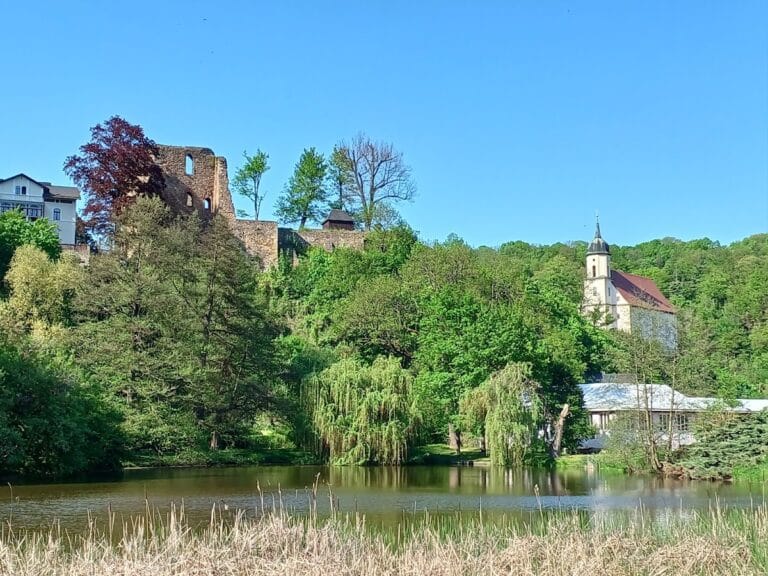
The park extends south and east of the manor house. A small pond is surrounded by larches, plane trees, and ginkgo trees, and numerous sculptures occupy the grounds. The Rotkopf Görg monument, inaugurated in 1861, commemorates the legendary musician Rotkopf Görg and a mountain spirit said to have appeared to him on the Windberg.
Tagesstrecke Oberes Revier
The park contains the entrance to the Tagesstrecke Oberes Revier, a mine adit driven from the surface. Driven through the castle garden between 1828 and 1832, it served the Freiherrlich von Burgker Steinkohlen- und Eisenhüttenwerke as both a transport route and a ventilation passage. Until 1870, it was the only underground access route for miners working in some of the more distant shafts, who traveled through the workings on foot.
The adit is about 1,300 metres long. It was extended in 1835 to the foot of the Fortuna shaft and shortly afterward to the Neuhoffnung shaft on the Windberg. A steep section through the herb garden, once used by miners, is now secured. The passage also supplied fresh air to the mine. During a firedamp explosion, caused by the ignition of combustible underground gas, at the Segen-Gottes and Neuhoffnung shafts on 2 August 1869, Carl Eduard Hermann, Wilhelm August Brückner, and Robert Büttner escaped unharmed through the tunnel.
Museum collections and mining technology
The Städtische Kunstsammlungen include nine classical paintings by Otto Dix, together with works by Willy Kriegel, Wilhelm Lachnit, Wilhelm Rudolph, Pol Cassel, Otto Lange, Curt Querner, Christoph Voll, and Ewald Schönberg. The mining exhibition includes “Dorothea,” described as the world’s first electrically powered mining railway. Siemens & Halske built it in 1882 for the Oppelschacht at Zauckerode. A technical garden presents equipment used in mining during the immediate postwar period.