Schloss Mönchstein: A Historicist Castle and Hotel in Salzburg


Site at a Glance
- Rating
- 4.8
- Popularity
- Low
- Country
- Austria
- Primary era
- Modern
- External website
- Open
- Eras represented
- Early Modern, Modern
- Civilizations
- Holy Roman Empire
- Site type
- Domestic
- Remains
- Castle
On this page9 sections
History
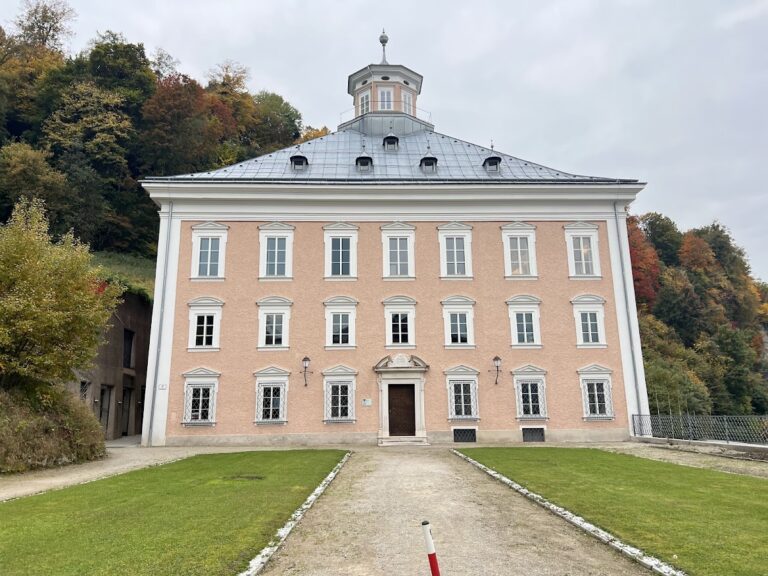
Schloss Mönchstein is a historicist building in Salzburg, Austria, on the northern edge of the Mönchsberg plateau. Its history reaches back to a defensive tower first documented around 1350, while its present role grew from successive estates, retreats, villas, and hotel conversions.
From the Tetelheimer Tower to the Fröschlmoser estate
The wider site was first recorded around 1350 as the location of the Tetelheimer Tower, named after the Tetelhaimer noble family. The small defensive structure may also have been called Mönchstein Tower and stood southwest of the Augustiner Gate. From 1419 to 1565, the tower and its associated estate belonged to the Fröschlmoser family.
In 1531, Virgil Fröschlmoser established a pleasure house, a farmhouse, barns, and a cistern on the property. A chapel was built or added soon afterward. On 3 August 1661, it was rededicated to Saint Mary, Saint Anne, and all holy monks. In 1565, Christoph Fröschlmoser’s impoverished widow sold the property to the Salzburg citizen Wolf Windisch. The sale included the tower, the Fröschlmoos house and pleasure garden, and other gardens near the Klausen Gate and Mönchsberg Gate.
University retreats on the Mönchsberg
The estate passed to Mülln Abbey in 1622 and to the Benedictine University of Salzburg in 1654. The university was a Catholic institution associated with the Benedictine order. After acquiring the property, it built a small retreat in the area of the present Schloss Mönchstein. Known as the Professors’ Little Castle, it offered professors a place for fresh air and relaxation from academic work.
A second building, the College Little Castle, served students, and a nearby Mathematical Tower supported astronomical observations. The tower was demolished around 1780. The chronicler and Enlightenment thinker Lorenz Hübner lived in the Professors’ Little Castle for part of the period before 1800.
Nineteenth-century ownership and transformation
The Bavarian government dissolved the Benedictine University in 1810, and the estate was auctioned. Josef Felner, a royal Bavarian councillor at the Supreme Court, acquired it in 1813 and arranged for the neglected property to be renovated. He placed its administration in the hands of the Salzburg merchant Leopold Hagenauer.
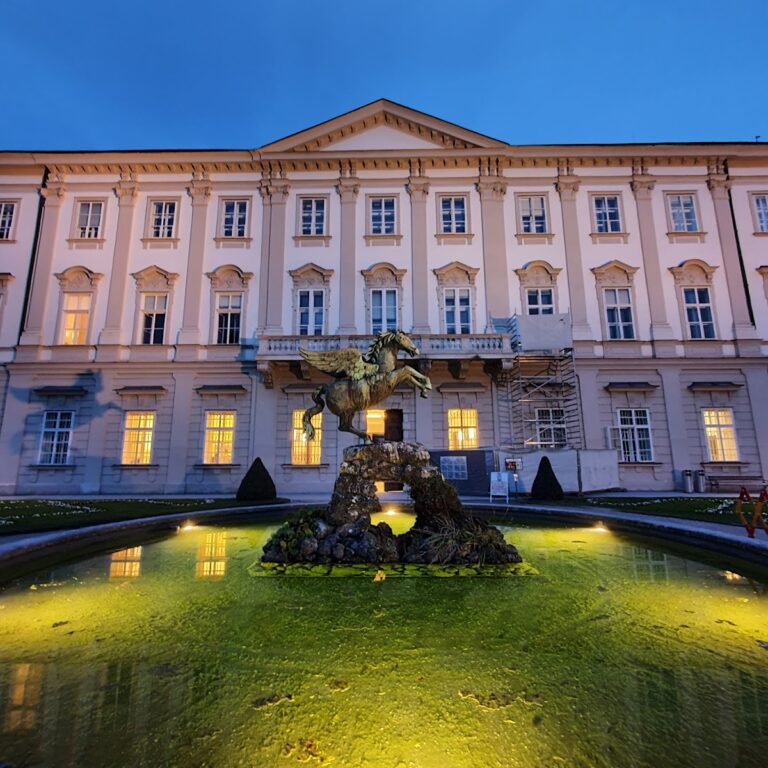
After the 1818 fire at Mirabell Palace, Hagenauer acquired statues from the palace for the small castle’s garden. He added unconventional inscriptions to them, including a humorous text on a statue whose left arm had been broken off. His son Josef, who owned Salzburg’s largest brewery, the Steinbräu, acquired the estate in 1834. The painter Anton Faistauer later lived temporarily in the villa.
In 1887, Hagenauer’s heirs sold the estate to Karl Leitner, a banker born in Mattighofen. It remained in the Leitner family, under the name Leitner Villa, until 1917. Leitner’s wife, Kreszentia, commissioned Jakob Ceconi to carry out initial extensions. Karl Leitner also founded the Salzburg electricity works in 1886. In 1890, he had the electrically powered Mönchsberg elevator and the road from Mülln onto the Mönchsberg built, and developed the Klausen Terrace and a path to the lift.
Schloss Mönchstein and the hotel era
After Karl Leitner’s death, his widow sold the property in 1917 to Hofrat Bela Veith, a financial adviser to the Romanian royal family. Hofrat was an official title for a senior civil servant or court councillor in the German-speaking lands. Veith extensively enlarged the castle in 1919, and the name Schloss Mönchstein became customary during this period, recalling an earlier building associated with the surrounding landscape.
Queen Mother Marie of Romania visited the castle several times during the Salzburg Festival season. After Veith’s death, his sons Guido and Ferdinand took ownership. Ferdinand Veith founded the Hotel Betriebs KG F. Veith in Salzburg in 1948. Because of heavy indebtedness, he soon brought Adolf Brühl and his wife Lucia into the company as partners. Brühl converted the property into a luxury hotel in 1948 with the architects Hugo Hübner and Walter Baumgartner.
The Brühls emigrated to Brazil in 1952, and the Mierka family joined the operating company in 1956. The castle passed to a Tyrolean hotel-owning family in 2000. Under its sole owner, Anna Gabrielli-Schwarz, the hotel entered bankruptcy in 2003. The German entrepreneur Hans-Peter Wild acquired the property in 2005 for 10.1 million euros and had the hotel renovated and expanded.
Extensive remodeling and modernization took place in 2017, with the extension completed in 2018. The site now operates as a five-star hotel, continuing the property’s long transformation from a fortified medieval holding and private estate into a place of residence, retreat, and hospitality.
Remains
The surviving site occupies an exposed position on the northern edge of the Mönchsberg plateau. Its physical history is expressed through the present historicist building, the earlier estate elements associated with it, and later additions for hotel use. The property developed from a small defensive and agricultural complex into a villa and then a modern hotel organized around restored historic fabric and newer extensions.
Earlier estate and university buildings
The earlier Tetelheimer Tower was a small defensive tower positioned southwest of the Augustiner Gate. The sixteenth-century Fröschlmoser estate included a pleasure house, a farmhouse, barns, a cistern for collecting and storing water, and gardens. A chapel associated with the estate was dedicated to Saint Mary, Saint Anne, and all holy monks. The later Professors’ Little Castle stood southeast of the Monika Gate in the area of the present building, while the nearby College Little Castle served students. South of the College Little Castle stood the Mathematical Tower, which was used for astronomical observations before its demolition around 1780.
The historicist villa
The present building is a historicist structure, meaning that it uses historical architectural forms and motifs without reproducing one earlier building exactly. The nineteenth-century villa contained an interior commissioned in the Neo-Gothic style, along with additional furnishings acquired for the property. Its enlarged form reflects the changes made during the villa’s private ownership, including the extensions commissioned by Kreszentia Leitner and the substantial enlargement carried out by Bela Veith in 1919.
Garden sculpture and hotel additions
The garden incorporated statues acquired from Mirabell Palace after the palace fire of 1818. Some of these sculptures received humorous or unconventional explanatory inscriptions from Leopold Hagenauer, including one referring to a statue’s missing left arm. The 1948 conversion adapted the building for hotel use. Later work created a five-star establishment with 24 rooms and suites, a 300-square-metre spa and wellness area, and an outdoor infinity pool.
The Glass Garden restaurant and Apollo Bar were created during the 2017–2018 modernization. They occupy an innovative glass-and-steel structure designed by the Salzburg architect Volkmar Burgstaller, adding a contemporary architectural element to the historicist property.
Nearby sites