Schloss Lindach: A Castle Complex and Cultural Monument in Germany


Site at a Glance
- Rating
- 4.7
- Popularity
- Very Low
- Country
- Germany
- Primary era
- Medieval
- Eras represented
- Medieval, Early Modern
- Civilizations
- Duchy of Württemberg, Holy Roman Empire
- Site type
- Military
- Remains
- Castle
On this page7 sections
History
Schloss Lindach is a castle complex in Germany, in Lindach, a district of Schwäbisch Gmünd. Its oldest parts date from the Staufian period, the era of the Hohenstaufen dynasty, which supplied medieval rulers of the Holy Roman Empire and the Duchy of Swabia. The present complex incorporates a square tower now attributed to the time of Duke Frederick II of Swabia, rather than to Roman origins as earlier interpretations had proposed.
Medieval origins and early lords
The earlier Lindach Castle occupied a naturally protected position and developed around its medieval tower. Tibert von Lindach, who lived at Lindach, served as royal chamberlain under King Conrad III, the first Hohenstaufen king of Germany. He became the progenitor of the Lords of Weinsberg.
Ownership under Württemberg
In 1515, the Diemar family of Lindach bought the complex from the Schenks of Limpurg. The knight Hans Diemar von Lindach fought against the imperial city of Schwäbisch Gmünd in 1543 and 1544. Lindach passed to Lorch Abbey in 1577 and thereby came under Württemberg. Two years later, Duke Ludwig of Württemberg granted it as a fief, property held from a superior lord in return for service, to Erasmus von Laymingen. Laymingen was chief bailiff of Stuttgart and later became a privy councillor and court steward, senior administrative offices in an early modern German territory. His family retained Lindach for exactly 100 years.
From 1699, the castle was held by Court Marshal Johann Friedrich von Staffhorst. In 1744, it passed to the Württemberg state minister Heinrich Reinhard Freiherr Roeder von Schwende, and in 1751 to Duke Carl Eugen of Württemberg. The same year, the smelter administrator Johann Georg Blezinger of Königsbronn acquired the estate.
Later owners and changing uses
Count Joseph Ignaz von Beroldingen took over the castle in 1842. Ownership then changed rapidly among the families von Larisch and von Buttler and the Stuttgart brewery Rettenmeyer. Lieutenant Colonel Otto von Haldenwang bought the castle at auction in 1911. After his death during the First World War in 1916, it passed to Consul Ferdinand Freiherr von Scholley.
Members of the Württemberg ducal family held the property again from 1929. Duke Albrecht Eugen of Württemberg and his wife Nadejda, a daughter of Tsar Ferdinand I of Bulgaria, moved into Schloss Lindach. The US Army confiscated the castle in 1945 and used it as a generals’ headquarters, but returned it to the House of Württemberg in 1946. In 1958, ownership passed to the Abele family of physicians.
Between 1958 and 1959, Schloss Lindach was converted into a private clinic and sanatorium, an institution for extended medical treatment and recuperation. Medical use continued until 2008. The Seventh-day Adventist Reformation Movement community then used the castle for worship until 2013. The property was offered for sale in March 2013 and has been privately owned again since 2014. Schloss Lindach is designated a cultural monument.
Remains
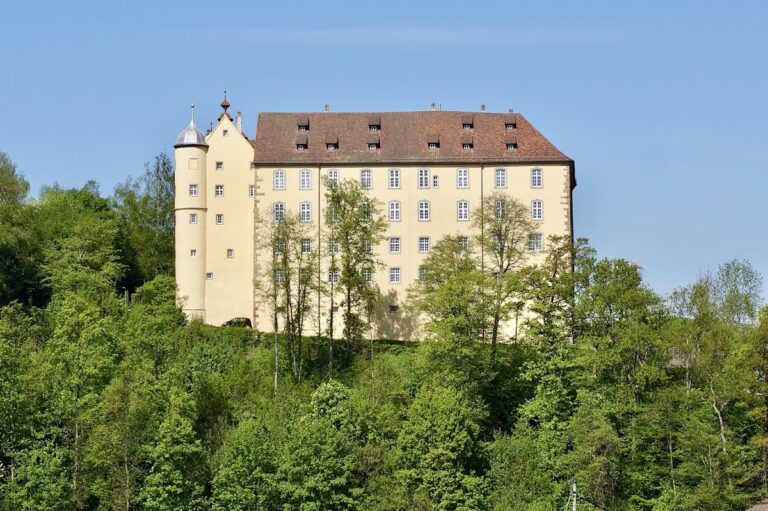
The castle stands within Lindach, in the urban area of Schwäbisch Gmünd in Baden-Württemberg. Its earlier defensive position used the slope to the north and west, while a moat, a defensive ditch around a fortified site, protected the southern and eastern sides. The surviving complex combines a medieval tower, later additions, and buildings arranged around the historic castle grounds.
Medieval tower and later additions
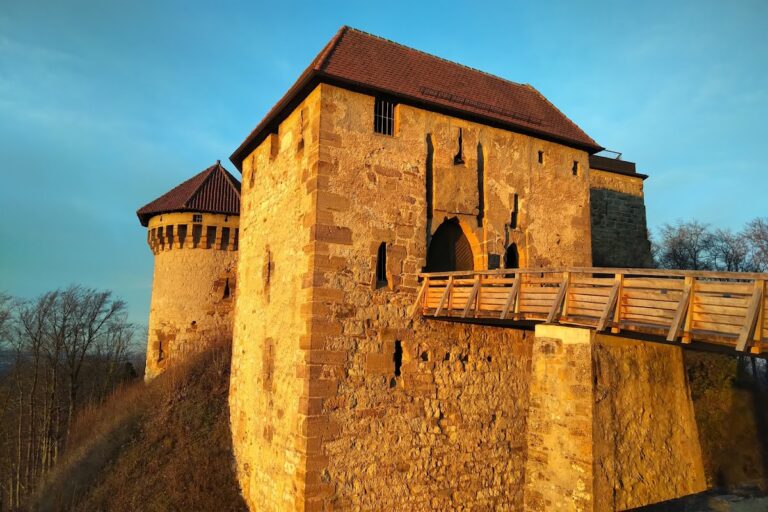
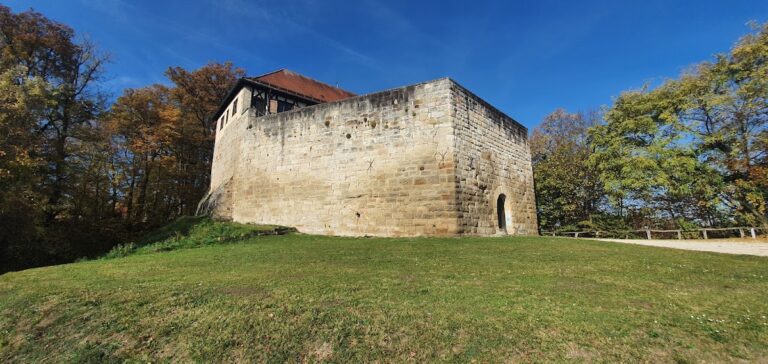
The central medieval element is a square Staufian tower built of humpback ashlar, masonry formed from roughly dressed stone blocks with projecting faces. A Renaissance superstructure was later added, using architectural forms associated with the Renaissance. A long building occupies the northern side of the complex.
The castle was altered through several early modern building phases. A gate was cut through the complex in 1580, followed by the construction of a round tower in 1583. A stair tower was added in 1624. The surviving Doctor’s House belongs to the group of former service and agricultural buildings associated with the castle.
Estate buildings and commercial use
In 1751, the grounds included a horse stable, servants’ quarters, a well house, a brewery, a large barn, a stone henhouse, a washhouse, a gatehouse, and a sheep stable. These buildings supported the estate’s domestic, agricultural, and commercial functions. From 1752, the complex also housed a tavern operated first by Johann Georg Blezinger and later by the Rettenmeyer brewery.