Schloss Heubach: A Sixteenth-Century Castle in Germany


Site at a Glance
- Rating
- 4.3
- Popularity
- Very Low
- Country
- Germany
- Primary era
- Early Modern
- Eras represented
- Early Modern
- Civilizations
- Holy Roman Empire
- Site type
- Domestic
- Remains
- Castle
On this page7 sections
History
Schloss Heubach is a sixteenth-century castle in Heubach, Germany, built on the site of a former parish estate. Its history reflects changing noble, territorial, and civic ownership in the town.
From parish estate to noble residence
Until 1524, the site belonged to a parish estate associated with Königsbronn Monastery, a former Cistercian monastery in present-day Baden-Württemberg. In 1525, Georg VII von Woellwarth acquired the property in exchange for a barn, a garden, and a granary in Heubach. He then commissioned a three-storey rectangular building on the site.
After Georg VII died, the castle temporarily became the residence of his widow, Barbara Eckbrecht von Türckheim. Later, Maria Magdalena von Woellwarth married Johann von Wessen. In 1698, Johann von Wessen bought the castle from the Woellwarth family for 3,800 gulden, a historical currency used in German-speaking Central Europe.
Territorial and private ownership
Johann von Wessen’s second wife, Henrica Louisa Schertlin von Burtenbach, sold the castle to Württemberg in 1726. Württemberg was a German territorial state that later became part of the modern state of Baden-Württemberg. In 1737, the castle was auctioned to the Heubach surgeon Johann Knauß for 3,100 gulden.
Following Knauß’s death in 1803, the building was briefly adapted as a residence for the mayor. It was later divided among several owners, ending the period in which it functioned as a single privately held property.
Municipal restoration and present use
By 1985, the building had severely deteriorated, leading the City of Heubach to decide to purchase it. After the city acquired the final privately owned share, renovation began in 1991 and was completed in 1997. The restored building subsequently accommodated several civic and cultural functions.
Remains
Rectangular castle building
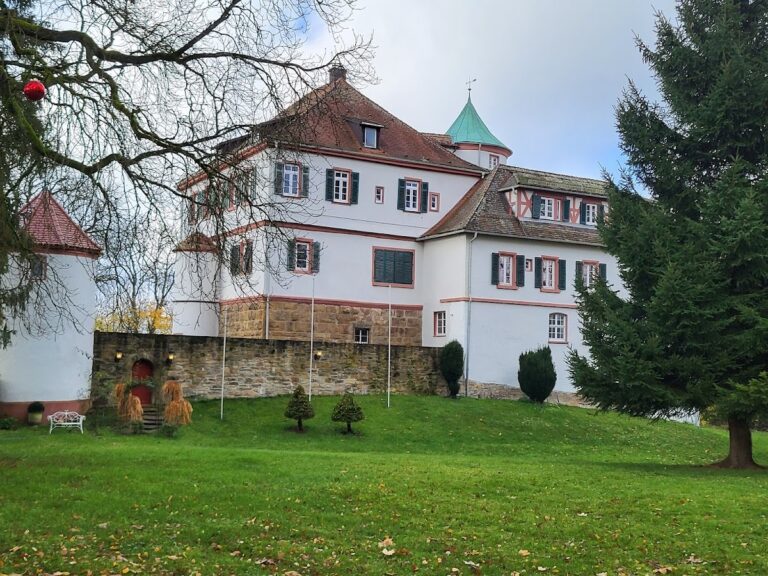
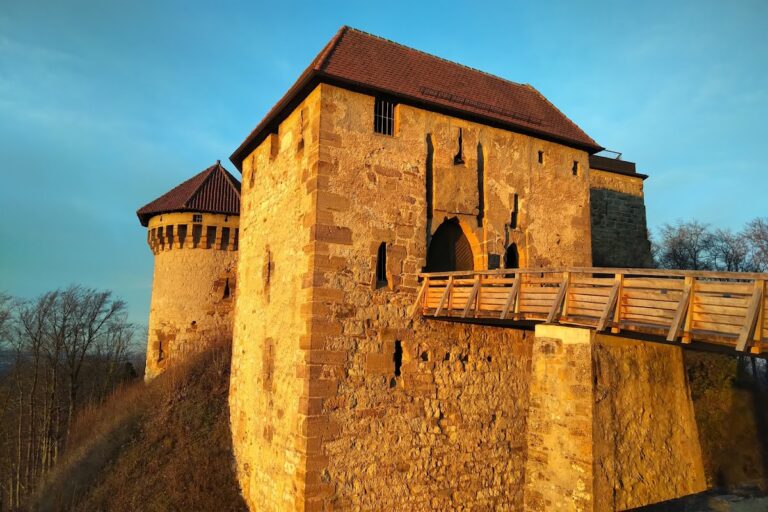
Schloss Heubach survives as a three-storey rectangular building on the former site of the parish estate associated with Königsbronn Monastery. Its present form incorporates the structure created after Georg VII von Woellwarth acquired the property in 1525. The building underwent extensive renovation between 1991 and 1997 after a period of severe deterioration.
Civic and cultural interiors
The first floor contains the Heubach City Library, which moved into the building in 1997. Schloss Heubach also includes a room for civil wedding ceremonies and the city’s corsetry museum, opened in 2005. These uses preserve the building as part of Heubach’s civic and cultural life.
Nearby sites